Digital media marketing changes too quickly to be mastered through slides alone. Platforms evolve, privacy rules shift, formats rise and fade, and audiences behave differently across search, social, video, retail media, email, and emerging channels. That is why the most valuable digital media marketing skills are not just memorized. They grow through repeated decisions, feedback, and reflection.
For educators, trainers, and marketing leaders, this matters. A learner may understand what impressions, reach, frequency, click-through rate, conversion rate, and attribution mean in theory. Yet the real test comes when they must decide how much budget to put behind awareness versus conversion, whether to optimize for efficiency or learning, and how to explain a campaign that performed well on one metric but poorly on another.
Practice turns digital media marketing from vocabulary into judgment. It helps learners experience tradeoffs, make mistakes safely, and build the confidence needed to operate in a real marketing environment.
Why digital media marketing is learned best through practice
Digital media is not a static subject. It is a decision environment. Marketers have to interpret incomplete data, anticipate competitor behavior, understand audiences, choose channels, adapt creative, and defend budgets. These are applied skills, not just conceptual ones.
The scale of the market makes this even more important. According to the IAB Internet Advertising Revenue Report, U.S. internet advertising revenues reached $225 billion in 2023. Behind that number are millions of decisions about where to invest, how to target, what to test, and when to change course.
In a classroom or corporate training program, learners need more than definitions. They need to practice the thinking process that sits behind effective media decisions. That includes asking better questions, such as: What business outcome are we trying to influence? Which audience behavior are we trying to change? What evidence supports this channel mix? What will we do if early results contradict our assumptions?
This is where experiential learning becomes powerful. When learners can simulate campaigns, test assumptions, see consequences, and iterate, concepts become easier to remember because they are attached to action.
The practice gap in digital media marketing
Many digital media courses focus heavily on tools. Tools are important, but tool knowledge has a short shelf life. Interfaces change. Targeting options change. Reporting dashboards change. The deeper skill is knowing how to think clearly when the tool changes.
That practice gap shows up in several ways. Learners can often describe a funnel but struggle to allocate media budget across it. They can explain segmentation but still build generic audiences. They know that testing matters but design tests that do not isolate a meaningful variable. They can read a dashboard but may not know which metric deserves attention first.
Practical learning closes that gap by forcing learners to connect strategy, execution, and measurement. A strong learning experience does not ask, “Do you know what paid search is?” It asks, “Given this objective, this audience, this budget, and these competitors, how would you use paid search alongside other media options, and why?”
For instructors designing courses around changing media ecosystems, StratX has also explored the broader challenge of teaching digital transformation in media, including the need to connect media objectives, social listening, planning, and execution.
Digital media marketing skills that improve through repeated decisions
The strongest digital media marketers develop a blend of analytical, strategic, creative, and communication skills. These skills improve when learners make decisions, receive feedback, and try again.
| Skill | What practice forces learners to do | What feedback reveals |
|---|---|---|
| Media objective setting | Translate business goals into measurable campaign priorities | Whether chosen KPIs match the business problem |
| Audience insight | Move beyond demographics to needs, behaviors, and context | Which segments respond and which assumptions were weak |
| Channel selection | Build a media mix instead of choosing channels in isolation | How channels interact across awareness, consideration, and conversion |
| Budget allocation | Make tradeoffs under constraints | Whether spend is supporting the right stage of the journey |
| Experiment design | Test messages, targeting, timing, or placements with discipline | Whether results are interpretable or misleading |
| Data interpretation | Separate signal from noise | Which metrics indicate real progress and which are vanity metrics |
| Storytelling | Explain decisions and results clearly | Whether recommendations are persuasive and grounded in evidence |
The common thread is repetition. A single case study can introduce a concept. Repeated practice builds the instincts to apply it.
Turning business goals into media objectives
One of the first skills learners need is the ability to translate business goals into media objectives. This sounds simple, but it is often where campaigns go wrong.
If the goal is to launch a new product, the media plan may need to prioritize awareness, reach, and message comprehension before immediate conversion. If the goal is to defend market share, the plan may need to focus on retention, competitive positioning, and high-intent audiences. If the goal is to increase profitability, the team may need to look beyond volume metrics and evaluate efficiency, customer value, and margin impact.
Practice helps learners see that no metric is universally “best.” A low cost per click may look attractive, but it may not matter if the traffic does not convert or if the audience is not strategically valuable. A high reach number may look impressive, but it may be wasteful if the message is irrelevant.
By practicing objective setting, learners become more disciplined. They learn to start with the business problem before selecting platforms or tactics.
Reading audiences beyond demographics
Digital media marketing rewards audience understanding. Age, location, and income can be useful, but they rarely explain the full picture. Marketers must understand motivations, barriers, decision triggers, media habits, and the context in which people engage.
In practice-based learning, audience insight becomes more concrete. Learners see that two segments with similar demographics may respond differently because they have different needs or levels of category knowledge. They discover that a message designed for early-stage exploration may not work for a ready-to-buy audience. They also learn that media behavior matters, since the same person may use search, social, video, and email for different purposes.
This is an important shift. Instead of asking, “Who can we target?” learners begin asking, “What does this audience need to believe or do next, and where are they most likely to be receptive?”
Choosing channels as a portfolio, not a checklist
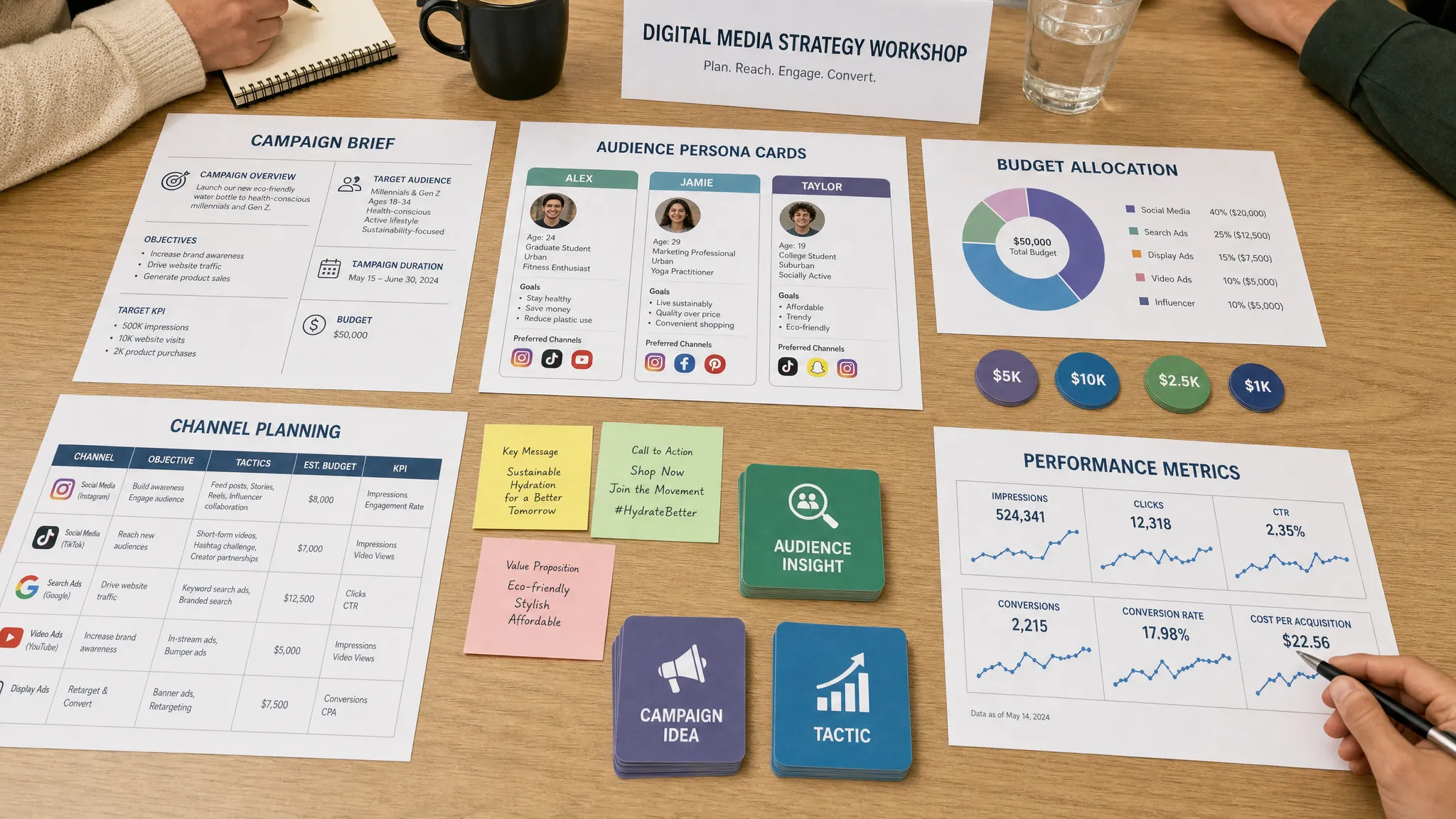
A common beginner mistake is treating channels as a checklist: add social, add search, add video, add email, then call it integrated. In reality, an effective media strategy depends on how channels work together.
Practice helps learners understand channel roles. Search may capture existing demand. Social video may create awareness or shape perception. Display may support retargeting or reach. Email may nurture known contacts. Retail media may influence shoppers close to purchase. None of these roles is automatic. The right role depends on the objective, audience, category, and competitive context.
This is where simulation-based learning can be especially useful. In a realistic environment, learners can see how a media mix performs over time and how one decision affects another. For example, underinvesting in awareness may limit future conversion potential. Overinvesting in lower-funnel channels may improve short-term efficiency while weakening brand growth.
Programs that want learners to practice strategic digital decision-making can use a tool such as Digital Markstrat to connect digital strategy, competition, and performance outcomes in a more active learning format.
Making budget tradeoffs under pressure
Budget allocation is one of the most valuable skills in digital media marketing because it forces prioritization. Learners must decide what not to fund, which is often harder than deciding what to fund.
In real campaigns, budgets are limited, timelines are tight, and stakeholders may disagree. A sales team may want more lead generation. A brand team may want more awareness. Finance may want proof of efficiency. Senior leadership may want growth without increasing spend.
Practice gives learners a safe place to experience these tensions. They learn that spreading budget too thin can reduce impact. They learn that optimizing too quickly can cut off useful learning. They learn that a campaign can be efficient and still strategically weak if it is not building the right customer behavior.
Good budget practice also builds comfort with uncertainty. Marketers rarely have perfect information. They must make the best decision available, monitor results, and adjust.
Interpreting data without overreacting
Digital media produces a lot of data, but more data does not automatically mean better decisions. Learners need to know which metrics matter, how to diagnose performance, and when not to overreact.
For example, a campaign with a high click-through rate may be attracting curiosity rather than qualified demand. A campaign with a higher cost per acquisition may still be valuable if it reaches customers with higher lifetime value. A creative asset may perform poorly overall but work well for a specific segment.
Practice teaches learners to ask sharper diagnostic questions. Is the issue the audience, the offer, the creative, the channel, the landing experience, or the measurement setup? Are results stable enough to act on? Are we comparing performance against the right benchmark?
This analytical judgment is difficult to build through lectures alone. It grows when learners repeatedly review results, make decisions, and see whether their interpretation was accurate.
Testing creative and messaging with discipline
Digital media makes testing easier, but not all tests produce useful learning. Learners need to understand how to test creative and messaging in a disciplined way.
A weak test changes too many things at once. If the audience, placement, image, headline, and offer all change, it becomes difficult to know what caused the result. A stronger test isolates a meaningful variable and connects it to a hypothesis.
Practice helps learners move from random experimentation to structured learning. Instead of saying, “Let’s try a new ad,” they learn to say, “We believe this audience is more motivated by convenience than price, so we will test a convenience-led message against a price-led message while keeping the audience and placement consistent.”
That shift is significant. It turns testing into a learning system rather than a collection of disconnected tactics.
Using AI and automation with human judgment
AI and automation now influence many parts of digital media marketing, from content drafting and audience analysis to bidding, optimization, and reporting. These tools can improve speed, but they do not remove the need for human judgment.
Learners need to practice deciding when to trust automation, when to question it, and how to evaluate the quality of AI-assisted work. They also need to discuss transparency, originality, brand voice, and responsible use. For example, instructors can use AI-writing detection resources as a conversation starter about how AI-generated text is evaluated, why human editing matters, and how marketing teams should set standards for content quality.
The key skill is not simply “using AI.” It is knowing how to supervise AI-enabled workflows. Marketers still need to define the strategy, evaluate outputs, protect the brand, interpret results, and make ethical decisions.
Communicating recommendations clearly
Digital media marketers do not just make decisions. They have to explain them. This is especially important when results are mixed, budgets are contested, or stakeholders focus on different metrics.
Practice helps learners build the habit of structured communication. They learn to state the objective, summarize the evidence, explain the tradeoff, recommend an action, and clarify what will be measured next. This matters because even a strong analysis can fail if it is not communicated clearly.
In team-based exercises, communication skills become even more visible. Learners must align around a recommendation, defend assumptions, and respond to questions. That mirrors the real marketing workplace, where success often depends on collaboration as much as technical knowledge.
How to design practice that actually builds skill
Not every practical activity creates deep learning. Asking learners to build a media plan once is helpful, but repeated decision cycles are better. The most effective practice environments include clear objectives, realistic constraints, timely feedback, and structured reflection.
A strong practice cycle often includes five elements:
- A realistic business context with a defined market, audience, and competitive situation
- Decisions that require tradeoffs across objectives, channels, budgets, and messages
- Feedback that shows the consequences of those decisions
- Reflection that asks learners to explain what happened and why
- Repetition that gives learners the chance to improve their next decision
This cycle matters because digital media marketing is learned through adjustment. Learners need to compare expectations with outcomes, revise their assumptions, and try again.
The role of simulations in digital media marketing education
Simulations are effective because they compress experience. Instead of waiting months to see how decisions play out in a real market, learners can make strategic choices, receive feedback, and observe consequences in a shorter timeframe.
They also make learning safer. In a live campaign, a poor budget decision can waste money or damage performance. In a simulation, the mistake becomes a learning moment. Learners can experiment, debate, and adapt without real-world risk.
For universities and corporate training teams, simulations also support engagement. Learners are not passively receiving information. They are responsible for decisions. They see how their choices affect outcomes. They learn from competition, feedback, and reflection.
For media-specific learning goals, Digital MediaPRO is designed around digital transformation in media planning and execution, giving learners a structured way to practice media strategy, targeting, budgeting, and performance analysis.
Frequently Asked Questions
What are digital media marketing skills? Digital media marketing skills include setting campaign objectives, understanding audiences, choosing channels, allocating budget, interpreting performance data, testing creative, using automation responsibly, and communicating recommendations.
Why is practice important in digital media marketing? Practice is important because marketers must make decisions under uncertainty. Repeated exercises help learners connect strategy, execution, and measurement, then improve based on feedback.
Can digital media marketing be taught without simulations? Yes, but simulations make practice more realistic and engaging. They allow learners to experience tradeoffs, competition, and consequences in a safe environment.
Which digital media marketing skill should beginners practice first? Beginners should start with translating business goals into measurable media objectives. This skill shapes every later decision, including audience selection, channel mix, budget allocation, and reporting.
How does AI change digital media marketing training? AI makes it more important to teach judgment. Learners need to know how to evaluate AI-assisted outputs, maintain brand quality, interpret automated recommendations, and make responsible decisions.
Help learners build skills that last
Digital media marketing will keep changing, but the core learning challenge remains the same: learners need to practice making better decisions. When they can test strategies, interpret results, and adjust their approach, they build skills that transfer beyond any single platform or tool.
StratX Simulations helps educators and corporate training teams bring that kind of experiential learning into marketing, strategy, sales, and innovation programs. With realistic business simulation software, learners can engage actively, receive feedback, and develop the practical judgment today’s digital media environment demands.