Why Sales and Marketing Training Works Better in Simulations
Most sales and marketing training begins with the right intent: help people understand customers, communicate value, and make better commercial decisions. Yet too often, the format works against the goal. Learners sit through slides about segmentation, negotiation, pipeline management, pricing, objection handling, or campaign planning, then return to work where the reality is messier, faster, and full of trade-offs.
That gap is exactly why sales and marketing training works better in simulations. A simulation does not simply explain what good decision-making looks like. It asks learners to make decisions, live with the consequences, compare outcomes, and try again. For skills that depend on judgment, timing, collaboration, and customer context, that difference is decisive.
The Problem With Teaching Sales and Marketing as Separate Theories
Sales and marketing are often trained in modules: one session on messaging, another on lead generation, another on negotiation, another on channel strategy. Each topic matters, but real commercial performance does not happen in isolated modules.
A marketing decision can change the quality of leads that sales receives. A pricing decision can affect perceived brand value, sales cycle length, and margin. A salesperson's negotiation choices can influence customer satisfaction, future renewal potential, and the profitability of an account. When training treats these decisions separately, learners may understand the concepts but still struggle to connect them in practice.
This is especially true in modern go-to-market environments. Buyers compare options independently, sales cycles involve more stakeholders, digital channels create more data, and teams must adjust quickly when competitors move. In that setting, knowledge alone is not enough. Learners need practice making connected decisions under uncertainty.
Why Simulations Create Stronger Learning
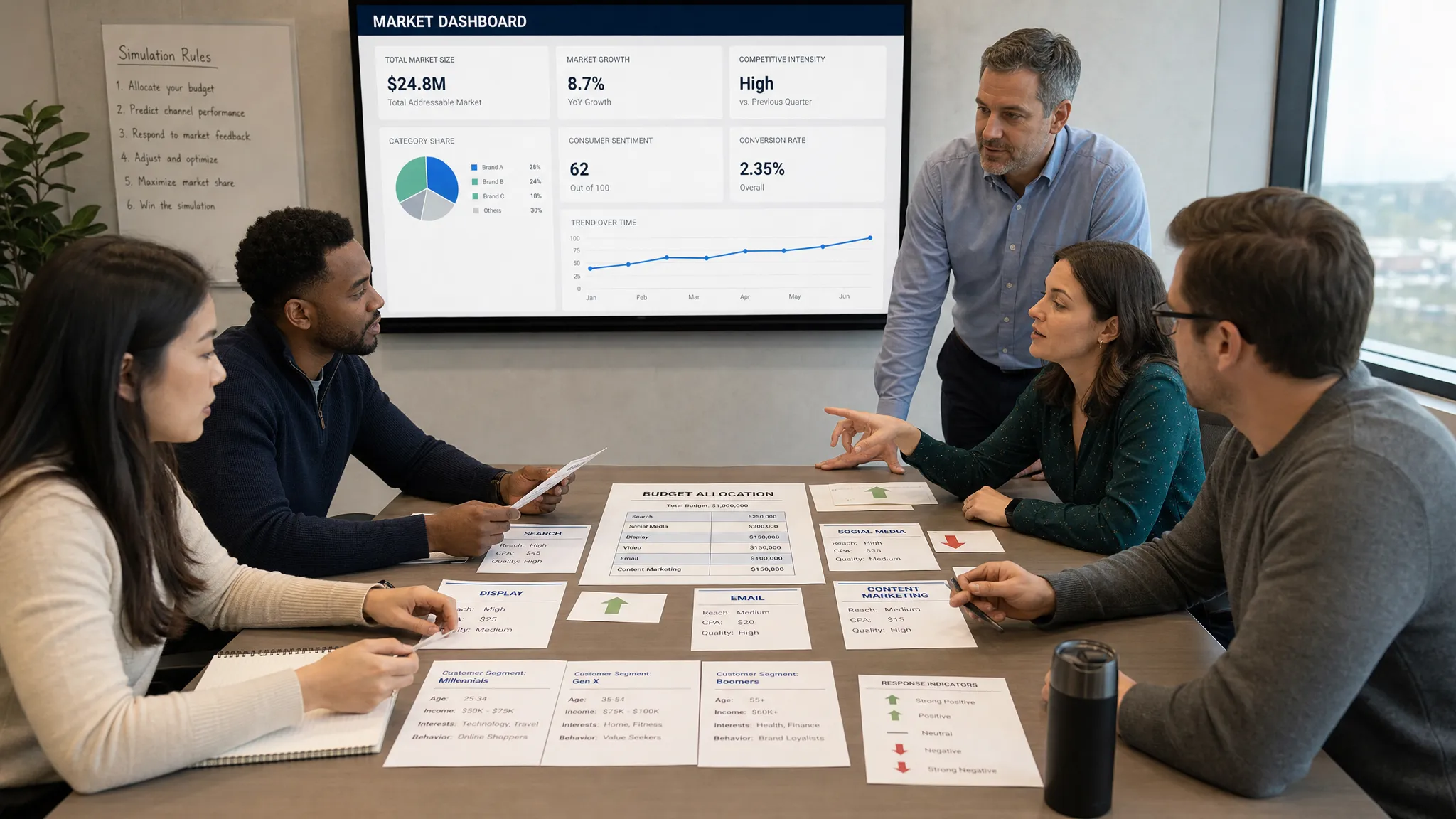
A well-designed business simulation puts learners inside a simplified but realistic market. They analyze information, choose a strategy, allocate resources, respond to competitors, negotiate with constraints, and receive feedback on results. Instead of passively receiving best practices, they build judgment by applying them.
This aligns with what learning research has shown for years: active learning generally produces better outcomes than passive instruction. A 2014 meta-analysis published in PNAS found that active learning increased student performance and reduced failure rates in undergraduate STEM courses. While the study focused on STEM education, the underlying principle applies strongly to business skills: people learn more deeply when they must retrieve, apply, test, and refine what they know.
Simulation-based learning is particularly powerful because it combines active learning with feedback and repetition. Research published in Personnel Psychology found that computer-based simulation games can improve learning outcomes, especially when they include instructional support. In other words, the simulation matters, but so does the briefing, coaching, and debrief around it.
Traditional Training vs. Simulation-Based Training
The advantage of simulations becomes clearer when you compare them with common training formats.
| Training challenge | Traditional training limitation | Simulation advantage |
|---|---|---|
| Applying theory | Learners may understand a framework but not know when to use it | Learners apply frameworks to realistic decisions |
| Handling trade-offs | Slides often present clean answers | Simulations force choices between growth, margin, risk, and customer satisfaction |
| Retaining knowledge | Concepts can fade quickly after a session | Repeated decisions and feedback reinforce learning |
| Building confidence | Role plays can feel artificial or narrow | Simulations create broader business context and measurable consequences |
| Aligning teams | Sales and marketing may train separately | Cross-functional teams can practice shared decision-making |
| Measuring progress | Attendance and satisfaction are easy to track, behavior change is harder | Decisions, outcomes, and improvement can be observed during the experience |
This does not mean lectures, workshops, coaching, or role plays have no value. They do. The issue is that sales and marketing require more than explanation. They require practice in a system that resembles the real one.
Why Sales Training Improves in Simulations
Sales performance depends on much more than knowing a script. Strong salespeople diagnose customer needs, prioritize accounts, adapt to buyer behavior, protect margins, manage negotiations, and collaborate internally. These skills are difficult to master in a classroom because they involve judgment under pressure.
In a simulation, sales learners can practice decisions such as which account to prioritize, how to prepare for a negotiation, when to concede, how to protect value, and how short-term choices affect long-term relationships. They can see that winning a deal at any cost may damage profitability. They can also see that refusing to adapt may cause a promising opportunity to stall.
This is where simulations go beyond role play. A role play may help learners practice a conversation. A sales simulation can show how that conversation fits into territory strategy, customer segmentation, pricing discipline, and business outcomes. It gives learners a commercial reason to improve, not just a communication reason.
Simulations also create psychological safety. A salesperson can make a poor pricing decision, mishandle a negotiation, or choose the wrong account strategy without losing a real customer. That safe failure is not a weakness of the method. It is one of its greatest strengths.
Why Marketing Training Improves in Simulations
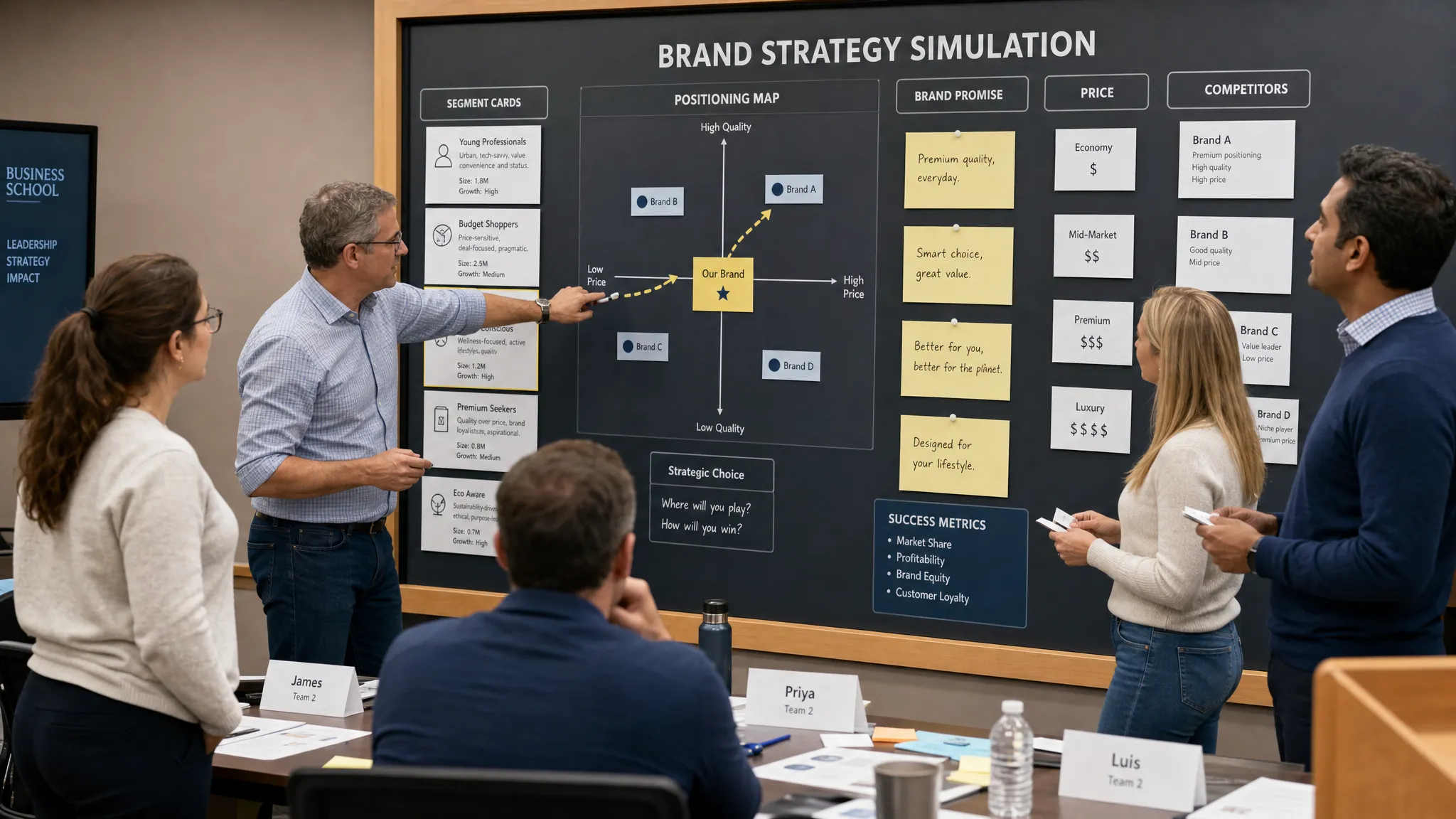
Marketing is full of concepts that are easy to define and difficult to execute. Segmentation, targeting, positioning, pricing, channel mix, brand equity, customer lifetime value, and media allocation all sound straightforward in theory. In practice, every decision interacts with the others.
A marketing simulation helps learners experience those interactions. If they increase advertising spend, what happens to awareness, demand, and profitability? If they reposition a product, how does the market respond? If they chase a new segment, what happens to the brand's existing customer base? If competitors change price or invest in innovation, how should the team respond?
The immediate value is not that learners discover one perfect answer. Real markets rarely offer that. The value is that they learn how to think like marketers: form hypotheses, interpret data, choose a strategy, monitor results, and revise decisions based on evidence.
This is especially useful for digital marketing training. Digital channels produce abundant metrics, but more data does not automatically create better decisions. Learners must distinguish between vanity metrics and business outcomes, connect campaign actions to customer behavior, and understand when optimization supports the broader strategy or distracts from it.
Why Sales and Marketing Should Train Together
The biggest gains often appear when sales and marketing teams train together rather than separately. In many organizations, these functions share revenue goals but operate with different assumptions. Marketing may believe the messaging is clear, while sales hears different objections in the field. Sales may want more leads, while marketing worries about quality, cost, and brand consistency.
A simulation makes these tensions visible in a productive way. Teams can test how their decisions affect one another. Marketing can see how positioning and budget allocation influence sales opportunities. Sales can see how negotiation discipline and customer feedback influence brand performance and profitability. Both functions can practice using a shared commercial language.
This is also where realistic business constraints matter. In IP-heavy markets, for example, a scenario might ask teams to evaluate licensing revenue, enforcement risk, and deal flow, the kind of growth context addressed by platforms such as Third Chair. The point is not that every simulation needs to include legal complexity. The point is that stronger training reflects the real environment in which commercial decisions are made.
When sales and marketing teams learn together, they are more likely to align on questions that directly affect performance: Who is the priority customer? What value promise are we making? Which channels matter most? What should sales protect during negotiation? Which metrics define success?
The Role of Feedback: Why Consequences Make Learning Stick
One of the reasons simulations work so well is that feedback is built into the experience. In traditional training, feedback often arrives as a quiz score or facilitator comment. In a simulation, feedback comes from the market itself: share shifts, profitability changes, customer response, competitive movement, or negotiation outcomes.
That kind of feedback feels different. It is not abstract. It is connected to a decision the learner made. When participants see that a pricing move improved volume but damaged margin, or that a campaign increased awareness but failed to reach the right segment, the lesson becomes memorable.
The debrief is critical here. Without a debrief, learners may notice what happened but miss why it happened. A skilled facilitator helps participants connect outcomes to decisions, challenge assumptions, and translate insights back to their work or coursework.
What Good Simulation-Based Sales and Marketing Training Includes
Not every interactive exercise delivers the same value. The best simulation-based programs are intentionally designed around learning outcomes, not just competition or entertainment.
A Realistic but Manageable Level of Complexity
A simulation should feel close enough to reality to be credible, but not so complex that learners drown in details. The goal is to focus attention on the decisions that matter most for the course or training objective.
For an introductory marketing course, that might mean emphasizing segmentation, positioning, and budget allocation. For an advanced corporate sales program, it might mean focusing on negotiation strategy, value capture, and account planning. For cross-functional training, it might mean linking campaign choices, sales execution, and financial performance.
Repeated Decision Cycles
One decision round can be useful, but repeated cycles are where learning accelerates. Learners make a decision, see results, adjust their assumptions, and try again. This mirrors real business more closely than a single case discussion because it shows how strategy unfolds over time.
Clear Metrics That Connect to Business Outcomes
Good simulations do not only tell learners whether they won. They show why. Metrics might include market share, contribution margin, customer satisfaction, brand perception, account profitability, or return on marketing investment. The metrics should match the desired learning outcomes.
Structured Reflection and Debriefing
Reflection turns activity into learning. Facilitators can ask learners to explain their strategy, identify assumptions, compare expected and actual results, and define what they would change next time. This is where the experience becomes transferable.
Support for Instructors and Trainers
Simulation-based training works best when instructors and facilitators are confident with the platform, the scenario, and the debrief. This is especially important in academic settings where simulations must fit course objectives, and in corporate settings where training must connect to business priorities.
Measuring the Impact Beyond Engagement
Engagement matters, and simulations are often more engaging than slide-based training. But engagement is only the beginning. The real question is whether learners make better decisions after the training.
| Impact area | What to look for |
|---|---|
| Knowledge application | Learners can use concepts in realistic situations, not only define them |
| Decision quality | Learners make clearer trade-offs and justify choices with evidence |
| Cross-functional alignment | Sales and marketing teams use shared assumptions, metrics, and priorities |
| Confidence | Learners feel more prepared to handle ambiguity and pressure |
| Behavior transfer | Participants apply lessons in planning, customer conversations, campaigns, or negotiations |
| Business relevance | Training outcomes connect to revenue, margin, customer value, or market performance |
For corporate teams, this measurement can be paired with manager observations, pipeline reviews, campaign reviews, CRM data, or post-training action plans. For educators, it can be paired with reflection papers, presentations, peer evaluation, or performance across decision rounds.
The best assessment asks not only what did you learn, but what did you do differently because of what you learned?
Where StratX Simulations Fits
StratX Simulations provides experiential business simulation software for education and corporate training across areas such as marketing, strategy, sales, and innovation. For organizations and instructors trying to make sales and marketing training more practical, simulations can help learners move from understanding concepts to applying them in realistic decision environments.
For example, StratX has shared how Biotest AG used a sales simulator to train global sales and marketing teams in negotiation skills through a dedicated training initiative. You can explore the Biotest customer case study for a practical example of simulation-based learning in a corporate setting.
If you are new to the broader concept, StratX also offers an overview of business simulations and how they support experiential learning in academic and professional contexts.
When Simulations Work Best
Simulations are most effective when they are treated as part of a learning journey, not a one-off event. Learners benefit from preparation before the experience, active facilitation during it, and a thoughtful debrief afterward. They also benefit when the simulation is connected to real goals, such as improving sales negotiation discipline, strengthening marketing analytics, aligning go-to-market teams, or preparing students for business decision-making.
They are not a replacement for every form of development. Salespeople still need coaching on real calls. Marketers still need exposure to live campaign data. Students still need conceptual foundations. But simulations make those other learning methods more effective because they give learners a practical mental model for how decisions connect.
In short, simulations help sales and marketing training do what it is supposed to do: change how people think, decide, collaborate, and perform.
Frequently Asked Questions
What is sales and marketing simulation training? Sales and marketing simulation training uses realistic business scenarios to help learners practice commercial decisions such as segmentation, pricing, campaign planning, account strategy, and negotiation. Learners receive feedback based on the results of their decisions.
Why is simulation training better than lectures for sales and marketing? Lectures can explain concepts, but simulations require learners to apply them. This is important because sales and marketing decisions involve trade-offs, uncertainty, customer behavior, and competitive response.
Can simulations be used for both students and corporate teams? Yes. In academic settings, simulations help students connect theory to practice. In corporate training, they help teams practice job-relevant decisions in a risk-free environment before applying lessons in the market.
Do simulations replace role plays in sales training? Not necessarily. Role plays are useful for practicing conversations. Simulations add broader business context by connecting sales conversations to pricing, account strategy, profitability, and customer outcomes.
How do simulations improve sales and marketing alignment? Simulations help both teams see how their decisions affect shared outcomes. Marketing can understand sales constraints, sales can understand marketing trade-offs, and both functions can align around customers, value, and performance metrics.
Make Sales and Marketing Training More Experiential
If your learners need more than theory, simulation-based training can help them practice the decisions that drive real commercial performance. With the right scenario, feedback, and debrief, sales and marketing teams can build stronger judgment before the stakes are real.
Explore how StratX Simulations helps educators and organizations create hands-on learning experiences in marketing, strategy, sales, and innovation.
.png?width=352&name=Blog%20Image%20Template%20UPDATED%20(31).png)