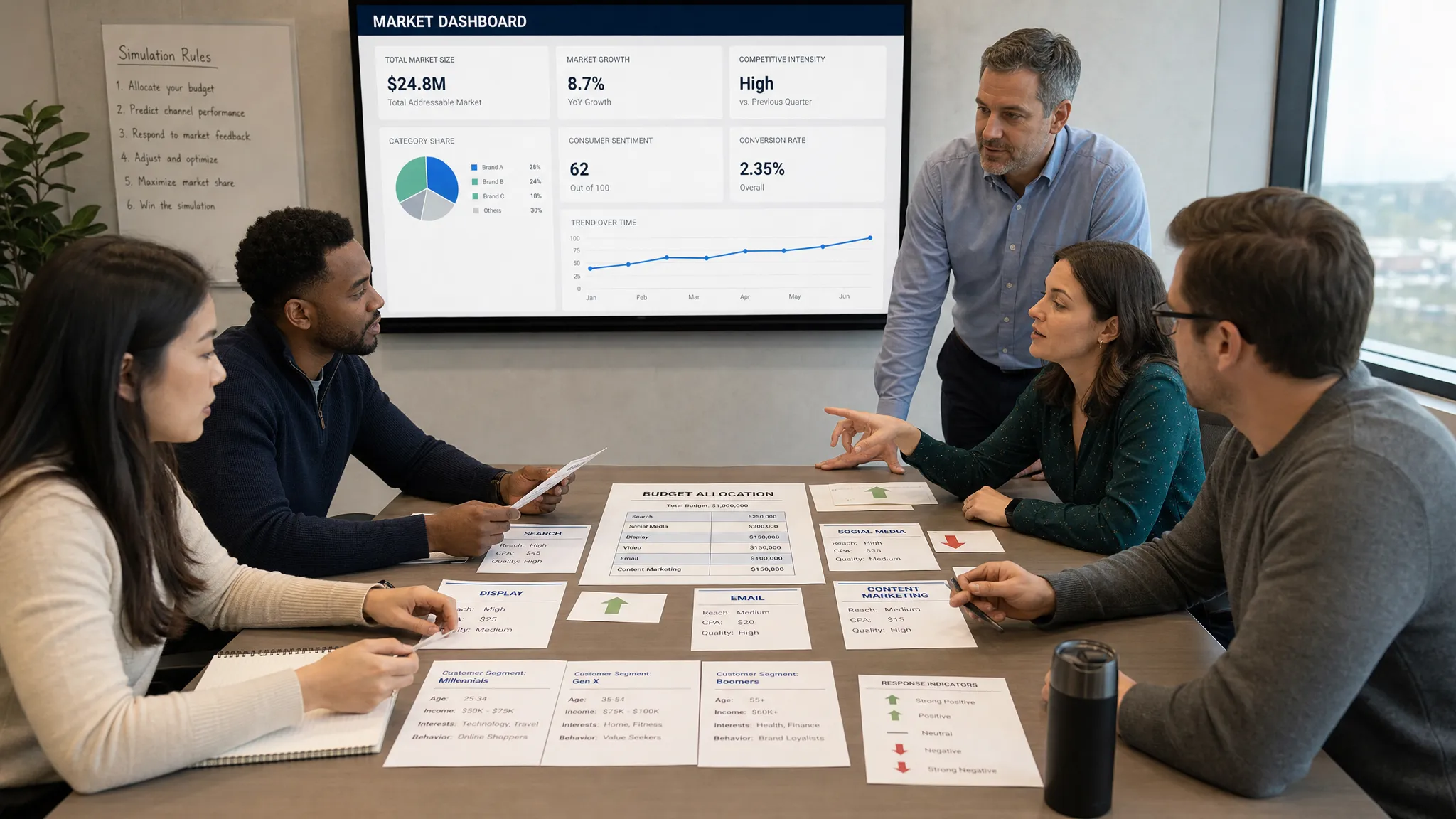
Brand strategy is easier to understand than it is to do. Most learners can define positioning, segmentation, differentiation, and portfolio management after a lecture. The harder part is making those ideas work together when budgets are limited, competitors react, customers change preferences, and every decision creates a tradeoff.
That is where simulation changes the learning curve. A well-designed business simulation compresses months or years of brand decisions into a focused learning experience. Instead of only discussing what a brand should do, learners make decisions, see outcomes, defend their logic, and improve the next round.
For universities, executive education, and corporate training teams, this matters because brand strategy is not a single concept. It is a set of judgment-based skills that grow through practice.
Why brand strategy develops faster in a simulation
Brand strategy sits at the intersection of market insight, customer psychology, financial discipline, and competitive behavior. In a traditional classroom or workshop, these elements are often taught separately. In the market, they are never separate.
Simulation brings those moving parts back together. Learners must decide where to compete, what to promise, how to allocate resources, and how to respond when the market does something unexpected. The result is not just better recall. It is better strategic reflexes.
Experiential learning is especially powerful because it follows a cycle: act, observe, reflect, adjust, and act again. A simulation makes that cycle repeatable. Participants are not punished by real market losses, but they still feel the consequences of weak assumptions, inconsistent positioning, or poorly timed investments.
This is one reason many educators and training leaders use simulations to connect sales, marketing, and strategy. If you are exploring that broader learning case, StratX has also covered why sales and marketing training works better in simulations, especially when teams need to practice connected decisions instead of isolated tactics.
The brand strategy skills learners build faster
The strongest brand strategists are not simply creative. They are disciplined. They know how to read a market, make choices, focus resources, and keep the brand coherent under pressure. Simulation accelerates these skills because learners practice them repeatedly in a realistic competitive setting.
Market diagnosis and insight interpretation
Brand strategy begins with diagnosis. Who is buying? What do they value? Which needs are underserved? Which competitors own the strongest perceptions? In a simulation, learners cannot skip this step because every round exposes whether their assumptions were accurate.
They learn to separate noise from signal. A dip in performance may come from a weak value proposition, poor channel fit, pricing misalignment, or a competitor move. The skill is not just reading data. It is asking better questions before acting.
Over time, participants become faster at spotting patterns. They learn to connect customer segments, brand perceptions, competitive intensity, and financial results into a strategic view of the market.
Segmentation, targeting, and positioning
Segmentation often sounds straightforward in theory, but it becomes more difficult when learners must choose one target over another. A simulation forces that choice. Participants see that trying to appeal to every segment usually weakens the brand, spreads investment too thin, and makes positioning harder to defend.
The same is true for positioning. Learners can test whether their brand promise is distinctive, relevant, and credible. If they position too close to a stronger competitor, the market response shows it. If they choose a niche but fail to support it with product, pricing, and communication decisions, the gap becomes visible.
This is one of the fastest improvements simulation creates: learners stop treating positioning as a statement and start treating it as a system of choices.
Resource allocation and tradeoff discipline
Brand strategy is always constrained. Budgets, time, teams, product capabilities, and market access are limited. Simulation makes those constraints real.
Participants must decide how much to invest in awareness, product development, distribution, pricing moves, or customer experience. They also learn that a good decision in one period can become a weak decision later if the market changes.
This builds tradeoff discipline. Learners become more comfortable saying no. They see that strategy is not a list of priorities, but a hierarchy of choices backed by resources.
For teams that want to develop this broader commercial judgment, the same principle applies across marketing decisions. StratX explores related capabilities in its article on marketing management skills teams can practice in real time, including budget allocation, market diagnosis, and competitive response.
Competitive response and scenario thinking
In real markets, competitors do not stand still. They launch new offers, adjust prices, target attractive segments, and copy winning moves. Simulation helps learners stop thinking in static plans and start thinking in scenarios.
A team may enter a round with a strong brand strategy, only to discover that a competitor has moved into the same segment. Now the question changes. Should the team defend the position, reposition, double down on differentiation, or shift investment to a more attractive opportunity?
That pressure builds strategic agility. Learners practice responding without overreacting. They also learn that every competitive move has a cost, and not every threat deserves the same response.
Brand coherence across decisions
A brand is not built by messaging alone. It is built through repeated decisions that customers experience as consistent or inconsistent. Simulation makes coherence measurable.
If a team claims premium positioning but competes mainly on price, the strategy weakens. If it targets innovation seekers but underinvests in product development or customer education, the promise loses credibility. If it expands too quickly into segments with different needs, the brand can become diluted.
Through simulation, learners see that brand strategy requires alignment across product, price, communication, channel, and customer experience. This is where abstract brand thinking becomes practical management.
| Brand strategy skill | What learners practice in simulation | Why it develops faster |
|---|---|---|
| Market diagnosis | Reading customer, competitor, and performance signals | Feedback arrives quickly and repeatedly |
| Positioning | Choosing a distinct and credible market space | Learners see whether the market accepts the choice |
| Resource allocation | Prioritizing budgets across competing actions | Tradeoffs are unavoidable in every round |
| Competitive response | Adjusting strategy after rival moves | The market is dynamic, not theoretical |
| Brand coherence | Aligning decisions with the intended promise | Inconsistency shows up in results and debriefs |
| Strategic communication | Explaining decisions to peers or instructors | Teams must defend assumptions and learn from debate |
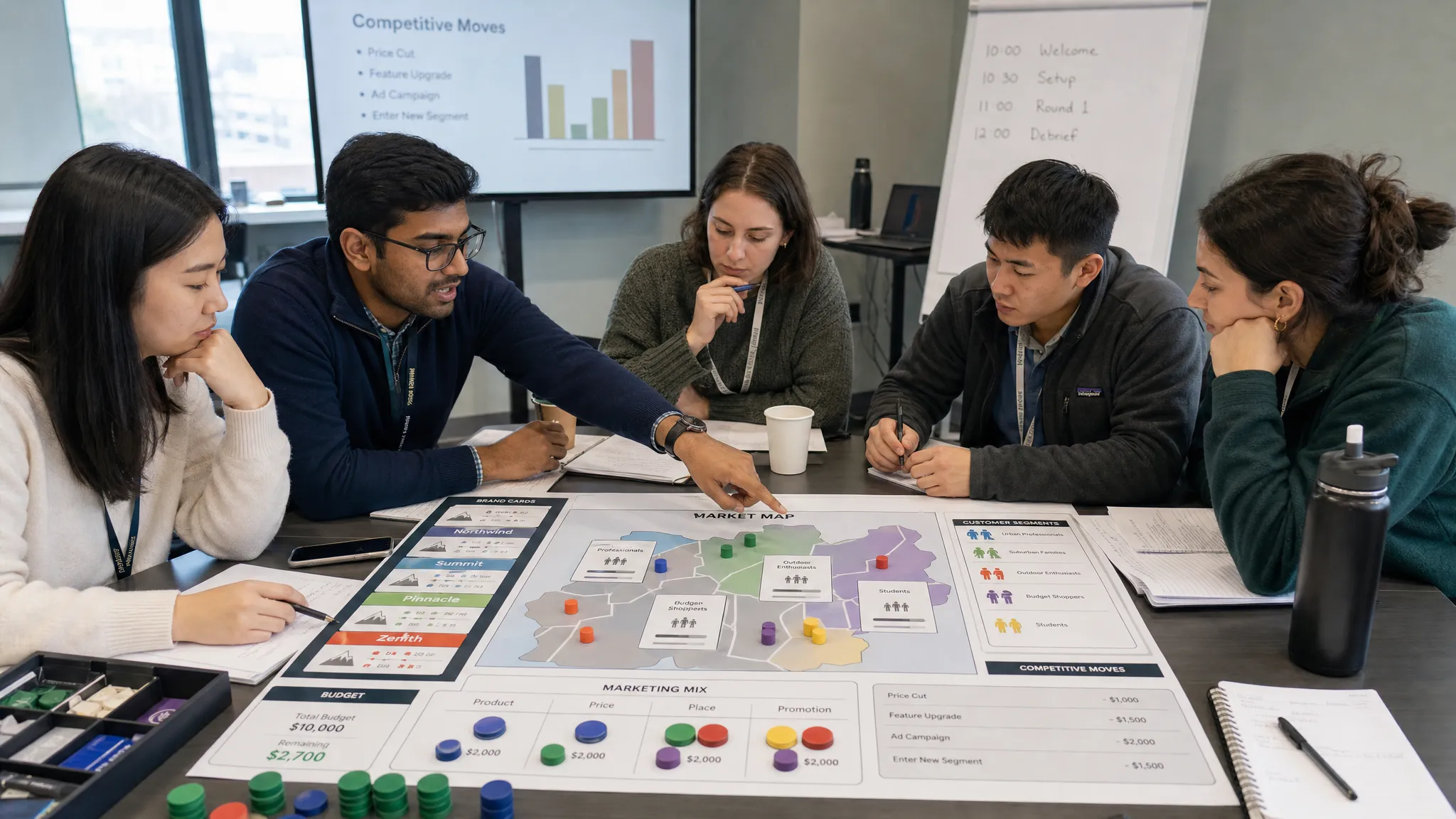
From data to brand judgment
Modern brand leaders work in data-rich environments. That does not automatically make strategy better. More data can create more confusion if teams do not know which signals matter.
Simulation helps learners build data judgment. They practice deciding which metrics are diagnostic, which are lagging indicators, and which may be misleading. For example, a short-term sales increase may look positive, but if it comes from discounting that damages premium perception, the brand may be weaker in the next round.
This skill is increasingly important as more industries rely on automation, analytics, and connected workflows. In insurance, for example, an AI-powered insurance automation platform can reshape underwriting, claims, and service operations, which changes what customers expect from a brand. Brand strategists need to understand how operational realities, data systems, and customer promises reinforce each other.
The lesson for learners is simple: data is not the strategy. Data improves strategy when teams use it to make sharper choices.
What a strong brand strategy simulation experience includes
Not every simulation teaches brand strategy equally well. The best experiences combine decision-making, competitive pressure, feedback, and guided reflection. Without reflection, participants may only chase scores. With reflection, they connect outcomes to strategic reasoning.
A strong experience usually includes four moments.
First, learners interpret the market. They review customer needs, segment attractiveness, brand perceptions, and competitive positions. Second, they make decisions that require tradeoffs. Third, they receive results that show the impact of those decisions. Fourth, they debrief what happened and decide how to improve.
That final step is critical. The learning does not come only from winning or losing. It comes from understanding why a strategy worked, why it failed, and what the team would do differently next time.
StratX offers a dedicated brand strategy simulator for learners who need to develop, test, and refine brand strategies in a competitive environment. Used well, this type of experience helps participants move beyond terminology and into applied judgment.
How simulations support academic and corporate learning goals
In academic programs, simulation helps students connect frameworks to managerial reality. They may know the theory of brand equity or segmentation, but simulation asks them to make choices with incomplete information. That prepares them for internships, case interviews, and early career roles where the right answer is rarely obvious.
For instructors, simulation also creates richer classroom discussion. Instead of asking students what a company should do in a static case, instructors can ask why a team made a choice, what happened, and how that choice compares with another team facing the same market conditions.
In corporate training, the value is different but equally important. Teams often bring functional expertise but need shared strategic language. Sales, marketing, product, finance, and leadership may all view the brand from different angles. Simulation gives them a common market challenge, which makes alignment more concrete.
Corporate learners can also practice riskier decisions than they would in the real business. They can test a repositioning move, an aggressive investment, or a focused segment strategy without putting actual revenue at risk. The emotional realism remains, but the business downside is contained.
How to tell whether learners are improving
The value of simulation should not be measured only by final rank or market share. Those outcomes matter, but they do not tell the whole story. A team can win a round for the wrong reason, or lose a round while making a strategically sound long-term move.
Better evaluation looks at the quality of thinking before, during, and after decisions.
| Progress indicator | What to look for |
|---|---|
| Clearer diagnosis | Learners explain what is happening in the market before recommending action |
| Stronger focus | Teams choose priority segments and avoid chasing every opportunity |
| Better tradeoffs | Participants can explain what they are not doing and why |
| Improved adaptation | Teams adjust based on evidence instead of reacting emotionally |
| Strategic consistency | Decisions across product, price, communication, and channel support the same brand promise |
| Better debriefs | Learners connect results to assumptions, not just outcomes |
When these behaviors improve, the learning is deeper than simulation performance. Participants are building the habits of brand strategists.
Common mistakes simulation helps correct
Simulation is effective because it exposes weak habits quickly. One common mistake is confusing activity with strategy. Learners may increase spending, launch more initiatives, or chase more segments without making the brand clearer. The results often show that more action does not mean better strategy.
Another common mistake is overcorrecting after one bad result. A team may abandon a positioning choice too early, even when the issue was execution rather than the strategy itself. Simulation teaches patience and evidence-based adjustment.
A third mistake is treating competitors as background noise. Once learners see rival decisions affecting their own outcomes, they begin to think more strategically about differentiation, timing, and defense.
Finally, teams often underestimate the importance of internal alignment. A strong brand strategy can still fail if the team does not share the same assumptions. Simulation makes those disagreements visible, which gives instructors and facilitators a productive way to coach decision quality.
Frequently Asked Questions
What brand strategy skills are best learned through simulation? Simulation is especially effective for market diagnosis, segmentation, targeting, positioning, competitive response, resource allocation, and strategic communication. These skills improve through repeated decisions and feedback.
Is a brand strategy simulation only useful for marketing students? No. It is useful for marketing students, MBA participants, executives, sales teams, product managers, and cross-functional teams that need to understand how brand choices affect business performance.
How does simulation differ from a case study? A case study usually analyzes a fixed situation. A simulation is dynamic. Learners make decisions, competitors respond, market results change, and participants must adapt their strategy over multiple rounds.
Can simulation help experienced professionals? Yes. Experienced professionals often know the concepts, but simulation helps them test assumptions, align with colleagues, and practice decision-making in a competitive environment without real business risk.
How should instructors or facilitators debrief a brand strategy simulation? Effective debriefs focus on the link between assumptions, decisions, and outcomes. The best questions ask why a team chose a strategy, what evidence supported it, what changed, and what they would do next.
Turn brand strategy into a practiced capability
Brand strategy is not mastered by memorizing frameworks. It is built through repeated choices, feedback, reflection, and adjustment. Simulation gives learners that practice in a realistic, engaging, and low-risk environment.
If your goal is to help learners make sharper positioning decisions, understand competitive dynamics, and align brand choices with business results, simulation can shorten the distance between knowing and doing. Explore how StratX Simulations helps educators and organizations bring experiential brand learning into the classroom or training room through its brand strategy and marketing simulation experiences.