Internet marketing looks simple from a distance: choose the right channels, launch campaigns, watch the data, and optimize. In practice, the hard part is judgment. Teams must decide which audience to prioritize, how to position an offer, where to invest limited budget, which metrics to trust, and when to change direction.
Those skills do not develop quickly through slides alone. Teams learn internet marketing faster when they practice decisions, experience consequences, and debrief what happened. This is especially true for educators, corporate trainers, and marketing leaders who need learners to move beyond vocabulary and into confident, evidence-based action.
Why internet marketing is difficult to learn passively
Internet marketing is not one isolated skill. It is a connected performance system where strategy, creativity, analytics, sales alignment, and customer behavior influence each other.
A learner can understand what search intent means and still struggle to prioritize content ideas. A marketer can define conversion rate and still misread a campaign dashboard. A team can know the difference between paid, owned, and earned media, yet still overinvest in the wrong channel because they failed to connect channel choice with customer readiness.
Passive learning is useful for introducing frameworks, but it often hides the tradeoffs that make marketing decisions difficult. In a lecture, learners can be told that customer acquisition cost matters. In a practice environment, they must decide whether a higher cost is acceptable if the segment has stronger lifetime value, better retention, or strategic importance.
That gap between knowing and doing is where practice-based learning becomes powerful.
The internet marketing skills teams learn faster through practice
When teams practice in realistic scenarios, they build the habits that matter in actual marketing work. They learn to ask better questions, defend their assumptions, adjust after feedback, and collaborate under pressure.
The following skills are especially well suited to experiential learning.
| Internet marketing skill | What learners practice | What improves through feedback |
|---|---|---|
| Customer and market diagnosis | Interpreting customer needs, segment behavior, and market signals | Stronger prioritization and fewer assumption-driven decisions |
| Channel strategy | Choosing among SEO, paid media, email, social, content, and other channels | Better understanding of reach, intent, timing, and cost tradeoffs |
| Positioning and messaging | Matching value propositions to audience needs and competitive context | Clearer differentiation and more consistent campaign logic |
| Budget allocation | Distributing limited resources across channels, campaigns, and time periods | Better opportunity-cost thinking and ROI awareness |
| Measurement and analytics | Reading performance data and deciding what to optimize | More disciplined interpretation of metrics and fewer vanity-metric traps |
| Experimentation | Designing tests, comparing outcomes, and iterating | Faster learning cycles and better decision confidence |
| Cross-functional alignment | Coordinating marketing decisions with sales, product, and business goals | Stronger communication and more commercially grounded recommendations |
The common thread is that these skills improve when learners repeatedly make decisions in context. They do not simply memorize terms. They test their thinking.
Practice turns marketing concepts into decision-making habits
Internet marketing teams often need to make decisions with incomplete information. The market may shift, competitors may respond, budgets may change, or early results may be ambiguous. Practice helps learners get comfortable with that uncertainty.
A strong practice environment gives learners a safe place to make imperfect decisions. Instead of treating mistakes as failures, it treats them as data. Why did one segment respond better than expected? Why did a channel with strong reach produce weak conversions? Why did a campaign look efficient in the short term but fail to support long-term brand growth?
These questions build marketing judgment. They also make learning more memorable because learners have a personal stake in the outcome. When a team chooses a strategy, sees the result, and has to explain what happened, the lesson tends to stick.
This is one reason business simulations are widely used in marketing education and corporate training. They create structured practice around realistic business decisions, without putting an actual brand, budget, or customer relationship at risk. For a broader introduction to the approach, StratX has a helpful guide to business simulations and how they support experiential learning.
What effective internet marketing practice should include
Not all practice is equally useful. A worksheet, quiz, or one-time campaign exercise can reinforce knowledge, but it may not build the same level of applied skill. To help teams learn faster, practice needs to feel close enough to reality that learners must think, collaborate, and adapt.
Realistic constraints
Marketing work always involves constraints. Time is limited. Budgets are limited. Data is incomplete. Stakeholders disagree. Customer behavior changes.
Good practice includes those constraints instead of removing them. If every answer is obvious, learners are not developing judgment. They are only confirming what they already know.
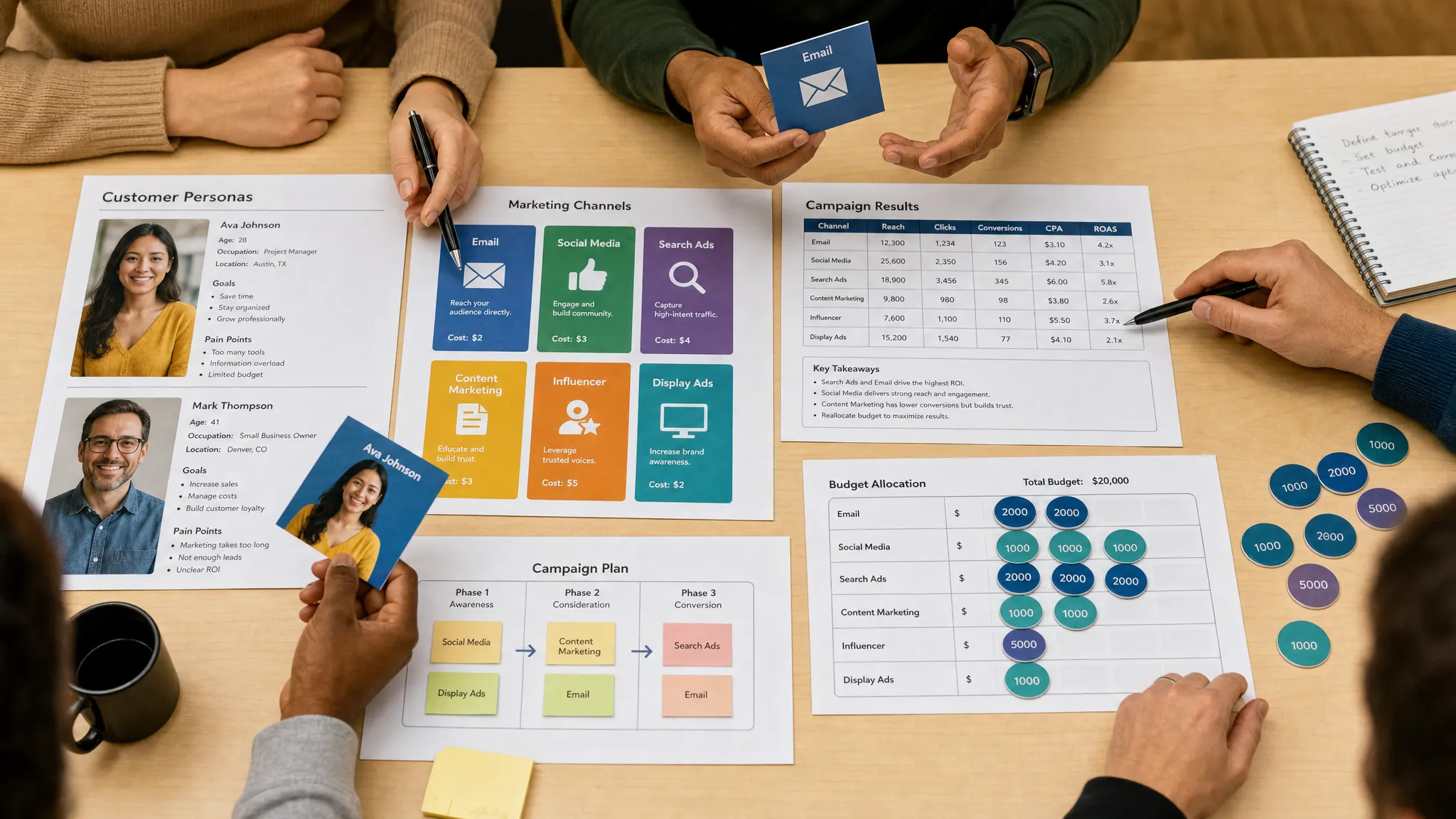
In a simulation or scenario-based exercise, learners might need to choose a target segment, allocate spend across channels, respond to performance data, and defend their strategy to peers. The value comes from making tradeoffs, not from finding a perfect answer.
Repeated decision cycles
One practice round is rarely enough. Internet marketing improves through cycles of decision, result, reflection, and adjustment. Teams learn faster when they can see how early choices affect later outcomes.
For example, a team may initially overprioritize awareness because it produces visible traffic. After seeing weak conversion or poor profitability, they may need to rebalance their strategy. That second decision is often where the deeper learning happens.
Immediate and meaningful feedback
Feedback should show learners what happened and help them understand why. Instant feedback is especially valuable because it keeps the decision fresh. Learners can connect their assumptions to the outcome before the reasoning fades.
However, feedback should not be limited to scores. The most useful feedback encourages interpretation. A result may show that a team gained market share, but the debrief should ask whether that growth was profitable, sustainable, and aligned with the chosen audience.
Team discussion and challenge
Internet marketing is rarely a solo activity. Campaigns involve analysts, content creators, media specialists, sales teams, product managers, agencies, and leadership. Practice should reflect that collaborative reality.
When learners work in teams, they must explain their reasoning, challenge weak assumptions, and align around a plan. This helps develop communication skills that are just as important as technical marketing knowledge.
How simulations accelerate internet marketing skill development
Simulations are effective because they compress experience. A marketing team might need months to see the full impact of a real campaign strategy. In a simulation, learners can move through multiple decision periods in a much shorter time, observe consequences, and apply what they learn immediately.
This does not replace real-world experience. It prepares people for it.
In marketing and digital marketing simulations, learners can practice concepts such as positioning, competitive response, channel prioritization, and budget allocation in a structured environment. They can test strategies, compare outcomes, and understand how decisions interact across the broader business.
For educators, simulations can make abstract marketing theory more concrete. Students can see how segmentation, pricing, branding, and communication choices affect performance. For corporate trainers, simulations can help teams align around better commercial decision-making before they apply those skills in the market.
StratX Simulations supports this kind of experiential learning across marketing, strategy, sales, and innovation. Its simulation-based approach is designed to increase learner engagement and help concepts stick through hands-on decision-making, feedback, and instructor-supported learning.
You can also explore why sales and marketing training often works better in simulations, especially when teams need to understand the connection between customer-facing decisions and business results.
Practice also reveals system and data gaps
One overlooked benefit of practice is that it exposes what prevents teams from performing well. Sometimes the issue is not a lack of marketing knowledge. It is fragmented data, unclear ownership, disconnected tools, or weak alignment between marketing and operations.
For example, a team may understand attribution in theory but struggle to make decisions because campaign data, sales data, and customer data live in separate systems. A practice environment can make that friction visible before it slows down real execution.
This matters because modern internet marketing depends on both human judgment and operational infrastructure. Many mid-market organizations combine team capability building with initiatives such as AI automation, ERP integration, and data-driven digital marketing support so marketers can make better decisions with cleaner, more connected information.
Training and technology should reinforce each other. Better systems give teams better inputs. Better practice helps teams use those inputs wisely.
A practical training path for faster skill development
A strong internet marketing learning experience does not need to start with advanced tactics. It should start with the decisions learners are expected to make in the real world.
Here is a simple structure educators and corporate trainers can adapt.
| Training phase | Learner activity | Trainer or instructor focus |
|---|---|---|
| Foundation | Review key concepts such as segmentation, positioning, channel roles, and performance metrics | Establish shared vocabulary and decision criteria |
| First practice cycle | Make campaign or market decisions in a scenario or simulation | Observe assumptions, teamwork, and reasoning |
| Feedback and debrief | Compare outcomes, identify surprises, and discuss tradeoffs | Connect results to marketing principles and business impact |
| Second practice cycle | Adjust strategy based on evidence and peer discussion | Reinforce experimentation and adaptation |
| Transfer to work or coursework | Apply lessons to a real brand, market, case, or internal challenge | Turn learning into an action plan |
The key is progression. Learners should not only complete an exercise. They should return to their decisions, evaluate what changed, and practice again with better judgment.
Common mistakes to avoid when teaching internet marketing skills
Practice-based learning works best when it is intentionally designed. If the exercise is too shallow, learners may stay at the level of tactics. If the debrief is rushed, they may miss the deeper lesson.
Common mistakes include:
- Treating internet marketing as a checklist of channels instead of a connected strategy.
- Measuring success only by activity, such as clicks or impressions, rather than business outcomes.
- Giving learners too much perfect information, which removes the uncertainty of real marketing work.
- Skipping the debrief, where much of the learning is consolidated.
- Focusing only on individual performance when marketing decisions usually require team alignment.
The best practice environments balance structure and ambiguity. Learners need enough information to make a reasoned decision, but not so much that the answer becomes automatic.
How to measure whether teams are actually improving
If the goal is skill development, assessment should look beyond final scores. A team might achieve a strong result once because of a lucky assumption. Another team might perform modestly but show excellent diagnostic thinking and improvement over time.
Useful measures include the quality of the team’s rationale, the way learners use data, the consistency between strategy and execution, the ability to adapt after feedback, and the clarity of the final debrief. In corporate programs, trainers can also look for transfer indicators, such as stronger campaign planning discussions, better cross-functional alignment, or more disciplined use of metrics after training.
For academic programs, practice-based assessment can complement exams and written assignments. It gives instructors a way to evaluate applied understanding, not just recall. StratX has also covered related applied marketing capabilities in its article on marketing management skills learners can practice in real time.
Frequently Asked Questions
What internet marketing skills are best learned through practice? Skills such as channel selection, campaign planning, budget allocation, analytics interpretation, experimentation, positioning, and cross-functional communication improve quickly through practice because they require judgment, not just memorization.
How do simulations help teams learn internet marketing faster? Simulations let teams make realistic decisions, see consequences, receive feedback, and try again in a risk-free environment. This accelerates learning by compressing multiple decision cycles into a structured training experience.
Can practice-based internet marketing training work online? Yes. Online simulations, collaborative exercises, and guided debriefs can support remote or hybrid learning when the experience includes clear objectives, realistic scenarios, team interaction, and timely feedback.
How should instructors or trainers assess practice-based learning? Assessment should include both outcomes and reasoning. Look at how learners diagnose the market, justify decisions, use data, adapt after feedback, and connect marketing actions to business goals.
Turn internet marketing concepts into practiced capability
Internet marketing changes quickly, but the core need remains the same: teams must make better decisions with limited time, imperfect data, and real business consequences. Practice helps them build that capability faster.
If you are designing a marketing course, executive education program, or corporate training initiative, simulations can help learners move from theory to action. Explore StratX Simulations to see how experiential business simulation software can support deeper engagement, stronger retention, and more confident marketing decision-making.