
FMCG sales training should help salespeople have better conversations with retailers, distributors and other trade customers, not simply deliver sharper product pitches. A buyer may like a brand and still reject a proposal because shelf space is limited, stock is moving slowly or the promotional economics do not work. Salespeople need to uncover those constraints before recommending a listing, display or discount.
For sales leaders and learning teams, the practical goal is observable behavior: better questions, commercially sound recommendations and clear commitments. The framework below shows what to teach, how to practice it and how to coach its use in real customer meetings.
What FMCG sales training should change in customer conversations
Fast-moving consumer goods selling involves two connected decisions: getting products into the channel and helping them sell through it. Sell-in is not the same as sell-out. A large order can look successful while leaving the customer with excess inventory and weakening the next conversation.
Training should therefore shift the salesperson’s focus from “How much can I sell today?” to “What would make this proposal work for this account?” The answer may involve category performance, shopper demand, availability, margin or execution capacity.
Different customer roles require different conversations. A store owner may prioritize cash tied up in stock and the effort needed to maintain a display. A category buyer may focus on assortment productivity and promotional performance. A distributor may care about coverage, inventory exposure and payment terms.
Effective FMCG sales training teaches representatives to adapt their questions to those responsibilities without losing sight of the commercial objective. The standard is not whether the salesperson sounds persuasive, but whether the customer has a credible reason to act.
Prepare an account hypothesis, not a fixed pitch
Before a meeting, ask the salesperson to prepare one account hypothesis: a plausible explanation of the customer’s problem that the conversation can confirm or reject.
For example: “Sales may be constrained by inconsistent availability rather than weak shopper interest.” That hypothesis leads to questions about replenishment, delivery timing and shelf execution. It does not justify immediately recommending a larger order.
Preparation should distinguish known facts from assumptions. Recent orders are facts; the reason an order declined may still be an assumption. Representatives should also identify gaps in the data, particularly when they can see shipments but not consumer purchases.
| Preparation area | What to check | Question it should inform |
|---|---|---|
| Product movement | Orders, available sell-out data and stock levels | Is the constraint demand, availability or excess inventory? |
| Customer economics | Purchase cost, selling price and applicable trade terms | What would make the proposal commercially worthwhile? |
| Execution | Delivery patterns, display capacity and staffing | Can the customer implement the proposed action? |
| Decision process | Buyer responsibilities and approval requirements | Who needs to agree before anything changes? |
FMCG sales training becomes more useful when preparation produces questions rather than additional slides. For teams needing broader commercial grounding, understanding how FMCG courses prepare learners for retail reality can help connect account conversations with pricing, distribution and promotion decisions.
Teach discovery that separates symptoms from causes
“We need a better price” is a starting point, not a complete diagnosis. It could mean the customer’s margin is insufficient, a competitor has offered funding or the buyer doubts the product will move quickly enough.
Teach representatives to explore the commercial issue before defending the current offer. Useful questions include:
- “Which matters most for this decision: margin per unit, stock movement or the cash committed to the order?”
- “What happened during the last promotion, and what would you want to change?”
- “Where does availability break down: ordering, delivery or replenishment on the shelf?”
- “What evidence would you need to support a trial?”
The follow-up matters as much as the opening question. If the buyer says a previous display underperformed, the salesperson should investigate location, availability and execution before concluding that deeper discounting is necessary.
A useful discovery habit is to summarize the diagnosis and invite correction: “It sounds as though your concern is holding additional stock without dependable replenishment. Have I understood that correctly?”
In FMCG sales training, assess whether the representative changes their recommendation when new information appears. Asking good questions has little value if the salesperson proceeds with the original pitch regardless of the answers.
Connect the proposal to the customer’s economics
A commercially useful conversation translates product benefits into consequences for the account. “Strong promotional support” is vague. Explaining the proposed price, expected execution requirements and assumptions behind the volume estimate gives the buyer something to evaluate.
Use simple margin calculations without promising results
Consider this hypothetical retail example. Assume a purchase cost of $2.10 per unit, excluding taxes and other costs, with no supplier promotional funding.
| Measure | Regular price | Promotional price |
|---|---|---|
| Retail selling price | $3.00 | $2.70 |
| Purchase cost per unit | $2.10 | $2.10 |
| Gross profit per unit | $0.90 | $0.60 |
| Units needed to generate $90 gross profit | 100 | 150 |
Under these assumptions, the retailer needs 50% more units to maintain the same total gross profit. That is a calculation, not a sales forecast. Additional labor, waste, funding or changes in product mix would alter the wider economics.
FMCG sales training should make representatives comfortable discussing that distinction. A responsible recommendation might be: “The lower price reduces gross profit per unit. We would need evidence that the additional volume can compensate, or a different funding arrangement.”
Representatives should also distinguish brand growth from category growth. If a promotion mainly shifts purchases away from another product the retailer already sells, the customer’s benefit may be smaller than the brand’s uplift suggests.
Negotiate commitments, not isolated discounts
Once the problem and economics are understood, negotiation becomes a discussion about exchanging value. A discount offered before discovery can spend margin without addressing the buyer’s actual concern.
Teach conditional proposals rather than automatic concessions. For example: “If you can confirm the agreed display location and replenishment plan, I can seek approval for the proposed support.” The wording matters: representatives should not promise funding or terms outside their authority.
Every concession should have a defined purpose, an approval boundary and a corresponding commitment where appropriate. That commitment might concern distribution, order timing, display execution or access to performance data.
Include the operational team’s perspective as well. A buyer’s agreement is not enough if store staff cannot maintain the display or deliveries cannot support the planned activity.
Good FMCG sales training also teaches representatives to close with an executable next step. Record what was agreed, who owns each action, when it will happen and what evidence will be reviewed. “We will try to grow sales” is not actionable. “We will review stock movement and availability after the agreed trial period” is.
Build practice around incomplete information
Training scenarios should make learners investigate before deciding. If the exercise reveals every customer need at the start, it tests presentation skills more than discovery.
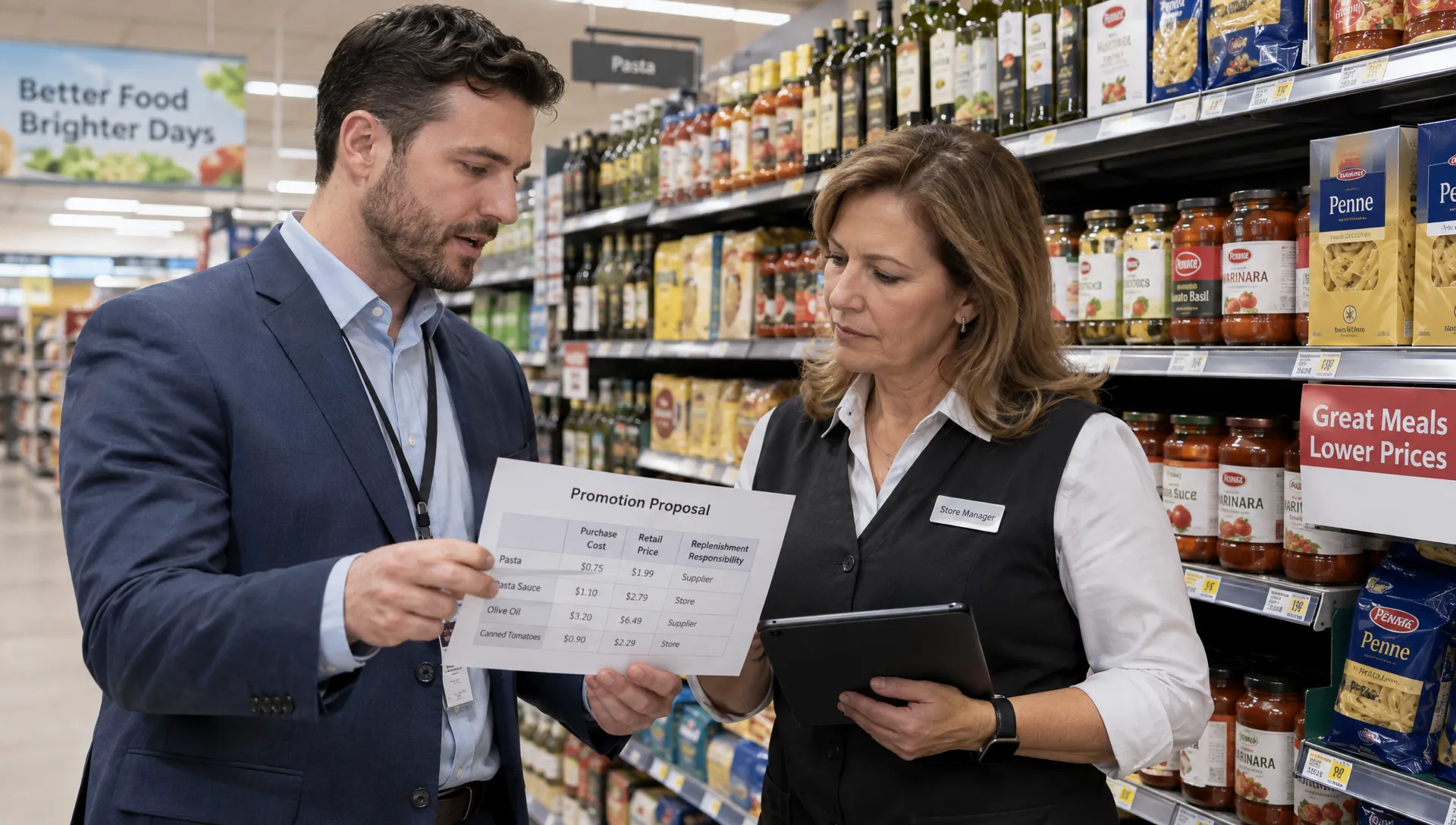
Give the salesperson an account brief with recent orders, current terms and a proposed promotion. Give the buyer separate information: stockroom space is constrained, a previous display was difficult to maintain or another stakeholder must approve the activity. The buyer reveals those details when the salesperson asks relevant questions.
For finance-focused role preparation, CFOLab’s customer stories provide Dutch-language accounts of businesses working with CFO support. Facilitators can use these narratives as background for financially minded stakeholder roles, while keeping any invented retail figures clearly labeled as hypothetical.
FMCG sales training scenarios should create a genuine decision: proceed, revise the proposal, request more information or decline an unworkable deal. Do not make closing the sale the only acceptable outcome.
Combine business decisions with conversation rehearsal
Business simulations can provide a setting for learners to make commercial decisions and examine their consequences. Facilitator-led buyer conversations can then help learners explain those decisions, respond to objections and revise their assumptions.
These activities serve related but different purposes. A decision exercise may expose weak commercial reasoning; a role-play may reveal that a learner understands the economics but cannot explain them clearly to a customer.
The value of combining sales and marketing training with simulations is the opportunity to connect choices, feedback and another attempt. Use a debrief to identify what the learner assumed, what the buyer revealed and why the recommendation changed or remained unchanged.
Coach observable behaviors after the exercise
A coaching scorecard should describe evidence, not personality. “Confident” and “engaging” are too broad to explain whether a customer conversation improved.
| Behavior | Evidence the coach should look for |
|---|---|
| Diagnoses the problem | Separates the buyer’s stated request from the underlying constraint |
| Uses account information | Checks assumptions and identifies missing data |
| Explains commercial value | Connects the proposal to relevant economics and execution needs |
| Negotiates responsibly | Makes conditional proposals within approval limits |
| Secures a clear next step | Confirms owners, timing and review criteria |
Score each behavior as not demonstrated, partially demonstrated or consistently demonstrated. Then ask the learner to repeat the weakest part of the conversation with one specific adjustment.
The most useful feedback in FMCG sales training is precise: “You offered a discount before asking why the previous promotion failed.” It gives the learner a behavior to change. “Be more consultative” does not.
Managers can use the same scorecard during joint customer visits. For recorded conversations, follow company policy and applicable consent requirements. Otherwise, use observation notes or an immediate post-meeting review.
Measure transfer, not just course completion
Completion rates and learner satisfaction show participation, but they do not establish whether customer conversations changed. Start with a baseline observation, then review comparable meetings after training.
Look for evidence that representatives test account hypotheses, discuss customer economics accurately and document executable commitments. Commercial indicators might include repeat orders, promotional execution, avoidable returns or margin quality, depending on the role and available data.
Interpret results in context. Seasonality, distribution changes, competitor activity and supply constraints can affect performance independently of training. Avoid attributing every improvement or decline to the program.
Sustained FMCG sales training requires managers to reinforce the same behaviors outside the classroom. A short review after a customer visit can identify the question that uncovered a constraint, the assumption that proved wrong and the next conversation that needs preparation.
Frequently asked questions
What should FMCG sales training cover? It should connect customer discovery with account economics, availability, promotional execution and negotiation. The emphasis should vary by role: field representatives need practical store-level conversations, while key account teams may need more detailed assortment and trade investment discussions.
How can sales teams practice retailer objections? Give the buyer a realistic reason behind the objection and require the salesperson to uncover it. Rehearse more than one response path, including revising the proposal or pausing until essential information is available.
How do you know whether the training worked? Compare observed behaviors before and after training, then examine relevant commercial outcomes with their context. A higher close rate alone does not show better selling if it comes with excessive concessions or unsold stock.
Build a program around the conversations your team needs
Start with a recurring customer challenge, define the behaviors needed to handle it and design practice that makes those behaviors visible.
Explore StratX Simulations for experiential business simulation software across marketing, strategy, sales and innovation. Its corporate and academic formats, instructor training and support, and learner feedback can support a program that connects commercial decisions with hands-on learning.