Every product marketing plan looks obvious after the fact. The target segment, the launch message, the price point, the sales narrative, and the channel mix all seem logical once the market has responded.
Before that response arrives, product marketers operate in a world of constraints. Budgets are limited. Sales teams need clarity. Product teams want feature emphasis. Executives want growth. Customers have competing needs. Competitors are moving. There is never enough time, data, or money to do everything.
That is why tradeoffs are not a side effect of product marketing. They are the work.
The strongest product marketing skills are built when learners and teams must choose between good options, not just identify the obvious bad ones. A product marketer who can make a disciplined tradeoff can explain who the product is for, what promise matters most, which proof points deserve attention, and where the company should focus its go-to-market energy.
Why Tradeoffs Build Better Product Marketers
Product marketing sits between market insight, product strategy, positioning, sales enablement, and demand generation. Because it connects so many functions, it is easy for product marketing to become a collection of requests. Add this feature to the launch deck. Mention this audience in the campaign. Support this event. Create one more sales asset.
Tradeoffs force product marketers to move from activity to strategy.
A tradeoff asks a simple but demanding question: if we choose this, what are we choosing not to do? That question turns product marketing from a communication function into a decision-making discipline.
This mirrors a classic strategy principle: competitive advantage depends on choices. If a company tries to serve every customer, emphasize every benefit, and compete on every dimension, it usually becomes less distinct. Product marketing gives those strategic choices language, evidence, and market-facing execution.
| Product marketing tradeoff | What the marketer must decide | Skill being built |
|---|---|---|
| Target one segment or broaden the market | Which customers are most likely to adopt, pay, and advocate | Segmentation and prioritization |
| Lead with one core benefit or several | Which message creates the clearest reason to care | Positioning and messaging |
| Price for adoption or perceived value | How pricing supports growth, margin, and brand perception | Commercial judgment |
| Invest in awareness or sales enablement | Where limited resources will remove the biggest growth constraint | Go-to-market planning |
| Respond to feedback or stay the course | Which signals are meaningful and which are noise | Market learning and iteration |
Skill 1: Choosing the Customer Before Choosing the Message
Many product marketing mistakes begin with vague audience definition. If the target is everyone, the message becomes generic. If the message is generic, sales teams struggle to create urgency. If urgency is weak, campaigns become more expensive and harder to measure.
Making tradeoffs teaches product marketers to choose a primary customer segment before finalizing positioning. That choice requires more than demographics or firmographics. It demands judgment about need intensity, buying power, switching costs, category awareness, and competitive alternatives.
For example, a software product might appeal to enterprise teams, small businesses, and independent professionals. Each audience may value the product differently. Enterprise buyers may care about governance and integration. Small businesses may care about speed and simplicity. Independent professionals may care about price and ease of use.
A product marketer cannot lead with all three at once without weakening the message. The tradeoff builds the skill of choosing the audience where the product has the strongest right to win.
This is also why product marketing education benefits from realistic market decisions. Learners need to feel the pressure of choosing a target and seeing the consequences, not simply discussing segmentation in theory. StratX has explored this idea in more depth in its article on how to teach product strategy through real market decisions, where market choices become the foundation for strategic learning.
Skill 2: Turning Positioning Into Practical Choices
Positioning is often presented as a statement. In practice, it is a sequence of tradeoffs.
Should the product be framed as premium or accessible? Innovative or reliable? Specialized or versatile? Built for experts or easy for beginners? Each choice affects copy, creative direction, sales conversations, pricing expectations, competitive comparisons, and even roadmap priorities.
The skill product marketers build here is not just writing a positioning statement. It is understanding the operational consequences of that statement.
A positioning choice should answer questions such as:
- Which customer pain point deserves the first sentence?
- Which competitor comparison should sales teams be ready to handle?
- Which proof point best supports the promise?
- Which feature should be de-emphasized because it distracts from the main value?
- Which category language will help buyers understand the product fastest?
These decisions are difficult because many messages may be true. The challenge is deciding which truth matters most to the market.
Great product marketers learn that clarity often comes from subtraction. A sharper message usually means removing secondary ideas so the primary promise can land.
Skill 3: Balancing Product Features With Customer Outcomes
Product teams naturally care about features. They invested time, expertise, and resources to build them. Customers, however, usually care about outcomes. They want to reduce risk, save time, grow revenue, improve confidence, gain status, or solve a persistent problem.
The product marketing tradeoff is deciding how much of the story should focus on what the product does versus what the customer achieves.
Too much feature language can make a launch feel technical and inward-looking. Too much outcome language without specifics can feel vague. Strong product marketers learn to connect the two: feature, proof, outcome.
For example, instead of saying a platform has advanced analytics, the product marketer may frame the value as faster decision-making with clearer visibility into performance. The feature is still present, but it is translated into a customer-relevant benefit.
This skill matters especially in competitive markets where many products claim similar capabilities. The winning message is rarely the longest list of features. It is the clearest explanation of why the product matters now.
Skill 4: Making Pricing and Packaging Decisions With Market Consequences
Pricing is one of the most important product marketing tradeoffs because it affects perception as much as revenue.
A lower price may reduce friction and support adoption, but it can also signal lower value. A higher price may reinforce a premium position, but it can narrow the market and increase the burden on proof points. Packaging decisions create similar tensions. Bundling more capabilities may increase perceived value, while simpler packaging may reduce confusion and accelerate buying decisions.
Product marketers do not always own pricing alone, but they should understand how pricing interacts with positioning, buyer expectations, competitive alternatives, and sales objections.
A team that practices pricing tradeoffs develops sharper commercial judgment. They learn to ask whether the pricing model supports the story the company is telling. They also learn to anticipate how customers will interpret the offer.
This is where product marketing moves beyond communication. It becomes a bridge between customer psychology and business economics.
Skill 5: Prioritizing Launch Channels and Market Moments
A launch can fail because the product is weak, but it can also fail because attention was spread too thin. Product marketers must decide where the launch will create the strongest signal: customer communities, sales outreach, analyst relations, paid media, events, partner channels, content, or existing customer advocacy.
Each channel has a different job. Events can create energy and credibility. Paid campaigns can test message-market fit quickly. Sales enablement can improve conversion in active deals. Customer advocacy can reduce perceived risk. Content can educate buyers over time.
The tradeoff is not simply which channel is best. It is which channel best matches the launch objective.
Even a high-impact event-led strategy involves product marketing judgment. A distinctive brand moment can generate attention, as a world-record event producer can demonstrate through memorable champagne pyramid experiences, but the marketer still has to decide whether that attention supports the product story, audience, and commercial goal.
This is why channel planning should be practiced before real budgets are committed. If your learners are exploring campaign choices, the same decision logic appears in marketing and advertising decisions worth practicing, especially when teams must connect objectives, audiences, and spend.

Skill 6: Reading Feedback Without Chasing Every Signal
Once a product enters the market, feedback arrives quickly. Sales teams report objections. Campaign data shows uneven performance. Customers ask for missing features. Competitors adjust their messaging. Executives want interpretation.
The product marketing skill is not collecting feedback. It is deciding what the feedback means.
Tradeoffs build this skill because every response option has a cost. If the team changes the message too quickly, it may abandon a strong strategy before the market has had time to absorb it. If the team ignores feedback for too long, it may miss clear evidence that the positioning is not working.
Strong product marketers learn to separate signal from noise by looking for patterns. One lost deal may be anecdotal. Ten similar objections across segments may indicate a positioning gap, pricing issue, product limitation, or sales enablement problem.
They also learn to connect qualitative and quantitative feedback. Campaign data may show where interest exists, but customer conversations explain why. Sales notes may identify objections, while conversion metrics reveal how much those objections matter.
For teams building this muscle, feedback loops are especially powerful when they happen in a safe environment. StratX’s perspective on performance marketing skills built through feedback shows how repeated decisions help learners interpret metrics, adjust hypotheses, and improve judgment over time.
Skill 7: Aligning Sales, Product, and Leadership Around a Clear Choice
Product marketing often fails quietly when internal alignment is weak. Sales may describe the product one way. Product may emphasize another. Leadership may expect a different market outcome. Campaigns may tell a fourth story.
Tradeoffs create alignment because they make assumptions visible.
When a product marketer says the launch will prioritize mid-market buyers over enterprise buyers, the sales team can respond with pipeline realities. When the marketer says the message will lead with efficiency rather than innovation, product leaders can discuss whether that reflects the roadmap. When the team chooses customer proof over feature depth, leadership can decide whether the launch goal is credibility, awareness, or conversion.
These conversations are not always easy, but they prevent scattered execution.
The skill being built is cross-functional influence. Product marketers need to defend recommendations with evidence while staying open to input from teams closer to customers, product constraints, or revenue goals.
A good tradeoff discussion does not end with everyone getting everything they wanted. It ends with everyone understanding what was chosen, why it was chosen, and how success will be measured.
How Simulations Help Product Marketers Practice Tradeoffs
Real markets teach powerful lessons, but they can be expensive teachers. A poorly chosen target segment, unclear launch message, or misallocated budget can cost months of effort and real revenue.
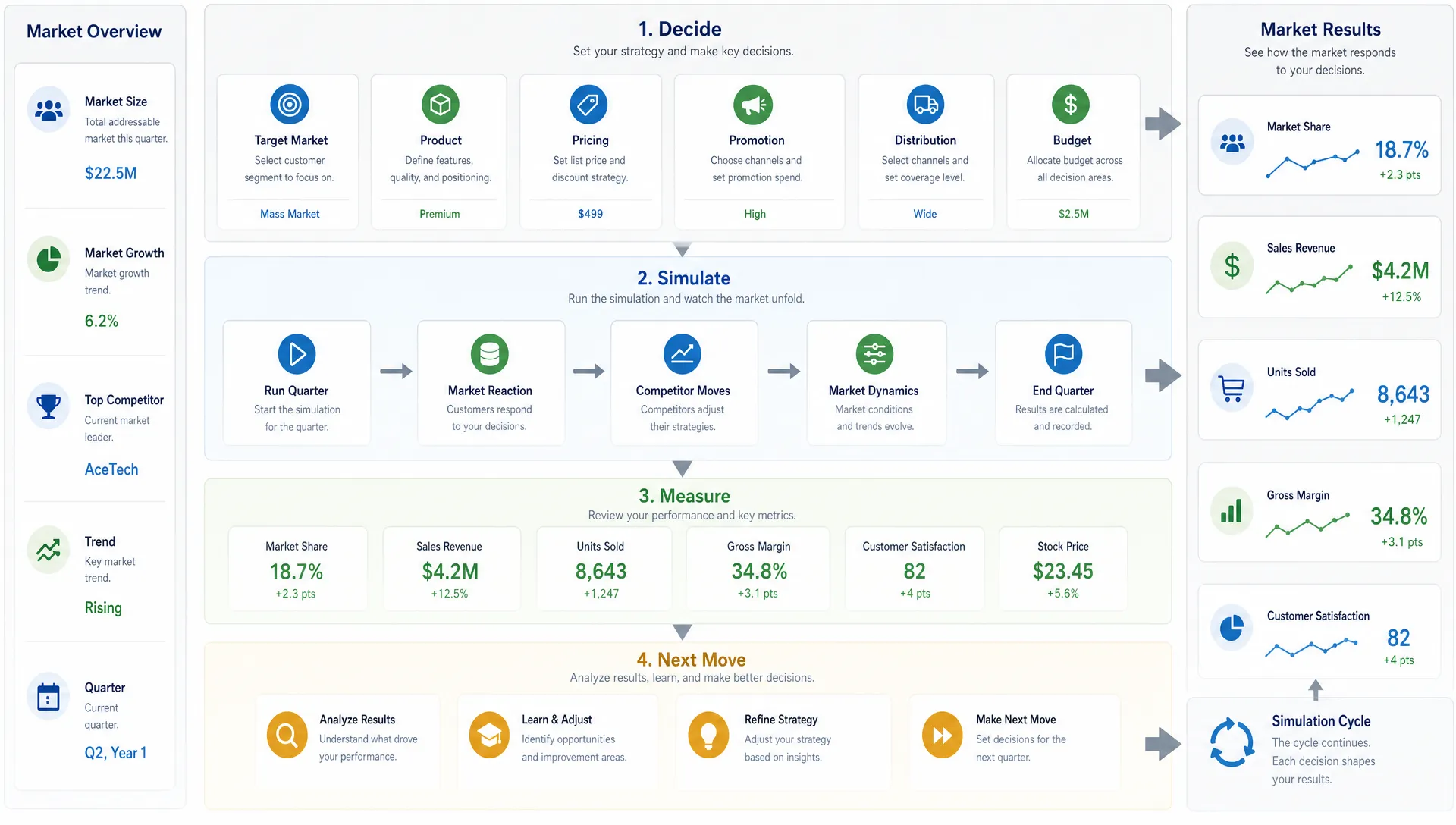
Business simulations give learners a way to practice product marketing tradeoffs before those consequences affect customers or company performance. They create a structured environment where teams can make decisions, receive feedback, compare outcomes, and try again.
This matters because product marketing judgment develops through repetition. Reading about positioning is useful. Discussing pricing is valuable. But making a pricing decision, seeing how the market responds, and then adjusting the next move creates a deeper learning loop.
In a simulation-based learning environment, product marketers can practice:
- Choosing segments under limited information
- Translating product capabilities into customer value
- Allocating budget across competing channels
- Responding to competitive moves
- Interpreting performance feedback
- Explaining decisions to stakeholders
The value is not that simulations remove complexity. It is that they make complexity teachable. Learners experience the pressure of tradeoffs, but in a setting designed for reflection and improvement.
For instructors and corporate training teams, this is especially useful because product marketing is hard to teach through lectures alone. Learners need to make choices, defend them, and see consequences unfold. That is where experiential business simulation software can turn abstract concepts into practical capability.
A Simple Tradeoff Exercise for Product Marketing Learners
If you are designing a product marketing workshop, class session, or internal training exercise, start with one realistic constraint. Do not give teams unlimited budget, unlimited audiences, and unlimited time. The constraint is what makes the learning meaningful.
For example, ask teams to launch a new product with only one primary segment, one core message, and one dominant channel. Then require them to explain what they did not choose.
The debrief is where the learning becomes durable. Ask teams why they prioritized that segment, what customer insight shaped the message, what risk they accepted, and what early feedback would make them reconsider. This turns the exercise from a creative presentation into a product marketing decision review.
A strong debrief should focus on reasoning rather than whether there was one perfect answer. In real product marketing, there rarely is. The goal is to build marketers who can make a choice with incomplete information, learn from the result, and improve the next decision.
Frequently Asked Questions
What are the most important product marketing skills built through tradeoffs? The most important skills include segmentation, positioning, messaging, pricing judgment, launch planning, feedback interpretation, and cross-functional alignment. Tradeoffs strengthen these skills because they require marketers to prioritize one path over another and explain the reasoning behind that choice.
Why are tradeoffs important in product marketing? Tradeoffs prevent product marketing from becoming too broad or generic. They help teams decide who the product is for, what message matters most, which channels deserve investment, and how success should be measured.
How can product marketing tradeoffs be taught effectively? They are best taught through active decision-making exercises, simulations, case discussions, and debriefs. Learners need to experience constraints, make choices, see outcomes, and reflect on what they would change.
Can simulations improve product marketing training? Yes. Simulations allow learners to practice realistic market decisions without risking real budgets or customer relationships. They help participants connect strategy, execution, feedback, and iteration in a hands-on learning environment.
Build Product Marketing Judgment Through Practice
Product marketing skills do not develop only by learning frameworks. They develop when marketers practice making hard choices and understand the consequences of those choices.
For educators and corporate training teams, the opportunity is to create learning environments where tradeoffs are unavoidable, feedback is immediate, and reflection turns decisions into skill. StratX Simulations supports that kind of experiential learning through business simulation software for marketing, strategy, sales, and innovation.
If you want learners to build sharper product marketing judgment, give them more than concepts to remember. Give them meaningful tradeoffs to make.