Corporate learning management has become much more than assigning courses and tracking completions. L&D teams are now expected to build skills that show up in real work: sharper decisions, stronger collaboration, better commercial judgment and faster adaptation to changing markets.
That is where simulations change the role of learning management. A learning management system can organize content, enroll participants and record progress. A business simulation adds the practice environment where learners make decisions, see consequences and improve through feedback. Together, they move corporate learning from administration to capability building.
For companies investing in leadership, sales, marketing, strategy or innovation training, simulations help answer a practical question: are employees simply finishing training, or are they learning to perform better?
Why corporate learning management needs more than content delivery
Most corporate learning programs are built around useful but limited activities: e-learning modules, classroom sessions, webinars, reading materials and assessments. These formats can transfer knowledge efficiently, especially for compliance or policy training. The challenge is that business performance rarely depends on knowledge alone.
A sales leader may understand negotiation theory but struggle when a customer pushes back on price. A marketing manager may know how segmentation works but make weak tradeoffs under budget constraints. A cross-functional team may know the company strategy but fail to align when market conditions change.
Corporate learning management improves when it gives people a place to practice these moments before they face them in the market. Simulations create a structured environment where learners can test decisions without risking revenue, customer relationships or brand equity.
This matters because many of the skills companies need are judgment-based. They require learners to interpret incomplete data, collaborate with peers, make tradeoffs and reflect on outcomes. A slide deck can explain those behaviors, but a simulation makes learners use them.
What simulations add to corporate learning management
Simulations strengthen corporate learning management by adding an experiential layer to the learning journey. They do not replace learning systems, facilitators or content libraries. They make those elements more effective by turning concepts into decisions.
Practice that mirrors real business complexity
In a simulation, learners are not only asked what they remember. They are asked what they would do. That shift is powerful.
A team might need to decide how to position a product, allocate budget across channels, respond to competitors or manage a customer negotiation. Each decision forces participants to apply concepts in context. They need to weigh short-term gains against long-term consequences, balance customer needs with business constraints and justify their choices to peers.
This is especially valuable in areas such as marketing strategy, digital marketing, sales, negotiation, brand management and innovation. These disciplines involve interdependent decisions, which means a choice in one area affects outcomes elsewhere. Simulations make those connections visible.
Feedback that supports faster learning cycles
Traditional training often delays feedback. Learners complete a course, take a quiz and move on. In simulation-based learning, feedback is built into the experience. Participants see the impact of their decisions and can connect results to the reasoning that produced them.
That feedback loop supports the learning cycle described by David Kolb: experience, reflection, conceptualization and experimentation. Learners try something, review what happened, adjust their thinking and test a better approach.
This is one reason simulations fit well into modern corporate learning management. They create measurable learning moments throughout the program rather than relying only on end-of-course evaluation.
Engagement that goes beyond attendance
Completion rates can look healthy even when engagement is low. People may attend a session, click through a module or pass a basic quiz without changing how they work.
Simulations raise the level of involvement because learners have to participate. They need to debate options, make decisions, respond to outcomes and explain tradeoffs. For cohort-based training, this creates a shared challenge that keeps energy high across in-person, virtual or blended formats.
If you want a deeper look at this broader training impact, StratX Simulations has also covered how simulations enhance corporate training through practice, feedback and retention.
From learning administration to performance enablement
The biggest improvement simulations bring to corporate learning management is a change in what gets managed. Instead of managing only content access and attendance, L&D teams can manage skill development, decision quality and application.
| Learning management area | Content-led approach | Simulation-enhanced approach |
|---|---|---|
| Program objective | Deliver information | Build practical capability |
| Learner role | Consume content | Make decisions and reflect |
| Feedback | Usually quiz-based or facilitator-led | Built into the decision cycle |
| Measurement | Completion, attendance and scores | Decisions, outcomes, participation and transfer |
| Manager involvement | Often before or after training | Can connect simulation insights to workplace coaching |
| Business relevance | Depends on content quality | Strengthened by realistic scenarios and tradeoffs |
This does not mean every topic needs a simulation. Compliance training, system walkthroughs and policy refreshers may not require complex practice. Simulations are most valuable when the learning goal involves judgment, behavior change or cross-functional decision-making.
How simulations improve each stage of the learning journey
Corporate learning management covers the full journey, from identifying needs to proving impact. Simulations can improve each stage when they are integrated intentionally.
Needs analysis becomes more practical
A common weakness in corporate training is defining learning needs too broadly. A team may say it needs better strategic thinking, stronger sales capability or more customer orientation. Those goals are valid, but they are hard to train or measure unless they are translated into observable decisions.
Simulations help L&D teams clarify what people must actually do differently. For example, better strategic thinking might mean prioritizing market segments, anticipating competitor moves or allocating resources under uncertainty. Stronger sales capability might mean diagnosing customer needs, managing value conversations or negotiating without unnecessary discounting.
Once the target decisions are clear, learning design becomes more focused.
Program design becomes more active
Simulations work best when they are not treated as an add-on activity at the end of a course. They should be connected to the learning objectives, facilitator debriefs and workplace application.
A strong design usually includes a short concept introduction, simulation rounds, reflection, team discussion and application planning. The balance depends on the audience and program length. Senior leaders may need more strategic complexity, while early-career managers may benefit from clearer scaffolding and more guided reflection.
For teams building a new experience, the principles in how to design a corporate training simulation that works are useful because they start with real decisions rather than generic learning activities.
Facilitation becomes more diagnostic
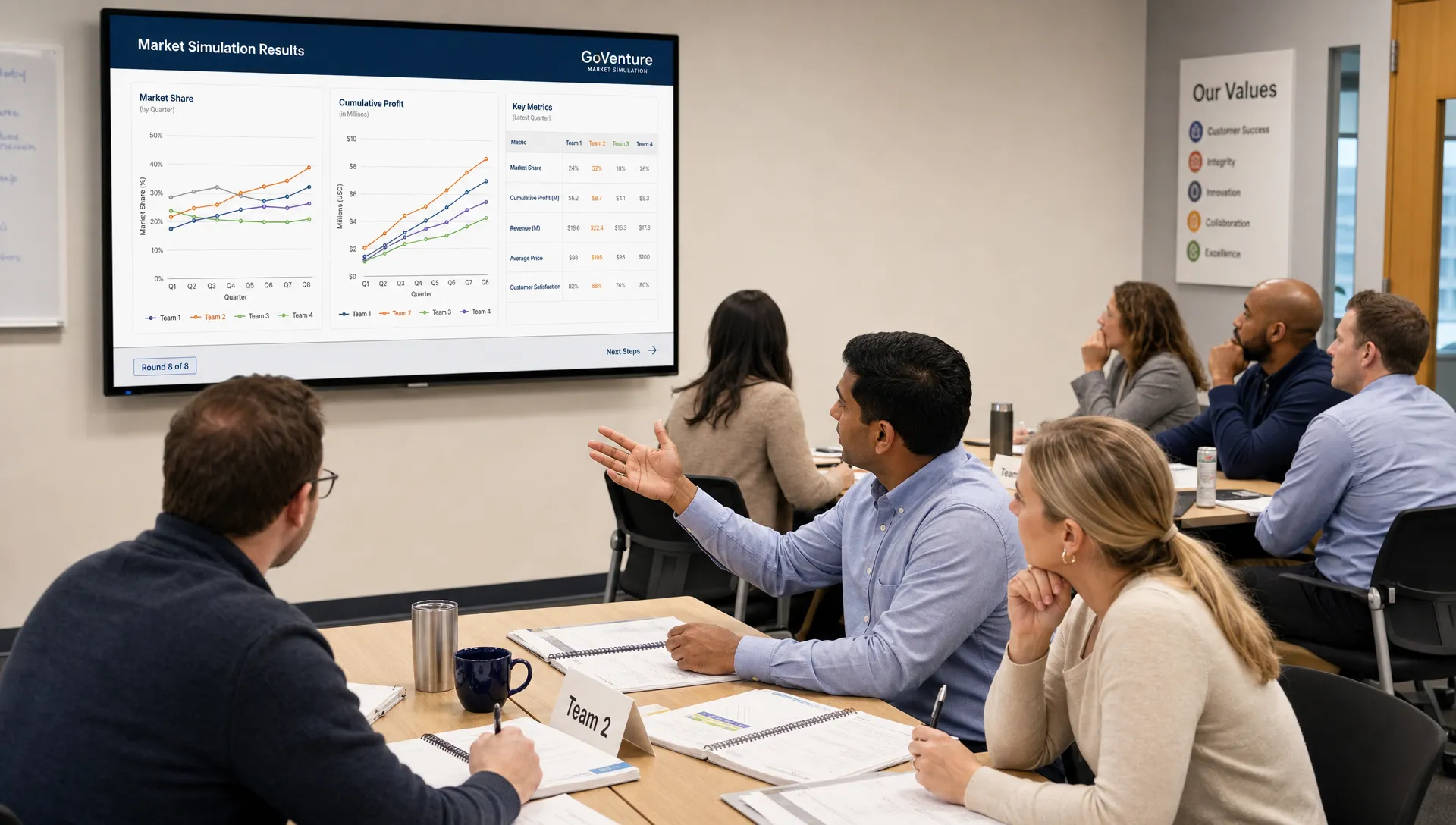
In a lecture, the facilitator often explains the right model or method. In a simulation, the facilitator can observe how learners think. That creates a richer coaching opportunity.
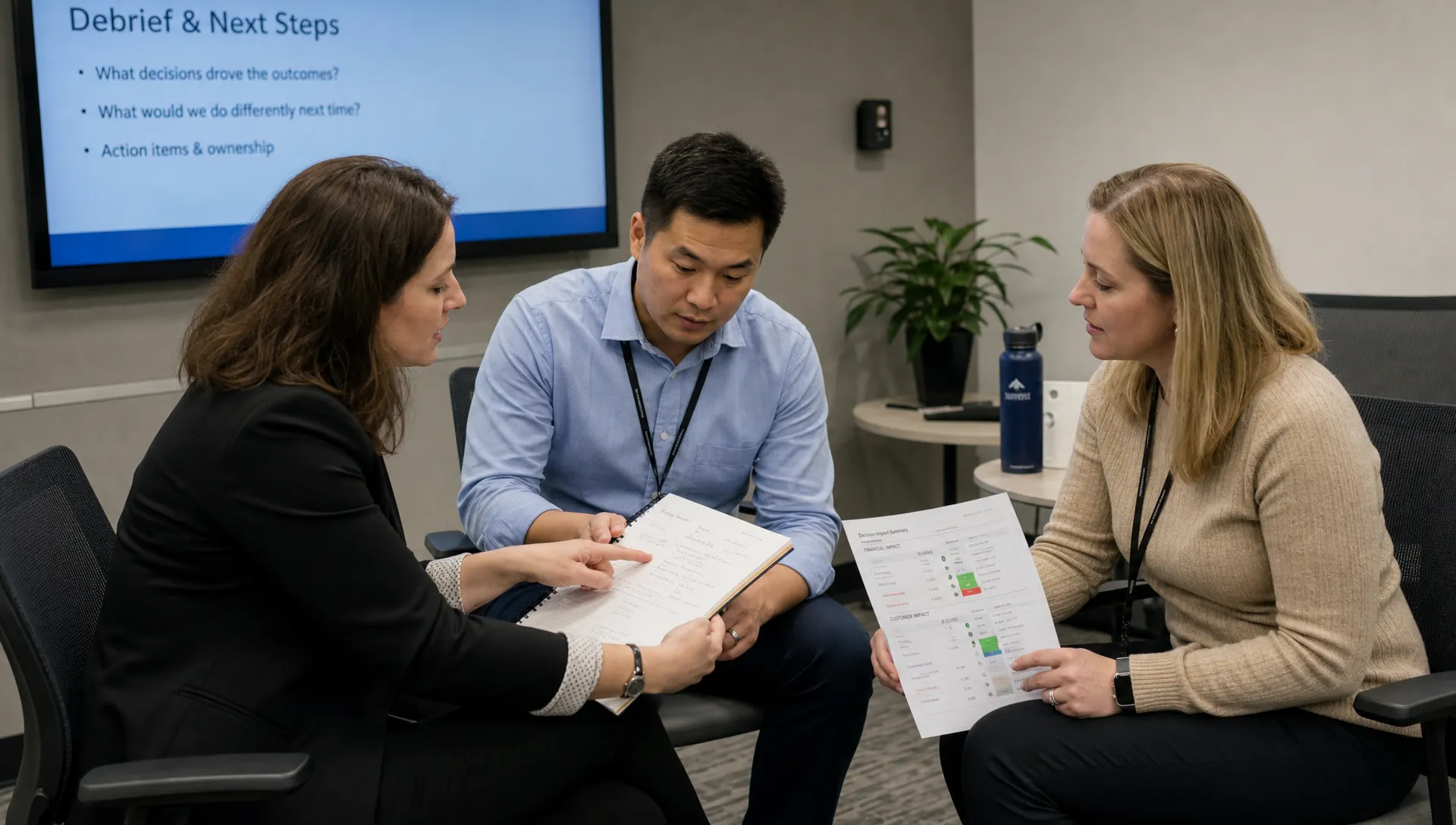
Facilitators can ask why a team chose a strategy, how they interpreted market signals, what assumptions they made and what they would do differently. The debrief becomes the learning moment where participants connect simulation outcomes to business principles.
This is particularly helpful for corporate cohorts with mixed functions. Sales, marketing, finance and product teams may interpret the same situation differently. A simulation gives them a shared case and a common language for discussing tradeoffs.
Communication and administration become smoother
Learning management is not only instructional design. It also includes the practical work of informing participants, aligning managers, preparing facilitators and following up after the program.
Clear communication affects adoption. Participants need to understand why the simulation matters, what preparation is expected and how the experience connects to business goals. Managers need to know how to support transfer after the session. For formal communications such as participant invitation letters, manager nomination notes or post-program follow-ups, an AI letter generator can help L&D teams draft polished first versions before tailoring them to company context.
The point is not to automate the learning strategy. It is to reduce administrative friction so L&D teams can spend more time on design, facilitation and impact.
Better measurement: from completion to capability
One of the strongest advantages of simulation-based corporate learning management is richer measurement. Instead of relying only on attendance and satisfaction surveys, L&D teams can observe how learners behave inside the experience.
The best measurement strategy combines several types of evidence. Completion data still matters, but it should sit alongside decision patterns, reflection quality, facilitator observations and post-program application.
| Measurement question | Useful evidence |
|---|---|
| Did learners participate? | Attendance, completion and activity logs |
| Did they understand the concepts? | Quizzes, discussions and reflection responses |
| Did they apply judgment? | Simulation decisions, tradeoffs and team rationale |
| Did they improve during the experience? | Changes across rounds, feedback response and debrief insights |
| Did learning transfer to work? | Manager check-ins, action plans and business project outcomes |
This approach aligns with the logic of the Kirkpatrick Model, which separates reaction, learning, behavior and results. Simulations are useful because they create evidence across several levels. Learners react to the experience, demonstrate learning through decisions, practice behaviors during the exercise and connect outcomes to business performance.
L&D teams should be careful not to overclaim direct business impact from a single training event. Many factors influence sales growth, customer retention or market performance. Still, simulations can provide stronger leading indicators than passive content alone.
Practical ways to integrate simulations into corporate learning management
A simulation becomes more valuable when it is embedded into the broader learning system rather than managed as a one-off event. The exact approach depends on the organization, but several practices consistently improve results.
Start by mapping the simulation to a specific capability. Avoid vague goals such as improving leadership or becoming more strategic. Define the decisions learners need to practice and the behaviors facilitators should observe.
Prepare participants before the simulation begins. This does not need to be heavy. A short pre-read, diagnostic survey or kickoff session can help learners arrive with the right context. If the simulation is part of a larger program, connect it to previous modules so the experience feels like a continuation rather than a separate exercise.
Use the debrief as the bridge between simulation and workplace application. The debrief should not only review winners and scores. It should unpack assumptions, tradeoffs, team dynamics and decision quality. This is where participants turn activity into insight.
Involve managers after the program. A simple follow-up conversation can help participants apply what they learned to current business priorities. Managers do not need every detail of the simulation, but they should understand the target capability and the action commitments learners made.
For a step-by-step view of adoption, see this practical guide to adding simulations into your learning programs, which explains how to connect simulations with objectives, program flow and learner engagement.
Where simulations fit best in corporate learning portfolios
Simulations are not the right tool for every learning need. They are most effective when the cost of poor judgment is high, the skill requires practice or the organization needs people to align around complex tradeoffs.
Strong use cases include strategic decision-making, marketing planning, sales and negotiation training, customer-centricity, innovation, business acumen and leadership development. These are areas where learners benefit from seeing consequences unfold in a realistic but safe environment.
They also work well when corporate learning management needs to serve different audiences. An academic-style lecture may not engage experienced managers. A generic e-learning course may not challenge senior leaders. A well-facilitated simulation can be adapted to the depth, pace and context of the audience without losing the core learning goal.
For organizations using business simulation software, online accessibility and instructor support are also important. L&D teams need experiences that are manageable for facilitators, clear for participants and flexible enough for corporate or academic formats.
How StratX Simulations supports experiential corporate learning
StratX Simulations focuses on experiential business simulation software for marketing, strategy, sales and innovation. For corporate learning teams, the value lies in giving participants a realistic environment where concepts become decisions and feedback helps those decisions improve.
This approach supports corporate learning management by making programs more engaging, easier to connect to business skills and more useful for facilitator-led reflection. Rather than treating learning as a content library alone, simulations help organizations build practical capability through hands-on experience.
Frequently Asked Questions
How do simulations improve corporate learning management? Simulations improve corporate learning management by adding active practice, realistic decision-making and feedback to the learning journey. They help L&D teams move beyond completion tracking and focus more on capability, behavior and business application.
Can simulations be used with an existing LMS? Yes. Many organizations use simulations alongside their existing learning management systems. The LMS can manage enrollment, communication and records, while the simulation provides the experiential practice component.
Which corporate training topics benefit most from simulations? Simulations are especially useful for topics that require judgment and decision-making, such as marketing strategy, sales, negotiation, innovation, business acumen and leadership development.
Are simulations only for senior leaders? No. Simulations can support different learner levels when the design matches the audience. Senior leaders may need complex strategic scenarios, while managers or early-career professionals may benefit from more guided exercises and structured debriefs.
How should L&D teams measure simulation impact? L&D teams can measure participation, decision quality, feedback response, reflection quality and workplace application. The strongest evaluation combines simulation data with facilitator observations, manager follow-up and post-program action plans.
Build learning programs that people can practice, not just complete
Corporate learning management improves when training helps people make better decisions in realistic conditions. Simulations bring that practice into the learning environment, giving teams a safe space to test ideas, receive feedback and connect concepts to business outcomes.
If your organization wants to strengthen learning in marketing, strategy, sales or innovation, explore how StratX Simulations can support experiential programs that make business concepts stick.