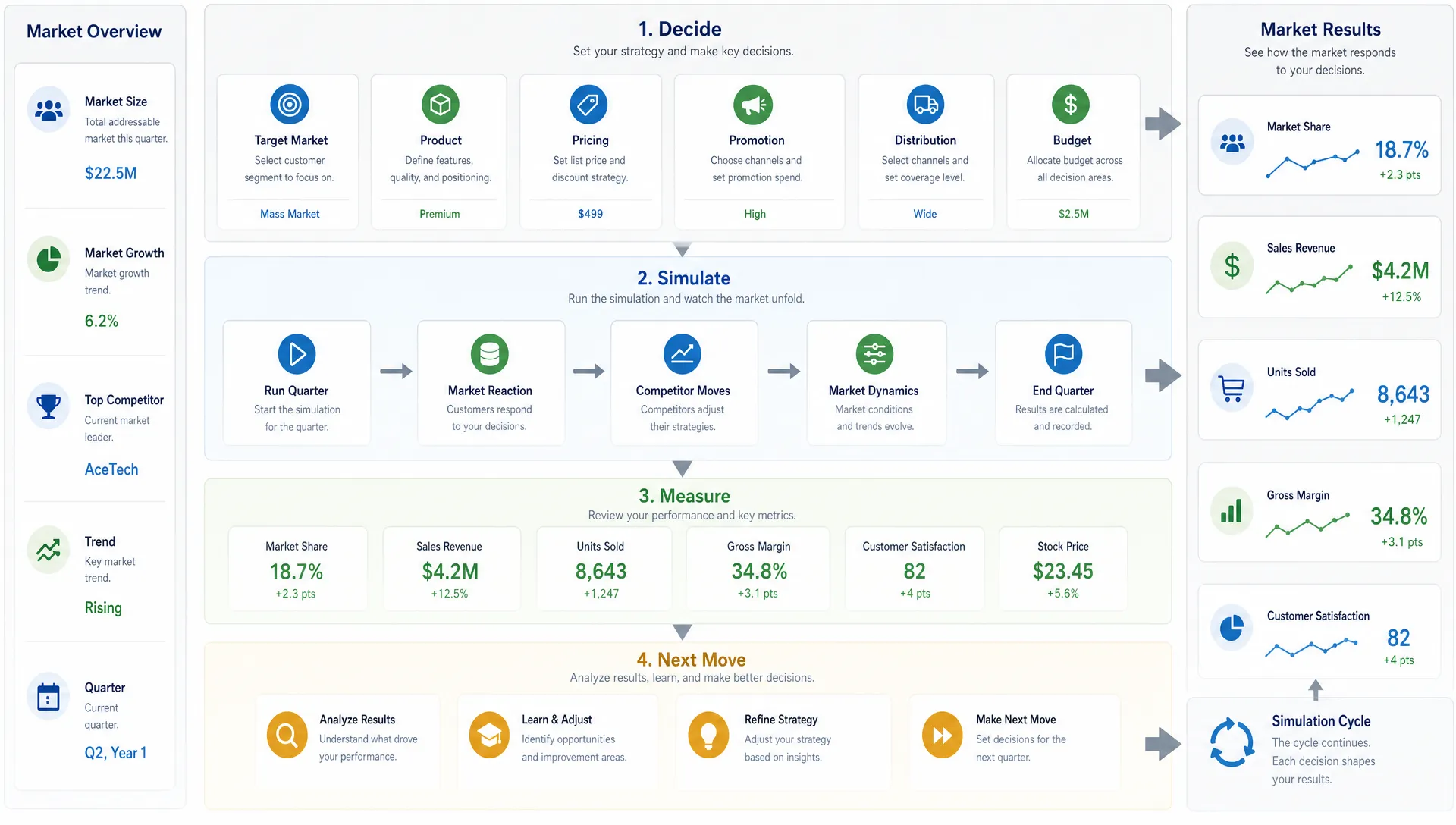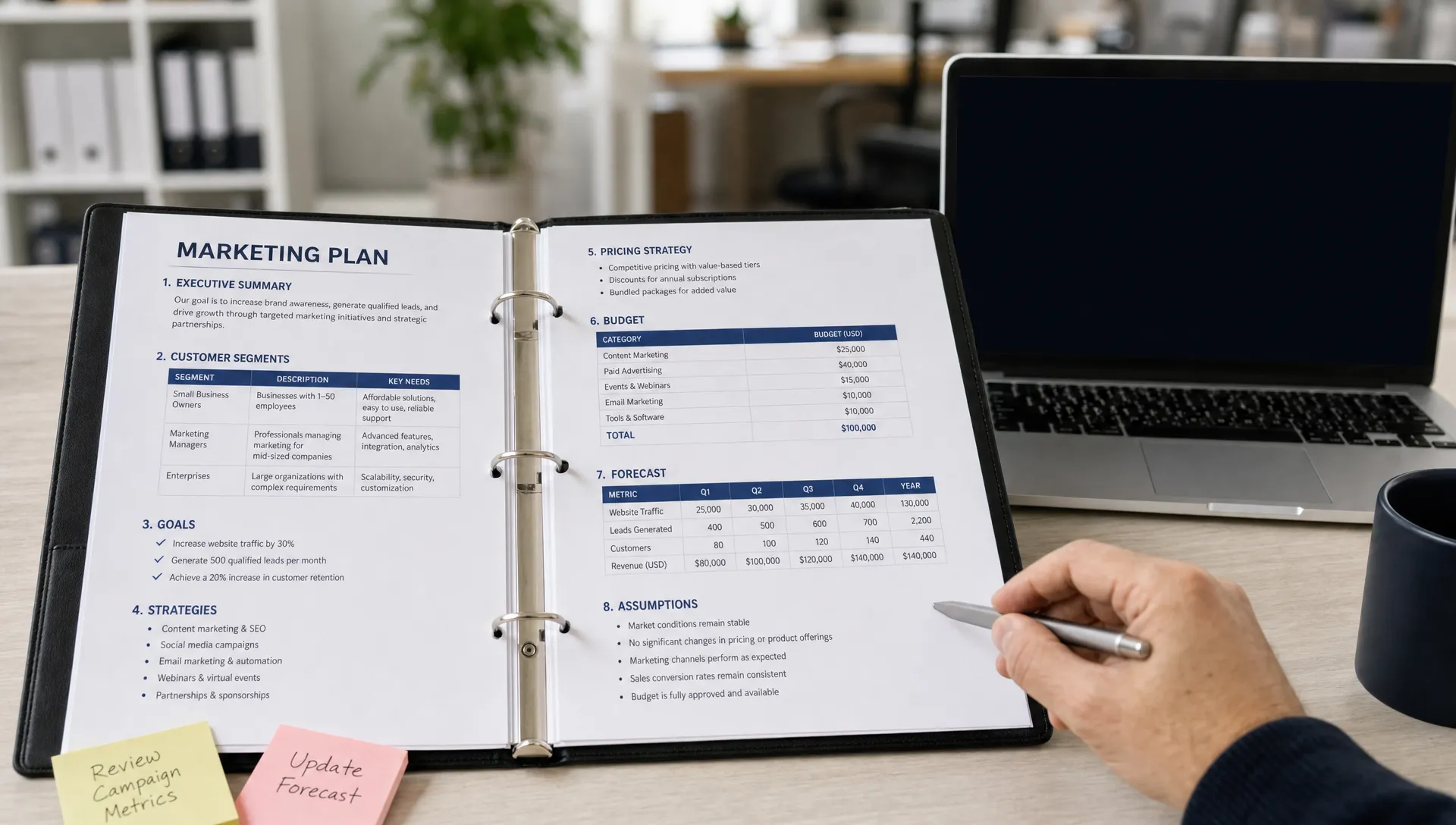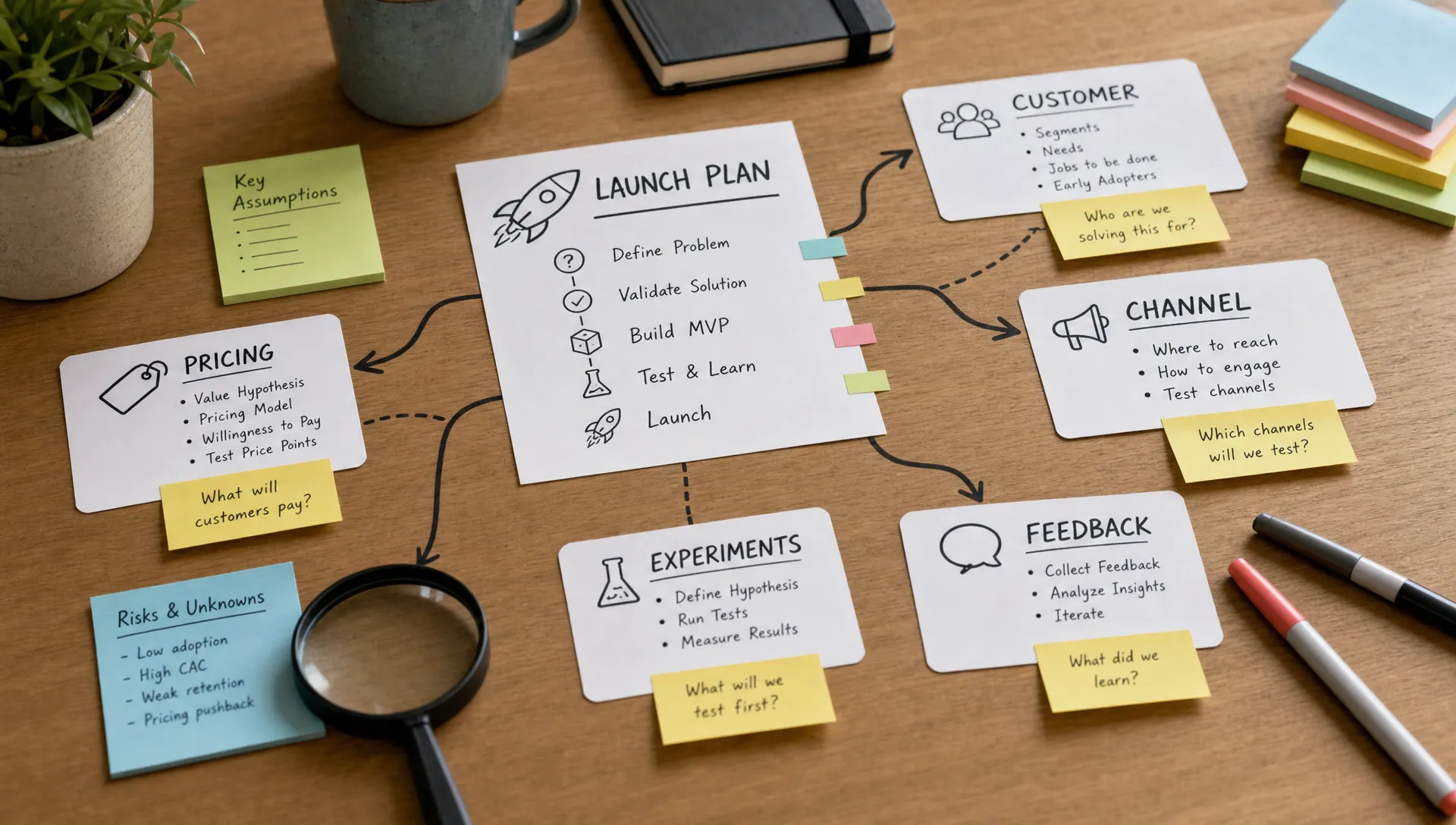
Students often understand the pieces of a marketing plan in isolation: segmentation, positioning, pricing, channels, budgets, and KPIs. The hard part is learning how those pieces fit together as a sequence of decisions.
That is why a strong marketing plan example is so useful in the classroom. It gives students a model they can critique, improve, and test. Instead of memorizing a template, they can see how marketing logic works from the first market insight to the final performance metric.
Below is a practical, classroom-ready example built around a fictional product. The numbers, assumptions, and market details are illustrative, so instructors can adapt them to a course, simulation, case discussion, or group project.
What Makes This Marketing Plan Example Useful for Students
A good student marketing plan should not be a collection of disconnected slides. It should tell a clear strategic story: what opportunity exists, who the brand will serve, what promise it will make, how it will reach the market, and how success will be measured.
The example below is designed to help students practice five important habits:
- Turning research into decisions, not just summaries
- Choosing a target segment instead of trying to serve everyone
- Connecting positioning to product, price, place, and promotion
- Making budget tradeoffs based on objectives
- Defining KPIs that reveal whether the plan is working
For instructors, this type of example works best when students are asked to defend their choices, compare alternatives, and revise their plan after receiving feedback. That is where marketing becomes an applied discipline rather than a theoretical checklist.
Scenario: Launching a Fictional Student Coffee Brand
For this marketing plan example, imagine a fictional company called Campus Brew. It sells ready-to-drink cold coffee in cans and wants to launch a new product on and around university campuses during one academic semester.
The product is not based on a real company. It is intentionally simple so students can focus on the quality of the marketing decisions rather than getting lost in industry complexity.
| Planning assumption | Classroom scenario |
|---|---|
| Product | Ready-to-drink canned cold coffee |
| Market | University students and young campus staff |
| Geography | Three campuses in one metropolitan area |
| Time frame | 12-week semester launch |
| Budget | $35,000 for launch marketing |
| Distribution | Campus convenience stores, pop-up sampling, selected local cafes |
| Main challenge | Build trial and repeat purchase in a crowded beverage category |
The core teaching question is straightforward: how should Campus Brew use a limited budget to earn attention, trial, and repeat purchase among students?
Marketing Plan Example: Campus Brew
1. Executive Summary
Campus Brew will launch a ready-to-drink cold coffee product for time-pressed students who want a convenient energy boost between classes, study sessions, and part-time work. The brand will focus on a clear position: a campus-friendly coffee drink that feels more practical than a cafe visit and more enjoyable than a generic energy drink.
The launch will target students who already buy convenience beverages several times per week. The plan prioritizes sampling, campus retail visibility, student ambassador activity, and paid social media. Success will be measured through awareness, trial, repeat purchase, retail sell-through, and contribution margin after promotions.
This summary is short, but it does three things students should notice. It names the target, states the positioning, and previews how the plan will be measured.
2. Situation Analysis
Students often spend too much time describing the market and not enough time explaining what the description means. A stronger situation analysis turns observations into implications.
| Area | Observation | Marketing implication |
|---|---|---|
| Customer need | Students want convenient drinks during busy academic days | Emphasize portability, speed, and availability near study routines |
| Category behavior | Many students buy beverages impulsively | Retail visibility and sampling can influence trial |
| Competition | Coffee shops offer taste and ritual, while energy drinks offer stimulation | Position Campus Brew between coffee enjoyment and functional convenience |
| Internal constraint | The launch budget is limited | Focus on a small number of high-impact channels instead of broad media coverage |
| Purchase barrier | Students may not switch without tasting the product | Sampling should be central to the launch plan |
The point is not that these assumptions are universally true. The point is that each observation leads to a decision. In a student plan, every important research finding should answer the question, so what?
3. Target Market
Campus Brew will focus on a primary target segment: students aged 18 to 24 who spend long hours on campus, buy convenience drinks at least three times per week, and use coffee or caffeinated beverages to manage busy schedules.
A simple student persona might look like this:
| Persona element | Example |
|---|---|
| Name | Maya, second-year business student |
| Routine | Classes, group projects, part-time work, evening study |
| Beverage behavior | Buys coffee before class and convenience drinks between commitments |
| Pain point | Wants something quick, affordable, and available near campus |
| Buying trigger | Sampling, peer recommendation, visible placement near checkout |
The plan intentionally avoids targeting all students. A broad audience makes the plan look ambitious, but it often weakens the strategy. Students should be able to explain why the selected segment is attractive, reachable, and likely to respond.
4. Marketing Objectives
Objectives should be specific enough to guide action. In this example, the objectives are fictional but measurable.
| Objective | Why it matters | How it will be measured |
|---|---|---|
| Reach 12% aided awareness among surveyed students by week 12 | Awareness is necessary for a new campus product | Short student survey before and after launch |
| Sell 18,000 cans during the semester | Sales indicate whether trial activity converts | Retail sales and event sales data |
| Generate 6,000 sampled units | Sampling reduces the risk of first purchase | Sampling logs and event counts |
| Achieve 20% repeat purchase among loyalty signups | Repeat behavior signals product-market fit | Promo code and loyalty tracking |
| Maintain a positive contribution margin after promotions | Growth should not depend only on discounts | Unit margin calculation after trade and promo costs |
This section teaches students that objectives must match the stage of the product. A new launch needs awareness and trial, but it also needs signs of repeat behavior.
5. Positioning Statement
A positioning statement helps students make disciplined choices. For Campus Brew, the positioning could be:
For busy university students who need a quick coffee boost during the day, Campus Brew is a ready-to-drink cold coffee that combines cafe-inspired taste with campus convenience, because it is available where students already study, shop, and socialize.
This statement is useful because it includes the target, the need, the category, the differentiation, and the reason to believe. Students can use it as a filter for every later decision. If a tactic does not support this positioning, it should be questioned.
6. Marketing Strategy: Product, Price, Place, and Promotion
The marketing mix should show how the positioning becomes real in the market.
| Element | Decision | Rationale |
|---|---|---|
| Product | Offer two flavors at launch: classic cold brew and vanilla oat | A narrow launch simplifies operations and makes sampling easier |
| Price | Set a student-friendly price below the average cafe drink but above basic canned soda | The price supports convenience and taste without looking like a discount-only product |
| Place | Prioritize campus stores, vending-adjacent displays, library pop-ups, and local cafes near campus | Distribution follows student routines rather than relying only on destination shopping |
| Promotion | Use sampling, student ambassadors, social content, and limited-time bundle offers | The product needs trial, peer credibility, and repeated reminders |
Students should see that the 4Ps are not separate boxes. If the brand promises campus convenience, then distribution matters as much as advertising. If the brand promises better taste than a generic energy drink, then sampling becomes a strategic priority.
7. Channel and Campaign Plan
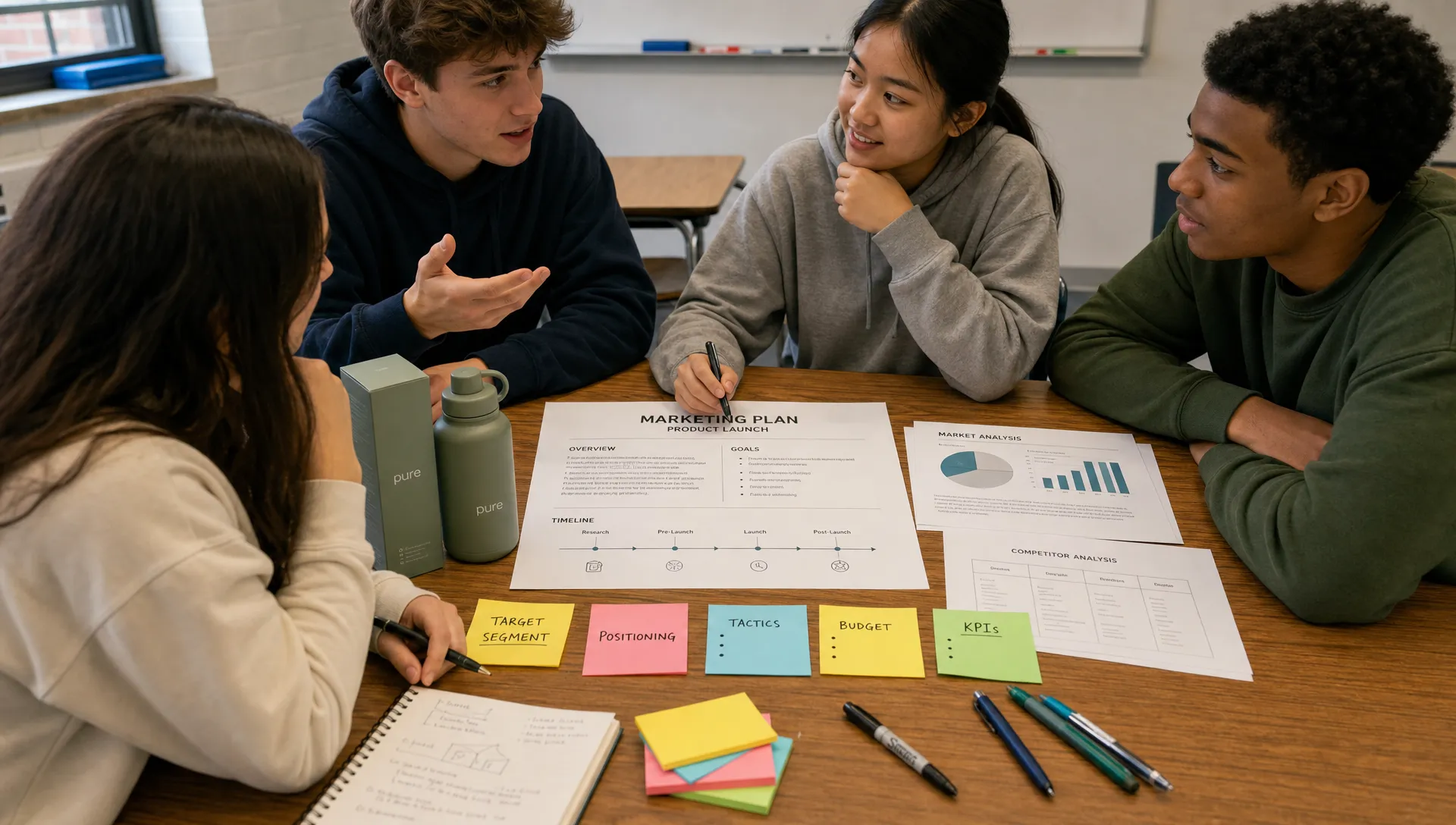
A campaign plan turns strategy into timing. For a 12-week semester launch, Campus Brew could organize activity around three phases: create awareness, drive trial, and encourage repeat purchase.
| Weeks | Focus | Example activities | Learning purpose |
|---|---|---|---|
| 1 to 2 | Pre-launch awareness | Teaser posts, campus ambassador recruitment, retail display setup | Build curiosity before sampling begins |
| 3 to 6 | Trial | Sampling tables, first-purchase promo codes, social proof from student ambassadors | Reduce uncertainty and encourage first purchase |
| 7 to 10 | Repeat purchase | Bundle offers, loyalty signups, study-week messaging | Move from trial to habit |
| 11 to 12 | Evaluation and optimization | Survey, sales analysis, budget review, final recommendations | Learn what worked and what should change |
If you want learners to go deeper on this part of the assignment, it helps to show them how to build a marketing campaign learners can test rather than simply ask for creative ideas. Testing forces students to define assumptions and compare outcomes.
8. Budget Allocation
A marketing budget reveals strategic priorities. In this example, Campus Brew invests heavily in sampling because the plan assumes tasting the product is the strongest path to trial.
| Budget item | Amount | Reasoning |
|---|---|---|
| Sampling events and materials | $8,000 | Supports the main trial objective |
| Paid social media | $9,000 | Reaches students with launch messages and retargeting |
| Student ambassadors | $5,000 | Adds peer credibility and campus presence |
| Retail displays and in-store promotion | $6,000 | Improves visibility at the point of purchase |
| Introductory discounts and bundles | $4,000 | Encourages first purchase and repeat purchase |
| Research and measurement | $2,000 | Funds surveys, tracking, and analysis |
| Contingency | $1,000 | Allows small adjustments during the launch |
| Total | $35,000 | Matches the classroom budget constraint |
This is where students learn an important lesson: a plan cannot prioritize everything. If they increase spending in one area, they must reduce it somewhere else. That tradeoff is not a weakness. It is the essence of strategy.
9. KPIs and Evaluation Plan
A strong plan defines what the team will learn, not just what it hopes will happen. Students should separate leading indicators, lagging indicators, and diagnostic indicators.
| KPI type | Example metric | What it tells students |
|---|---|---|
| Leading indicator | Sampling conversion rate | Whether trial activity is persuasive |
| Leading indicator | Social engagement from target campuses | Whether messages are reaching the intended audience |
| Lagging indicator | Total cans sold | Whether demand materialized |
| Lagging indicator | Repeat purchase rate among tracked customers | Whether the product can build habit |
| Diagnostic indicator | Sales by location | Which distribution points perform best |
| Diagnostic indicator | Promo code use by channel | Which channels influence purchase |
This distinction is valuable because students often rely on vanity metrics. Likes and impressions may be useful, but they are not enough. A marketing plan should connect attention to behavior and behavior to business outcomes.
10. Risks and Contingency Plan
Every marketing plan should acknowledge uncertainty. Students do not need to predict the future perfectly, but they should identify what could go wrong and how the team would respond.
| Risk | Warning sign | Possible response |
|---|---|---|
| Low sampling conversion | Many samples distributed but few purchases nearby | Change sampling location, revise offer, or adjust messaging |
| Weak retail visibility | Sales vary widely by store | Improve displays or negotiate better placement |
| Price resistance | Students try the product but do not repurchase | Test bundle pricing or loyalty incentives |
| Channel mismatch | Paid social engagement does not translate into sales | Shift budget toward ambassadors or point-of-purchase activity |
This section is often missing from student submissions, but it is one of the most realistic parts of the plan. Good marketers do not just launch. They monitor, learn, and adjust.
What Students Should Learn From This Example
The purpose of this marketing plan example is not to provide a perfect answer. It is to give students a structured model they can challenge. A strong classroom discussion might ask whether the target is specific enough, whether the budget is too sampling-heavy, or whether the repeat purchase objective is realistic.
The most important learning is that marketing planning is a chain of cause and effect. If the target changes, the positioning may change. If the positioning changes, the channel mix may change. If the channel mix changes, the budget and KPIs must change too.
| Common student mistake | Better marketing habit |
|---|---|
| Starting with tactics before strategy | Define the target and positioning first |
| Targeting everyone | Choose a segment that is attractive and reachable |
| Using SWOT without implications | Translate analysis into decisions |
| Listing channels without budget logic | Explain why each dollar is allocated |
| Measuring only awareness | Track trial, repeat purchase, and profitability signals |
This is also where experiential learning can make the plan more memorable. When students make decisions, see results, and revise their thinking, they build judgment. That is why marketing techniques students remember when they test them often have more impact than techniques they only read about.
How Instructors Can Use This Example in Class
This example can be used as a lecture companion, group assignment, case warm-up, or simulation preparation exercise. Instructors can give every team the same fictional scenario, then change one constraint for each group. One team might receive a smaller budget. Another might face a stronger competitor. Another might be required to focus on digital channels only.
That variation makes the exercise more realistic because students must adapt the plan rather than copy a template. It also creates better discussion when teams compare why they made different choices.
Instructors can also ask students to submit a one-page decision memo before the full plan. The memo should answer four questions: who is the target, what is the positioning, what is the biggest budget priority, and which KPI matters most. This forces clarity before students begin building slides.
AI can support this process when used carefully. Students might use AI tools to summarize survey comments, generate alternative message ideas, or identify patterns in campaign data. They should still be responsible for strategic judgment, evidence quality, and ethical use of data. For organizations exploring more advanced AI-supported workflows, an expert partner such as Impulse Lab can help assess opportunities for AI audits, training, and custom solutions that support productivity without replacing human decision-making.
Finally, the best way to extend this example is to let students test decisions in a dynamic environment. When learners can adjust pricing, budget, positioning, or channel strategy and then see the consequences, they practice the kinds of marketing management skills you can build in real time.
Frequently Asked Questions
What should a student marketing plan include? A student marketing plan should include a situation analysis, target market, positioning, objectives, marketing strategy, tactics, budget, KPIs, and risks. The strongest plans show how each section connects to the next.
How long should a student marketing plan be? Length depends on the assignment, but clarity matters more than page count. A concise 8 to 12 page plan or a focused slide deck can be effective if it includes clear decisions, evidence, and metrics.
Is a SWOT analysis enough for a marketing plan? No. SWOT can help organize information, but it is only useful when students translate it into choices. A marketing plan must explain what the team will do because of the analysis.
How can instructors make a marketing plan assignment more realistic? Add constraints, require tradeoffs, include competitor responses, and ask students to revise their plan after receiving performance feedback. Simulations, live cases, and structured reflection can all strengthen the learning experience.
Bring Marketing Plans to Life Through Simulation
A written marketing plan helps students organize their thinking. A simulation helps them experience the consequences of that thinking.
StratX Simulations provides experiential business simulation software for marketing, strategy, sales, and innovation education. With hands-on decision-making, online accessibility, instructor support, and instant feedback for learners, simulations can help students move beyond templates and develop practical marketing judgment.
If your learners are ready to test, adapt, and defend their marketing decisions, explore StratX Simulations and see how experiential learning can make marketing concepts stick.