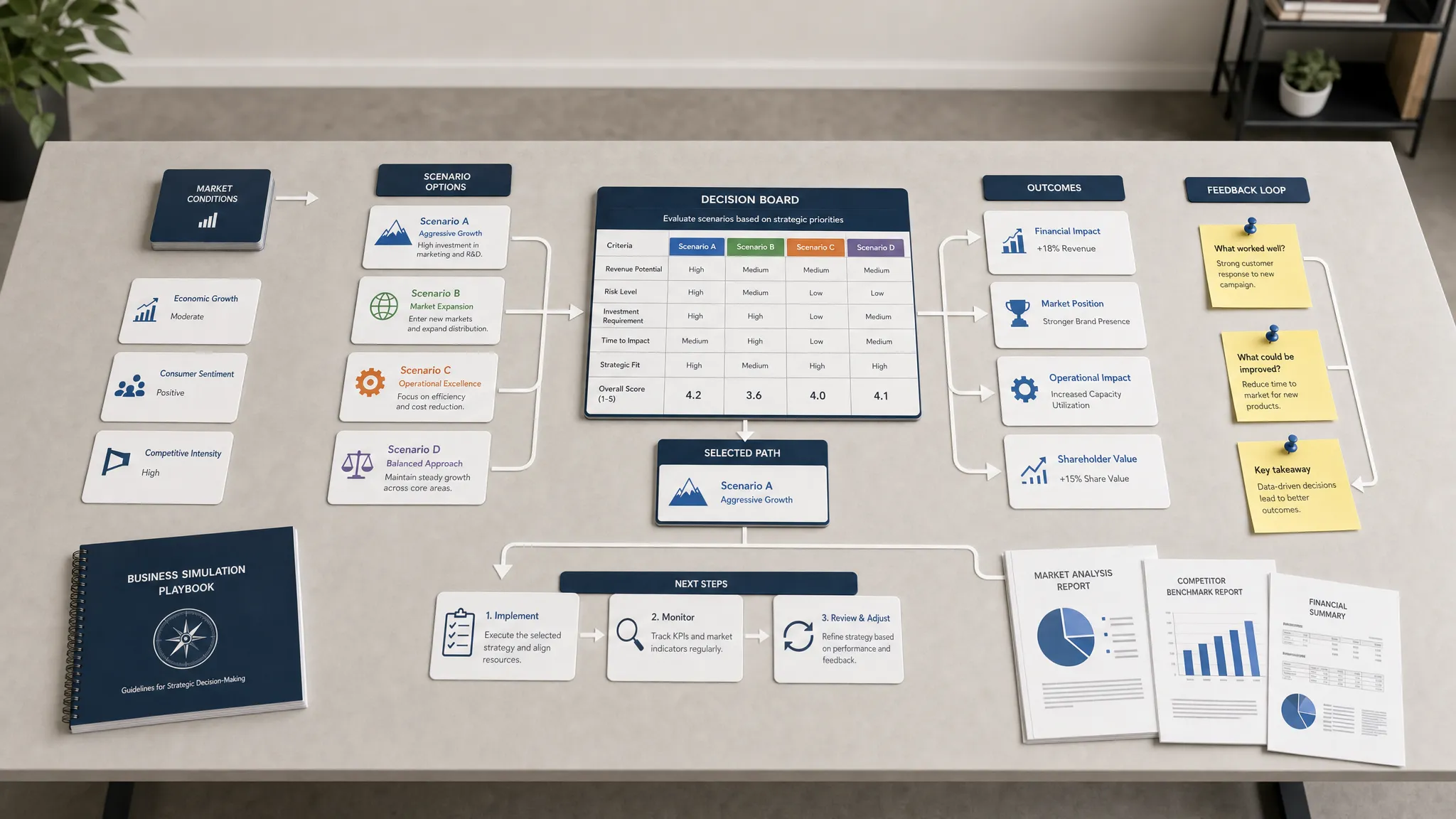
Most learners can describe a marketing campaign. Far fewer can explain why one campaign idea should outperform another, what evidence would prove them wrong, and how they would adapt when customers or competitors respond. That is the gap a testable campaign closes.
For instructors, corporate trainers, and learning designers, the goal is not simply to ask learners to create a polished campaign plan. The stronger learning experience asks them to make decisions, see consequences, interpret results, and improve the next round. In other words, the campaign becomes a controlled learning environment where strategy is practiced, not just presented.
Below is a practical framework for building a marketing campaign learners can test, whether you are using a business simulation, a live classroom project, a capstone assignment, or an internal training exercise.
Why a testable marketing campaign works better than a presentation
A traditional campaign assignment often rewards confidence, creativity, and slide design. Those skills matter, but they do not prove that learners understand marketing strategy. A testable campaign rewards reasoning. Learners define a market, choose a target, allocate resources, predict outcomes, and compare actual results with expected results.
That difference matters because marketing is full of tradeoffs. A high-reach channel may attract low-intent buyers. A niche segment may convert well but limit growth. A promotional offer may lift short-term volume while weakening perceived value. Learners only understand these tensions when they have to act under constraints.
StratX has explored why marketing techniques students remember are the ones they test, and the same logic applies to campaign design. The moment learners receive feedback on a real decision, concepts move from abstract vocabulary to applied judgment.
A testable campaign also reflects how marketing teams work outside the classroom. Modern marketers rarely launch once and hope. They form hypotheses, use customer data, compare alternatives, learn from performance signals, and adjust. A learning experience should mirror that rhythm.
Start with the learning objective, not the campaign deliverable
Before asking learners to build a marketing campaign, decide what kind of marketing judgment you want them to practice. If the goal is segmentation, the assignment should force them to choose between audience groups. If the goal is budget allocation, the campaign should include competing channels and limited resources. If the goal is brand positioning, learners should test how different messages affect perception and conversion.
The deliverable should serve the learning objective, not the other way around. A beautiful campaign plan that never forces a tradeoff may look impressive but teach very little.
| Learning objective | Campaign design implication | Evidence learners should produce |
|---|---|---|
| Segmentation | Require learners to choose and prioritize target groups | Segment rationale, expected behavior, and opportunity size |
| Positioning | Ask learners to select a value proposition and proof point | Message hypothesis and customer need analysis |
| Channel strategy | Give learners multiple media or contact options | Channel choice, budget logic, and expected funnel impact |
| Measurement | Require metrics before launch | Leading and lagging indicators tied to objectives |
| Competitive thinking | Include market changes or rival moves | Response plan and revised assumptions |
| Resource allocation | Limit budget, time, or capacity | Tradeoffs and expected return from each choice |
A clear learning objective also helps you decide how complex the exercise should be. Early learners may need a focused campaign with two segments and three channels. Advanced learners can handle a richer scenario with multiple products, competitive reactions, pricing choices, and brand equity implications.
Convert campaign ideas into hypotheses
A campaign becomes testable when learners can state what they expect to happen and why. The simplest way to do this is to turn every major campaign decision into a hypothesis.
A useful hypothesis format is:
If we target a specific audience with a specific message through a specific channel, then a specific metric will change because of a specific customer insight.
For example, a learner team might propose: If we target time-constrained professionals with a convenience-led message through search and retargeting, qualified trials will rise because this segment is already problem-aware and comparing options.
That statement is stronger than saying the campaign will increase awareness. It names the audience, the message, the channel, the metric, and the underlying assumption. It gives learners something to test and something to revise.
Strong campaign hypotheses usually include five elements:
- Audience: Who is the campaign designed to influence?
- Behavior: What should the audience do differently after seeing the campaign?
- Mechanism: Why should this message or channel change behavior?
- Metric: What signal will show whether the campaign is working?
- Time frame: When should learners expect to see meaningful evidence?
This structure prevents vague marketing language from hiding weak thinking. It also makes feedback easier to interpret. If the campaign underperforms, learners can ask whether the issue was the audience, the message, the channel, the budget, or the original assumption.
Give learners real decision rights
Learners cannot test what they cannot control. If every meaningful choice is pre-set, the campaign becomes an execution task rather than a strategic learning experience.
Decision rights do not need to be unlimited. In fact, too much freedom can overwhelm learners. The key is to give them enough control to create meaningful differences between teams, rounds, or campaign versions. If your main focus is promotion, start by letting learners practice risk-free advertising decisions such as audience selection, campaign objectives, media mix, and message emphasis.
| Decision area | Learner choice | What can be tested |
|---|---|---|
| Target audience | Which segment receives priority | Market fit, conversion potential, and acquisition efficiency |
| Value proposition | Which benefit or proof point leads | Message relevance and perceived differentiation |
| Creative direction | Rational, emotional, educational, or promotional angle | Attention, engagement, and response quality |
| Channel mix | Paid search, social, email, events, partners, or other options | Reach, cost, and funnel progression |
| Budget allocation | How much investment goes to each activity | Marginal return and opportunity cost |
| Offer strategy | Trial, bundle, discount, premium, or no offer | Volume, quality of demand, and perceived value |
| Timing | Launch sequence and campaign cadence | Momentum, fatigue, and learning speed |
The best decision set depends on the course or training context. A digital marketing module may emphasize channel mix and metrics. A brand management exercise may focus on positioning, perceived value, and long-term brand effects. A sales and marketing program may connect campaign choices to lead quality and negotiation outcomes.
Build constraints that make tradeoffs unavoidable
An unlimited budget teaches little. Real marketing decisions happen under pressure, and learners need to feel that pressure in a safe environment.
Constraints make a campaign testable because they force prioritization. When learners cannot do everything, they must explain what they will do first and what they are willing to sacrifice.
Common constraints include:
- A fixed campaign budget
- Limited launch periods or decision rounds
- Incomplete customer data
- Competitor activity
- Channel capacity limits
- Brand guidelines
- Sales team capacity
- Product availability or operational limits
The goal is not to frustrate learners. The goal is to make tradeoffs visible. If a team spends heavily on awareness, what happens to conversion support? If they target a large segment, do they dilute relevance? If they rely on a discount, what happens when the discount ends?
Good constraints are challenging but understandable. Learners should be able to explain the rules of the environment and connect those rules to their campaign choices.
Choose metrics before learners launch
Metrics are not an afterthought. They are part of the strategy. If learners choose metrics only after seeing results, they may select whatever makes the campaign look successful. That weakens the learning experience.
Ask learners to define success before launch. They should identify a primary metric tied to the campaign objective and a small set of supporting metrics that help diagnose performance.
| Campaign objective | Primary metric examples | Supporting metric examples |
|---|---|---|
| Build awareness | Reach, impressions, recall, share of voice | Frequency, audience coverage, branded search lift |
| Generate consideration | Click-through rate, site visits, content engagement | Time on page, return visits, lead magnet downloads |
| Drive conversion | Leads, trials, purchases, revenue | Conversion rate, cost per acquisition, lead quality |
| Improve efficiency | Return on ad spend, cost per qualified lead | Channel-level cost, marginal return, budget utilization |
| Strengthen customer value | Repeat purchase, retention, upsell | Satisfaction, product usage, customer lifetime value indicators |
Keep the metric set small enough to interpret. A long dashboard can make learners feel data-rich but insight-poor. Three to six well-chosen metrics are usually more useful than fifteen disconnected numbers.
It also helps to separate leading and lagging indicators. Leading indicators, such as engagement or qualified traffic, show whether the campaign is moving in the right direction. Lagging indicators, such as sales or retention, show whether the campaign ultimately created business value.
Design a feedback loop, not a final grade
Marketing learning accelerates when learners complete multiple cycles. They make a decision, predict an outcome, receive feedback, diagnose the gap, and adjust. A single final presentation cannot create the same depth of learning because there is no opportunity to correct course.
In a simulation, feedback may come through performance results after each decision round. In a live project, feedback might come from small-scale audience tests, survey responses, landing page experiments, or peer and instructor review. In a corporate workshop, feedback may come from scenario results, customer role-play, or facilitator-led market updates.
Outside marketing education, this same structure is why learners preparing for high-stakes exams often combine study guides with practice questions and readiness tracking. Platforms such as MindMesh Academy’s adaptive certification prep show how repeated practice can turn feedback into stronger retention, and campaign learners benefit from a similar rhythm of attempt, feedback, reflection, and retry.
A simple feedback loop can follow this sequence: decision, prediction, launch, result, diagnosis, adjustment, reflection. The reflection step is essential. Without it, learners may change tactics without understanding why.
| Stage | Learner action | Instructor or facilitator prompt |
|---|---|---|
| Before launch | State hypothesis and expected result | What assumption matters most? |
| After first feedback | Compare prediction with outcome | Where did reality differ from your expectation? |
| Diagnosis | Identify likely cause | Is the issue audience, message, channel, offer, or budget? |
| Adjustment | Revise one or two key choices | What will you change, and what will you keep constant? |
| Reflection | Document learning | What would you test next if you had another round? |

Make learner thinking visible
Results matter, but they do not tell the full story. A team can get lucky with a weak strategy, or make a strong decision that underperforms because of a competitor move or market constraint. To assess learning fairly, you need to see the reasoning behind the campaign.
Ask learners to maintain a decision log. It does not need to be long, but it should capture the logic of each major choice.
A useful decision log includes:
- The decision made
- The evidence or insight used
- The expected outcome
- The tradeoff accepted
- The result observed
- The next adjustment planned
This practice reduces hindsight bias. After results arrive, learners often explain them as if they were obvious all along. A decision log preserves the original assumptions, which makes the debrief more honest and more valuable.
Decision logs also help teams collaborate. Marketing campaigns often involve different perspectives, including analytics, creative, sales, finance, and customer insight. When learners document their reasoning, they can debate the logic rather than simply defend personal preferences.
Use simulations when the stakes need to be real but safe
Live campaign projects can be powerful, especially when learners work with real organizations. But live campaigns also have limits. Budgets may be too small, timelines may be too long, data may be incomplete, and brand risk may restrict experimentation. Learners may also avoid bold decisions because they fear harming a real partner.
Business simulations solve a different problem. They create a safe environment where learners can make consequential decisions, receive feedback, and experience market dynamics without real-world downside. That is especially useful when the learning objective involves strategic tradeoffs, competitive response, or repeated campaign optimization.
A simulation-based campaign can compress months of market learning into a shorter experience. Learners can test positioning, budget allocation, channel strategy, and customer targeting, then see how results shift over time. They can also experience how one decision affects another. A campaign that improves short-term demand may create budget pressure elsewhere. A segment choice may influence sales efficiency. A channel strategy may perform differently once competitors react.
This is where experiential learning becomes more than an engaging activity. It becomes a way to practice judgment. Learners do not just learn what a marketing funnel is. They learn how to manage one when resources are limited and results are uncertain.
Debrief the campaign as a strategist, not a judge
The debrief is where campaign testing turns into durable learning. If the debrief only asks which team won, learners may focus on ranking rather than insight. A stronger debrief asks why results happened and what decision principles can be carried into the next campaign.
Effective debriefs compare strategy, assumptions, execution, and adaptation. They invite learners to explain what they expected, what surprised them, and what they would do differently. The best discussion often comes from contrasting two teams that made different decisions under the same market conditions.
| Debrief lens | Strong question |
|---|---|
| Customer insight | What did you learn about the target audience that was not obvious at the start? |
| Strategic coherence | Did your audience, message, channel, and offer reinforce each other? |
| Data interpretation | Which metric was most useful, and which was misleading? |
| Tradeoffs | What did you choose not to do, and what did that cost you? |
| Adaptation | What changed between rounds, and why? |
| Transfer | How would this learning apply to a real campaign launch? |
A good debrief also normalizes intelligent failure. If learners made a reasonable hypothesis, tested it, found evidence against it, and adapted well, that should be recognized. In real marketing work, the ability to learn quickly is often more valuable than being right on the first attempt.
Assess both process and performance
If grading or evaluation focuses only on final performance, learners may optimize for short-term outcomes or hide uncertainty. A better assessment model considers both the quality of the result and the quality of the thinking that produced it.
You can evaluate a testable marketing campaign across several dimensions:
| Assessment area | What to look for |
|---|---|
| Strategic clarity | The campaign has a clear target, objective, and positioning logic |
| Hypothesis quality | Learners make specific, testable predictions |
| Use of evidence | Decisions are supported by data, research, or scenario information |
| Measurement discipline | Metrics are chosen before launch and tied to objectives |
| Adaptation | Learners revise decisions based on feedback rather than opinion alone |
| Team reasoning | The team explains tradeoffs and handles disagreement constructively |
| Business impact | Results show progress against the stated objective |
This balanced approach rewards learners for doing the hard work of marketing: making imperfect decisions with limited information, then improving through evidence.
A sample structure for a testable campaign exercise
A testable campaign does not have to be complicated. The structure below can be adapted for a single workshop, a multi-week course module, or an executive training program.
| Stage | Learner task | Output |
|---|---|---|
| Campaign brief | Analyze market, customer, product, and constraints | Situation summary |
| Hypothesis design | Choose audience, message, channel, and expected outcome | Campaign hypothesis |
| Launch decision | Allocate budget and set metrics | Campaign plan and forecast |
| Feedback round | Review results and compare against prediction | Performance diagnosis |
| Optimization | Adjust campaign choices based on evidence | Revised campaign plan |
| Final debrief | Explain learning, tradeoffs, and next test | Strategic reflection |
For beginner groups, you can simplify the exercise by limiting the number of decision variables. For advanced groups, you can add competitive moves, multiple segments, pricing implications, or sales follow-up. The important part is that learners move through at least one complete cycle of prediction, feedback, and adjustment.
Common mistakes to avoid
One common mistake is letting learners choose any audience, any message, and any metric. Total freedom sounds creative, but it often makes results impossible to compare. A better approach is guided freedom, with defined constraints and meaningful choices.
Another mistake is overloading the dashboard. Too many metrics can distract learners from the strategic question. If the objective is lead quality, for example, a high click-through rate may be interesting but not decisive.
A third mistake is ending the exercise at launch. Launching a campaign is only the beginning of marketing learning. The most valuable moments happen when learners see results and must decide what to change.
Finally, avoid grading presentation polish more heavily than strategic thinking. Strong visuals can support communication, but they should not compensate for weak assumptions, unclear targeting, or poor use of evidence.
Frequently Asked Questions
What makes a marketing campaign testable? A campaign is testable when learners define a clear audience, objective, hypothesis, metric, and time frame before launch. They also need feedback that shows whether their assumptions were supported or challenged.
Can learners test a campaign without a simulation? Yes. Learners can test campaign ideas through surveys, small audience experiments, landing page tests, peer review, or live projects. Simulations are especially useful when you want repeated decisions, competitive dynamics, and safe consequences.
How many metrics should learners track? Most learner campaigns work best with one primary metric and a few supporting metrics. The goal is not to create a large dashboard. The goal is to help learners interpret whether the campaign is achieving its objective and why.
How long should a testable campaign exercise run? It can run in a single session if the scenario is focused, but deeper learning usually requires multiple rounds. Even two cycles of decision, feedback, and adjustment can create more insight than one final presentation.
How do I stop learners from focusing only on winning? Evaluate both process and performance. Ask teams to document hypotheses, decisions, evidence, tradeoffs, and adjustments. Reward strong reasoning and learning agility, not just final rank.
Help learners test marketing strategy before real market risk
A marketing campaign learners can test is more than an assignment. It is a practice environment for strategic judgment. When learners make decisions, receive feedback, and refine their approach, they build the confidence to apply marketing concepts in real business situations.
If you want to bring that kind of hands-on learning into your classroom or corporate training program, explore StratX Simulations. StratX helps educators and training teams engage learners through experiential business simulations in marketing, strategy, sales, and innovation.