
Marketing leaders have heard enough predictions to know that a trend is not a strategy. A new channel, format or AI workflow only matters if it changes customer behavior in a way your team can measure.
That is why the strongest approach to trending marketing in 2026 is not to chase every tactic. It is to treat each one as a testable hypothesis: if we change this message, channel, creative format or customer journey, will the audience move one step closer to buying, subscribing, renewing or advocating?
Two forces make testing especially important this year. First, discovery is fragmenting. Gartner predicted that traditional search engine volume could drop by 25% by 2026 because of AI chatbots and virtual agents. Second, customers still expect relevance. McKinsey reported that 71% of consumers expect companies to deliver personalized interactions.
Those shifts do not mean every brand needs the same playbook. They mean marketers, instructors and corporate training teams need better experiments.
Start with a testing filter, not a trend list
Before testing any new tactic, define what you want to learn. A useful test should improve a decision, not just produce a dashboard. For example, “Can short-form video drive demand?” is too broad. “Can a three-part founder-led video series increase demo requests from mid-market buyers compared with static LinkedIn ads?” is testable.
This mindset is especially useful in marketing education and professional training. Trend lists age quickly, but the ability to form hypotheses, interpret signals and adjust a plan stays relevant. StratX has explored why growth marketing is best learned through testing, and the same logic applies to the tactics below.
Use this filter before putting budget or class time behind a 2026 marketing tactic:
| Filter question | Strong answer | Red flag |
|---|---|---|
| What behavior are we trying to change? | A measurable action such as trial starts, repeat purchases, qualified inquiries or product education completion | A vague goal like “increase awareness” with no proxy metric |
| What assumption are we testing? | A clear belief about audience, message, channel or offer | A tactic chosen because competitors are doing it |
| How soon can we read a signal? | A defined test window with leading indicators | Waiting months with no interim learning |
| What is the risk if it fails? | Limited spend, brand-safe creative and a rollback plan | A major campaign relaunch based on an unproven idea |
| How will we use the result? | A decision to scale, stop or redesign the tactic | A report that does not change future action |
1. AI search visibility for answer-first discovery
AI is changing how people collect information before they reach a website. Buyers may ask a chatbot for options, use AI summaries in search results or compare vendors through generated answers before they ever click. That makes visibility in answer-style discovery worth testing.
The tactic is not to “write for AI” at the expense of people. It is to create content that is clear, specific, well sourced and easy to extract. Google Search Central guidance emphasizes helpful, reliable, people-first content, which remains a sensible baseline even as discovery interfaces change.
A practical test might focus on one high-intent topic. Build a content cluster with a direct explainer, a comparison page, an FAQ section, customer language and visible subject-matter expertise. Then monitor search impressions, assisted conversions, branded search movement, sales team mentions and whether AI tools cite or summarize your content accurately.
Do not overread one ranking movement or one AI response. The learning question is broader: does clearer, evidence-rich content help your audience include you in the consideration set earlier?
2. AI-assisted creative experimentation
Generative AI has made it faster to produce variations of ads, emails, landing page copy, scripts and social hooks. The opportunity is not unlimited content volume. The opportunity is faster creative learning.
A good test starts with human strategy. Define the audience, customer tension, offer and brand guardrails first. Then use AI to generate variations around a specific variable: emotional appeal, proof point, opening hook, call to action or objection handling.
For example, a B2B team could test three ad concepts for the same webinar: one built around urgency, one around peer proof and one around practical outcomes. A consumer brand might test product page headlines that emphasize savings, convenience or identity. The point is to learn which message frame drives qualified action, not just which version gets a cheap click.
The main risk is mistaking efficiency for effectiveness. If AI helps produce 40 weak variants instead of five strong ones, the test becomes noise. Use human review for factual accuracy, brand fit and ethical boundaries before anything goes live.
3. Interactive value exchanges for first-party data
As audiences become more cautious about data sharing, marketers need to earn information rather than simply request it. Interactive value exchanges do this well because they give the customer something useful in return.
Examples include diagnostic quizzes, product finders, savings calculators, readiness assessments, configurators and interactive learning tools. The user shares preferences or needs because the interaction helps them make a better decision.
A simple test could compare a standard lead form with an interactive assessment. Instead of asking “Want to speak to sales?” the assessment might help prospects identify their current maturity level, then recommend a relevant next step. The leading metrics are completion rate, quality of submitted information, follow-up engagement and eventual conversion quality.
This tactic also works in education and training because learners can see how data capture, segmentation and customer value connect. If you are designing a learning activity around this, StratX’s guide on how to design a marketing campaign learners can test offers a useful structure for turning ideas into measurable exercises.
4. Creator and practitioner proof, not influencer reach alone
Creator marketing keeps evolving, but in 2026 the more interesting test is credibility rather than reach. Audiences are often more persuaded by practitioners, niche experts, customers, educators or respected operators than by broad lifestyle influencers.
For B2B brands, that might mean partnering with a known practitioner to explain a problem in plain language. For consumer brands, it could mean working with a creator who actually uses the product in a specific context. For universities or training providers, it might involve alumni, instructors or industry guests showing how a concept appears in real work.
Test one partnership around a defined learning or buying barrier. If prospects do not understand the category, use creator content to explain it. If they do not trust the claim, use practitioner proof. If they cannot picture use cases, let the creator demonstrate them.
Measure saved posts, qualified comments, direct traffic lift, referral quality and sales conversations influenced by the content. Also protect trust. The FTC Endorsement Guides make clear that endorsements should be honest and disclosed when there is a material connection.
5. Community-first distribution
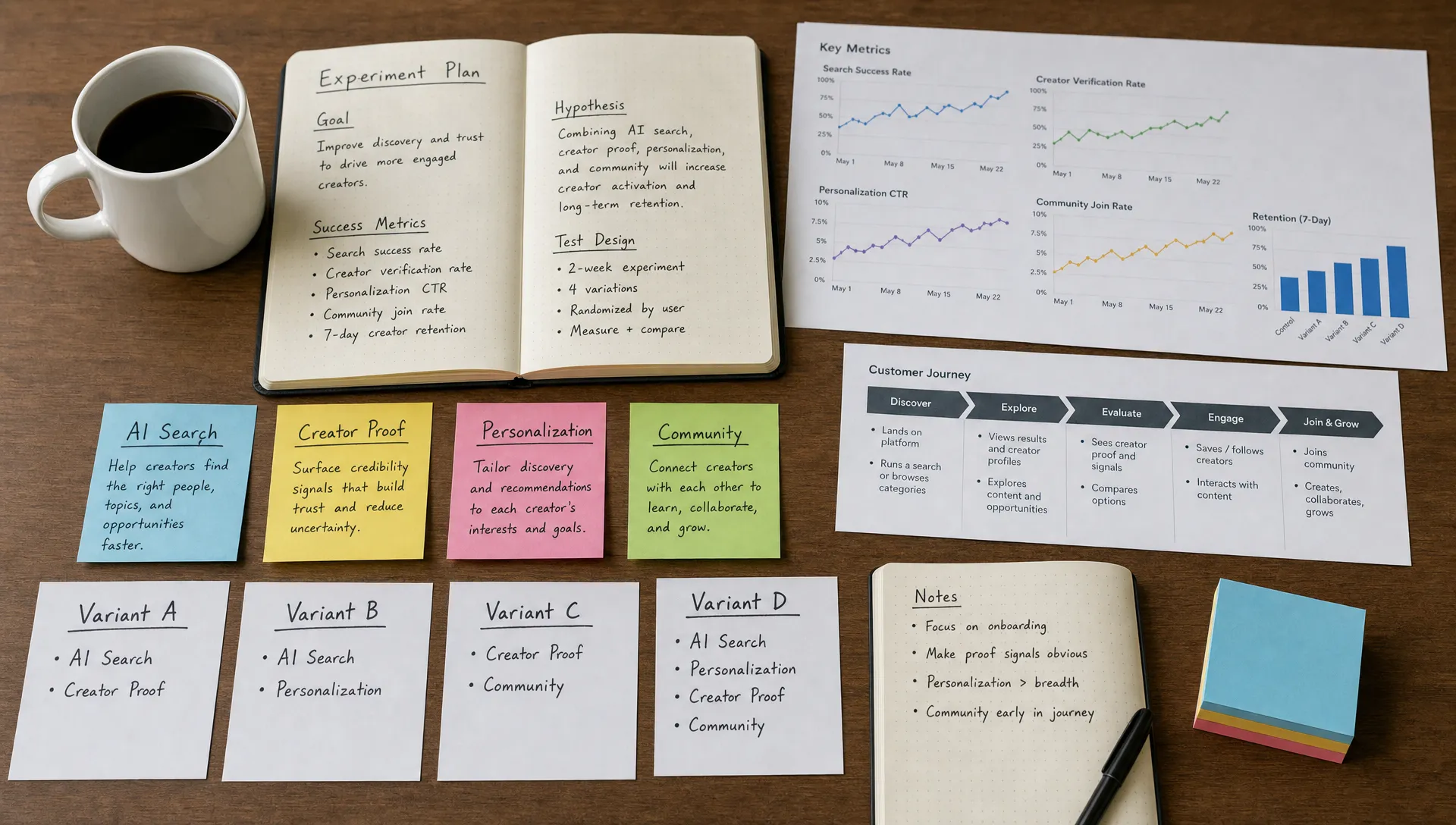
Many high-value marketing conversations happen outside trackable funnels: private Slack groups, LinkedIn comments, Reddit threads, WhatsApp groups, alumni communities, professional associations and niche newsletters. Treating these spaces as ad inventory usually backfires. Treating them as places to learn can produce better marketing.
The test is to participate before promoting. Identify recurring questions, objections and language. Then create content that answers those questions directly. Share it only where it fits the community norms.
A community-first test might start with one audience segment and one problem theme. For four weeks, track the questions that appear most often, the phrases people use and the resources they already trust. Then publish a practical guide, checklist or workshop based on that language. Use self-reported attribution, community-specific landing pages and qualitative sales notes to understand impact.
The value of this tactic is not always immediate lead volume. Often, the first win is better messaging. If your website, ads and sales materials begin using the same language customers use, conversion improvements can appear across multiple channels.
6. Lifecycle personalization with restraint
Personalization remains powerful, but customers notice when it becomes intrusive or irrelevant. In 2026, the best tests are likely to focus less on “we know everything about you” and more on “we understand what you need next.”
Start with lifecycle moments: onboarding, first purchase, stalled trial, renewal, upgrade, post-event follow-up or reactivation. Then test whether a tailored message improves the next useful action.
For example, a software company could compare a generic onboarding sequence with a role-based sequence. A university program could test different follow-up paths for prospective students based on their stated goals. A retailer could personalize replenishment reminders based on product category rather than overusing behavioral assumptions.
The key measurement is incremental lift. If possible, use a holdout group that receives the standard experience. Compare not only short-term clicks but also retention, purchase quality, unsubscribes and customer satisfaction signals. A tactic that raises clicks while damaging trust is not a win.
7. First-party and contextual media partnerships
Signal loss, privacy expectations and rising platform costs have pushed many marketers to revisit contextual media and first-party partnerships. This includes retail media networks, industry publications, newsletter sponsorships, podcast partnerships, professional communities and co-marketing with complementary brands.
The test should be built around audience fit. A niche newsletter read by the right 20,000 people may outperform a large platform buy with weak intent. A retail media placement may work well for a product already close to purchase, but it may do little for a category that needs education first.
Design the test with a clean comparison. Use matched audiences, unique offers, promo codes, post-purchase surveys or geo-based holdouts where possible. If direct attribution is imperfect, combine quantitative and qualitative evidence: traffic quality, branded search lift, pipeline influence, retailer sales data, survey recall and sales team feedback.
The mistake to avoid is judging every partnership by last-click conversion. Some channels create demand, some capture it and some build trust over repeated exposure. Decide which role the partnership is meant to play before the test begins.
8. Proof-led conversion content
As AI-generated content becomes easier to produce, generic claims become less persuasive. Buyers need proof that a product, service or learning experience works in their context.
Proof-led content can include case studies, before-and-after examples, product walkthroughs, comparison pages, ROI calculators, implementation guides, customer stories and objection-handling pages. The tactic is not new, but the need for specificity is stronger when audiences are surrounded by interchangeable content.
A useful test compares a standard conversion page against a proof-led version. Keep the offer the same, then add evidence: customer quotes you can verify, use-case detail, process transparency, data where available and answers to the objections prospects raise most often.
Measure conversion rate, lead quality, sales cycle progression and objection frequency in calls. If the proof-led page reduces unqualified leads but improves close rate, that may be a better business outcome than a higher top-line conversion rate.
How to turn a 2026 tactic into a real experiment
A tactic becomes useful when the team can explain what changed, why it changed and what the result means. The following structure works for marketing teams, university classrooms and corporate workshops.
- Define one decision the test should improve.
- Choose one audience segment and one behavior to influence.
- Change one primary variable, such as message, format, channel or offer.
- Set a baseline before the test begins.
- Pick leading and lagging metrics.
- Decide in advance what result would make you scale, stop or redesign.
- End with a debrief that explains the customer insight, not only the performance number.
This last step matters most. A failed test can still improve strategy if it reveals that the audience does not understand the category, dislikes the offer, trusts a different proof point or needs a longer education path.
For instructors and training leaders, this is where simulations and experiential learning add value. Learners can test decisions, see feedback and practice tradeoffs without putting real budgets or customer relationships at risk. The goal is not to predict the perfect 2026 tactic. The goal is to build the judgment to evaluate any tactic that comes next.
Frequently Asked Questions
What are the most important trending marketing tactics to test in 2026? AI search visibility, AI-assisted creative testing, interactive value exchanges, creator proof, community-first distribution, lifecycle personalization, contextual partnerships and proof-led conversion content are all worth considering. The best choice depends on your audience, sales cycle and learning goal.
How long should a marketing tactic test run? The test window should match the buying behavior. Paid creative tests may show early signals in days or weeks, while lifecycle, community and partnership tests often need longer. Define the minimum sample size and decision rule before launch.
How can teams test AI marketing tactics safely? Start with low-risk use cases such as creative variation, content outlines, internal research synthesis or message testing. Keep human review in place for accuracy, brand voice, bias, legal claims and customer privacy.
What metrics matter most when testing a new marketing tactic? Use metrics tied to the tactic’s role. Awareness tests may track reach quality, recall or branded search. Conversion tests should track qualified actions, sales progression and customer quality. Retention tests should include renewal, repeat behavior and satisfaction signals.
Are these tactics relevant for marketing students as well as professionals? Yes. Students can use the same tactics as structured learning exercises: form a hypothesis, make a marketing decision, interpret feedback and revise the plan. That process builds practical judgment faster than memorizing trend lists.
Help learners practice before decisions become expensive
Trending marketing tactics are easier to understand when learners can test them, see consequences and adjust their strategy. StratX Simulations helps educators and corporate trainers bring experiential business learning into marketing, strategy, sales and innovation programs, giving learners a safer environment to practice real-world decisions before real budgets are on the line.