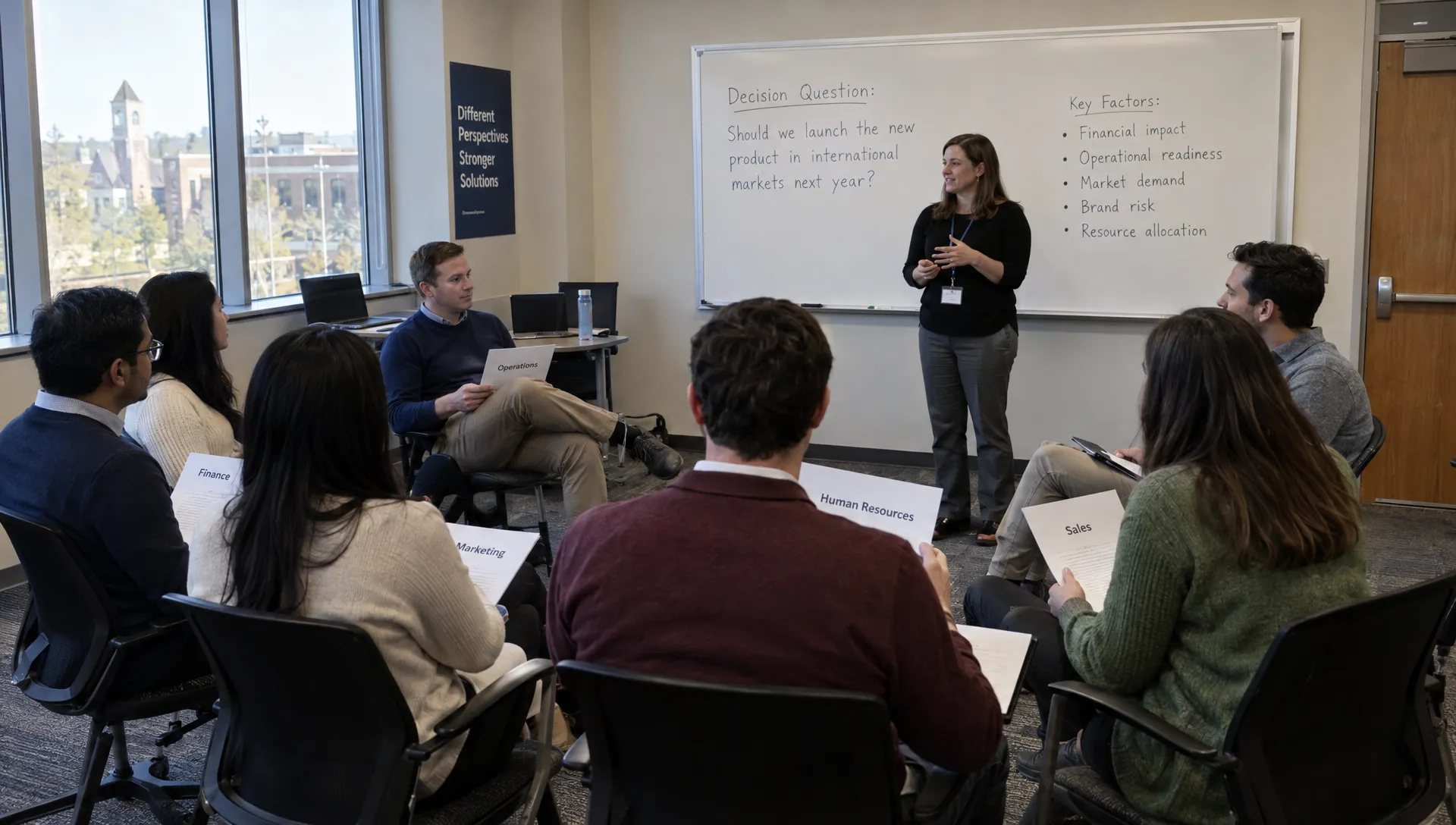

Remote learning has made MBA and executive education programs more accessible, flexible and international. However, keeping participants actively engaged, developing collaboration and translating management theory into practical skills remain significant challenges.
How can educators recreate the dynamics of real business decision-making when participants are spread across different locations, industries and time zones?
Business simulations for MBA and executive education offer a powerful solution. By placing participants in realistic, competitive markets, they transform remote learning from a content-driven experience into an active management experience.
Developed by StratX Simulations, Markstrat enables educators to bring strategic marketing, analytical thinking and collaborative decision-making into online, hybrid and face-to-face learning environments.
Key takeaways
- Online business simulations encourage active participation through competitive, team-based decision-making.
- Markstrat enables participants to manage a portfolio of brands and experience the long-term consequences of their strategies.
- Flexible delivery supports online MBA courses, executive education and international management development cohorts.
- Business performance data, strategic presentations and facilitated debriefings help educators assess learning outcomes.
- Markstrat combines sophisticated mathematical market models with decades of academic research and practical application.
Why remote MBA and executive education programs need experiential learning
MBA students and experienced executives expect more than lectures and theoretical frameworks. They want opportunities to apply their knowledge, challenge their assumptions and develop skills they can transfer to the workplace.
In remote settings, educators frequently face several challenges:
- Maintaining participant engagement beyond live teaching sessions.
- Encouraging meaningful collaboration across geographically dispersed teams.
- Connecting management concepts with practical business decisions.
- Creating a shared experience for participants with different professional backgrounds.
- Assessing strategic thinking, analytical skills and decision-making capabilities.
Online business simulations address these challenges by giving participants a common business objective, a competitive environment and responsibility for the consequences of their decisions.
Instead of simply discussing what makes a successful strategy, participants must develop, implement and adapt one themselves.
How Markstrat works in remote learning environments
Markstrat is a strategic marketing simulation in which participants manage a portfolio of brands in a dynamic, competitive market.
Working in teams, participants analyze market research, evaluate competitors, identify growth opportunities and make interconnected decisions across successive simulated business periods.
Analyze
Interpret market research, customer needs, competitor activity and brand performance.
Decide
Manage targeting, positioning, pricing, R&D, product portfolios and marketing investments.
Adapt
Evaluate business results, respond to market changes and refine strategic decisions.
Unlike static business cases, Markstrat uses sophisticated mathematical market models to create an evolving competitive environment.
Customer preferences change, technologies develop, competitors introduce new products and strategic decisions influence future business performance.
This creates a continuous cycle of analysis, decision-making, feedback and reflection that is particularly valuable in remote management education.
Five ways Markstrat strengthens MBA and executive education programs
1. Creates sustained MBA engagement
One of the difficulties of remote education is maintaining attention between scheduled teaching sessions.
Markstrat gives participants ownership of a virtual business and a clear objective: improve its competitive and financial performance through effective strategic decisions.
Because each decision influences subsequent results, participants have a reason to remain involved throughout the program. They return to analyze performance, discuss competitive developments and prepare their next strategic moves.
The competitive dimension adds motivation, while the evolving market encourages continuous learning.
2. Encourages meaningful collaboration across remote teams
Effective management requires more than individual knowledge. It also requires the ability to communicate priorities, reconcile different perspectives and make collective decisions.
Markstrat creates a shared business challenge that requires participants to collaborate, even when working from different countries or time zones.
Teams must interpret data, debate alternatives, negotiate investment priorities and agree on a coherent strategy.
For international MBA programs and global management development cohorts, this reflects the realities of working in distributed business teams.
3. Bridges the gap between management theory and practice
Market orientation, competitive advantage, customer segmentation and portfolio strategy are central to MBA curricula.
Understanding these concepts is one thing. Applying them under competitive pressure and with limited resources is another.
Through Markstrat, participants can discover that:
- Increasing marketing investment cannot necessarily compensate for poor product positioning.
- Short-term profitability may come at the expense of long-term competitiveness.
- Market research creates value only when translated into informed decisions.
- Competitor actions can undermine an otherwise well-designed strategy.
- Marketing, financial and product development decisions must be aligned.
These experiences create opportunities for deeper discussion and help educators connect simulation results to their teaching objectives.
4. Supports scalable delivery across international cohorts
Online business simulations can help institutions deliver a consistent experiential learning experience across multiple cohorts, campuses and geographic locations.
Markstrat can be integrated into several program formats:
| Program format | Potential application |
|---|---|
| Online MBA | Multi-week strategic marketing course |
| Executive MBA | Competitive strategy and business decision-making |
| Executive education | Intensive strategic marketing and leadership programs |
| Management development cohorts | Collaboration across markets and business units |
| Hybrid education | Online decision rounds combined with live workshops |
| Corporate universities | Simulation-based management training for future leaders |
Educators can organize decision rounds around their teaching schedules, combining independent team preparation with live discussions and facilitated debriefings.
This flexibility allows institutions to adapt the simulation to their pedagogical objectives rather than redesigning their programs around a fixed learning format.
5. Makes learning outcomes more observable
Measuring MBA and executive education outcomes requires more than tracking attendance or course completion.
Markstrat provides quantitative business performance indicators alongside opportunities for qualitative assessment.
Educators can evaluate how participants interpret competitive intelligence, develop coherent strategies, allocate resources, respond to changing conditions and justify their strategic choices.
The Share Price Index (SPI), alongside financial and market performance indicators, provides a quantitative reference point for evaluating business results.
However, effective assessment goes beyond the final ranking. Strategic presentations, reflective assignments and instructor-led debriefings can reveal how participants' reasoning develops throughout the experience.
Could Markstrat work in your MBA or executive education program?
Explore the simulation, discover the participant experience and discuss how it could support your learning objectives.
Explore Markstrat & Request a DemoAcademic case study: Developing strategic thinkers at Aston Business School
EXPERIENTIAL LEARNING IN PRACTICE
Aston Business School, United Kingdom
PROGRAM
MSc Strategic Marketing Management
SIMULATION
Markstrat
TEACHING FORMAT
Weekly in-person sessions
At Aston Business School, Teaching Fellow Narek Grigorian integrates Markstrat into postgraduate marketing education to help students apply strategic concepts to evolving business challenges.
His approach combines introductory practice, targeted teaching, progressive simulation rounds and peer mentoring. More successful teams help other teams develop their understanding, creating additional opportunities for collaborative learning.
Grigorian also uses BrandPRO in Aston's Executive MBA program, adapting simulation-based learning to a different educational audience.
The takeaway for remote educators: techniques such as progressive decision rounds, peer mentoring and structured reflection can also be incorporated into online teaching.
Read the full Aston Business School case study →The importance of academic research and realistic market models
When selecting business simulations for MBA and executive education, educators should consider the quality of the underlying model as well as the participant experience.
Originally developed by INSEAD professors Jean-Claude Larréché and Hubert Gatignon, Markstrat has a long history in management education.
Its mathematical market models represent the relationships between customer preferences, competition, product development, investment decisions and business performance.
This modeling depth is particularly important for experienced participants who need to explore complex decisions rather than simply practice isolated management concepts.
RESEARCH SPOTLIGHT
Management Perspectives on Markstrat: The GE Experience and Beyond
Thomas C. Kinnear and Sharon K. Klammer
Journal of Business Research, 15(6), 491–501, 1987.
Research involving managers at General Electric and other organizations found that participants across industries considered Markstrat a credible representation of marketing decision-making, supporting its relevance as a teaching and research environment.
The study provides historical evidence of the simulation's perceived business realism, rather than a measurement of engagement in contemporary remote education.
Read the research via the University of Michigan repository →How to structure a remote Markstrat MBA course
A successful online simulation requires intentional instructional design. Markstrat typically involves 12 to 20 hours of simulation activity, depending on the learning objectives and configuration.
The following example illustrates how educators could integrate the simulation into a six-week online MBA module.
WEEK 1
Onboarding and strategic foundations
Introduce the simulation, form teams, review the competitive environment and connect the experience to the course learning objectives.
WEEK 2
Market analysis and initial strategy
Teams analyze customer segments, evaluate competitors and agree on their initial business priorities.
WEEKS 3–4
Competitive decision-making
Participants complete successive decision rounds, evaluate results and attend instructor-led discussions focused on emerging strategic challenges.
WEEK 5
Strategic adaptation
Teams reassess their competitive position, review product development priorities and adapt their strategies based on market feedback.
WEEK 6
Final presentations and debriefing
Participants explain their strategic choices, evaluate their performance and identify lessons they can apply to real business situations.
This illustrative format combines asynchronous preparation with synchronous teaching and collaborative decision-making. The number of rounds and teaching hours can be adjusted to suit the curriculum.
For executive education, the same learning principles can be incorporated into a more intensive program with concentrated decision rounds and facilitated discussions.
How to measure executive education and MBA learning outcomes
Faculty and program directors can establish a structured evaluation framework before introducing a simulation.
Combining business performance with qualitative evidence helps educators assess not only what participants achieved but also how they developed their management capabilities.
| Learning objective | Suggested assessment method |
|---|---|
| Strategic thinking | Compare initial and final strategic presentations |
| Analytical skills | Evaluate interpretation of market research and financial data |
| Decision-making | Assess the rationale behind major business decisions |
| Collaboration | Use peer assessment and individual team reflections |
| Adaptability | Analyze responses to competitive and market developments |
| Business performance | Review SPI, profitability and market performance |
| Knowledge transfer | Develop a post-program workplace application plan |
For executive education providers, an additional follow-up assessment 30 to 90 days after the program could help explore whether participants have applied their learning in the workplace.
This approach can also help program directors communicate educational value to corporate sponsors and other stakeholders.
The role of artificial intelligence in remote management education
As generative AI becomes increasingly integrated into higher education, MBA faculty face new questions about how to assess independent thinking, critical judgment and practical management competencies.
Business simulations provide an environment where participants must go beyond generating recommendations. They must interpret information, manage interconnected decisions and respond to the consequences of their choices over time.
Markstrat also incorporates a real-time AI assistant to support participants within the simulation environment.
Educators can reinforce independent thinking by asking teams to explain why they made particular decisions, assess the reliability of their assumptions and reflect on the difference between expected and actual outcomes.
The objective is not simply to obtain the best answer, but to develop the ability to make informed decisions in complex business environments.
Further reading: AI in the simulation classroom
Explore insights from StratX Simulations' 2026 instructor survey on artificial intelligence and simulation-based learning.
Read the full instructor survey report →Why choose Markstrat for MBA and executive education?
When evaluating online business simulations, educators should consider the depth of the market model, relevance to the curriculum, flexibility of delivery and opportunities for meaningful assessment.
Markstrat brings together these elements in an established strategic marketing simulation.
40+
Years of Markstrat experience
62%
Of FT Top 50 MBA programs partner with StratX Simulations*
12–20
Typical Markstrat simulation hours
*Based on the Financial Times 2026 Global MBA ranking and StratX Simulations' institutional partnership data. This figure refers to StratX partnerships across its simulation portfolio.
Key Markstrat capabilities include:
- Sophisticated mathematical models representing evolving competitive markets.
- Multi-period strategic decision-making.
- Detailed market research and business performance data.
- Team-versus-team and team-versus-AI competition options.
- Built-in assessment tools.
- Real-time AI-assisted participant support.
- Accessibility features aligned with WCAG requirements.
- Flexible integration into online, hybrid and face-to-face programs.
Educators can also access online instructor certification sessions to develop their facilitation skills and explore effective ways of integrating simulations into their programs.
For institutions evaluating different experiential learning formats, the StratX simulation comparison guide provides an overview of available simulations, learning objectives and durations.
Frequently asked questions
What are business simulations for MBA and executive education?
Business simulations are experiential learning tools that place participants in realistic business environments where they make management decisions, analyze outcomes and adapt their strategies. They help participants practice strategic thinking, analytical skills, collaboration and business acumen.
Can Markstrat be used in fully online MBA programs?
Yes. Markstrat can be delivered remotely, with participants collaborating in teams, submitting decisions online and reviewing their results through virtual teaching sessions and debriefings.
Is Markstrat suitable for experienced executives?
Yes. Markstrat can be integrated into executive education and management development programs focused on strategic marketing, competitive decision-making, customer orientation, resource allocation and business performance.
How long does a Markstrat simulation take?
Markstrat typically involves 12 to 20 hours of simulation activity. Educators can integrate it into a multi-week academic course or an intensive management development program, with additional time allocated for teaching, preparation and debriefing as needed.
How can educators measure learning outcomes with Markstrat?
Educators can combine simulation performance indicators with strategic presentations, reflective assignments, peer assessments and facilitated debriefings to evaluate participants' strategic thinking, analytical skills and adaptability.
Can business simulations improve remote MBA engagement?
Business simulations encourage active participation by giving learners responsibility for business decisions and their consequences. Team collaboration, competitive dynamics and continuous feedback can help sustain engagement beyond traditional online lectures. The effectiveness of the experience also depends on instructional design and facilitation.
How can business schools implement Markstrat?
Business schools can integrate Markstrat into existing courses or dedicated experiential learning modules. StratX Simulations offers instructor resources, certification opportunities and implementation support to help educators prepare their programs.
Bring experiential learning to your remote MBA or executive education program
Remote education does not have to mean passive learning.
With the right simulation and facilitation approach, geographically dispersed participants can collaborate, compete, experiment and develop management skills in a shared business environment.
Whether you are designing an online MBA course, an international executive education program or a management development initiative, Markstrat can help you create a learning experience that connects management theory with the complexity of business decision-making.
Turn management theory into meaningful business decisions.
Discover how Markstrat can support your curriculum, engage your participants and help you assess strategic management competencies.
Request a Markstrat DemoReferences and further reading
- Kinnear, T. C., & Klammer, S. K. (1987). Management perspectives on Markstrat: The GE experience and beyond. Journal of Business Research, 15(6), 491–501. DOI | Full text.
- StratX Simulations. How Simulations Help Students Think, Decide, and Lead at Aston Business School.
- StratX Simulations. AI Impact on Business Simulations: Insights from the 2026 Instructor Survey.
- StratX Simulations. Markstrat Strategic Marketing Simulation.
- StratX Simulations. Business Simulation Comparison Guide.