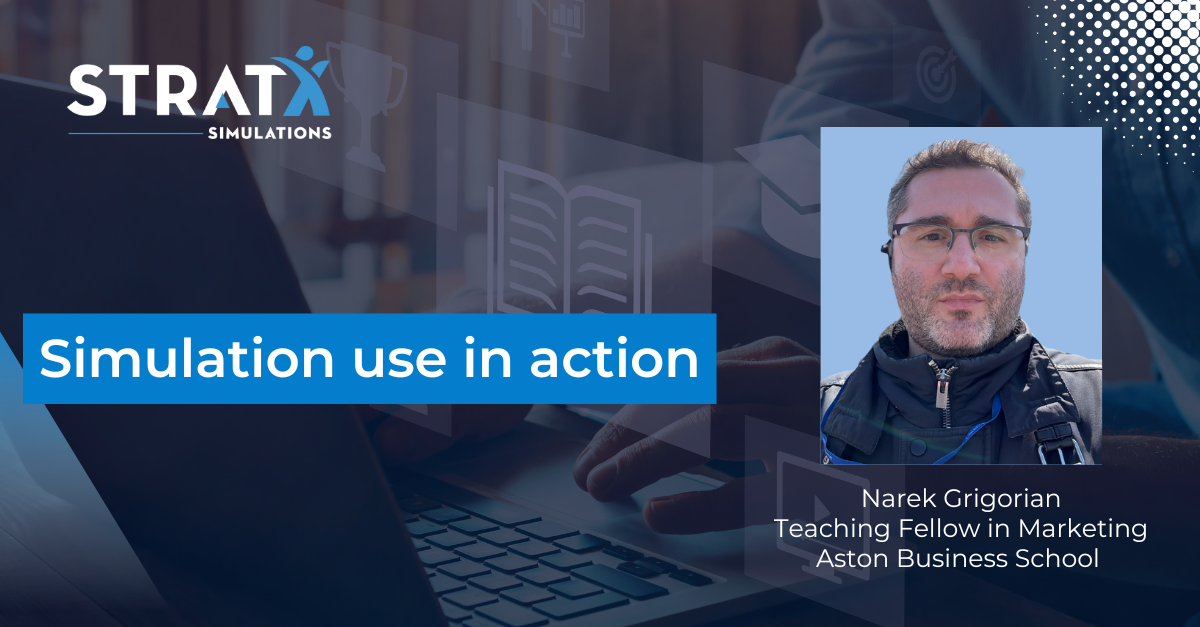

Reimagining the Marketing Classroom
At Aston Business School, a triple-accredited institution known for academic rigor and innovation, Teaching Fellow Narek Grigorian faced a familiar challenge: how to bridge the gap between marketing theory and real-world application. His mission was clear—cultivate strategic thinkers who could thrive in complex and uncertain business environments.
Grigorian wasn’t new to simulations. The school has a long tradition of integrating experiential learning tools into both undergraduate and postgraduate education. But it wasn’t until he fully integrated StratX Simulations—Markstrat for the M.Sc. in Strategic Marketing Management and BrandPRO for the Executive MBA—that he saw transformation take hold in both his students and the classroom.
“It is a rewarding experience to observe a shift in logic that occurs in-class about the role of marketing the more we delve into the various game rounds. Learners’ understanding of the subject is transformed from marketing as advertisement and sales-oriented practice to marketing as a data-driven, market-oriented strategy that aims to establish sustainable differential advantage in the minds of customers.”
Two Simulations, Two Distinct Journeys
BrandPRO in the Executive MBA: Fast-Paced, High Stakes
Delivered during two intensive residential days, BrandPRO challenged experienced professionals to manage branding decisions across five game rounds. Participants applied marketing theory from the earlier weeks of the Creating & Delivering Customer Value module, aligning cross-functional strategies in a high-pressure environment.
One memorable story stands out. A student—interacting with marketing for the first time—used insights from BrandPRO to deliver a presentation at their company, recommending the establishment of a marketing department where none existed before. This tangible real-world outcome, says Grigorian, exemplifies the “transformational power of the simulation and the tangible impact created by the synergy between the simulation itself, marketing knowledge, and student enthusiasm.”
Markstrat in the MSc Program: Strategy as a Living Practice
In the MSc program, Markstrat is embedded into the Marketing Strategy module through weekly in-person sessions starting from Week 1. Students gradually develop strategic fluency through low-stakes practice rounds, targeted lectures, and scaffolded simulation play.
To foster collaboration and support learning diversity, Grigorian introduced a peer mentorship model—strong-performing teams were asked to coach those that were struggling.
“This approach benefits both groups—it supports the progress of underperforming teams while enabling stronger teams to further refine their skills.”
From Students to Strategists
The classroom environment, once traditional, was completely reenergized by simulation-based learning.
“In both simulations, the class environment is visibly lively, noisy, energetic. The sessions are not only intellectually active but physically expressive and socially engaged.”
“Under the pressure of decision-making, students naturally express their personalities: the risk-taker emerges, the leader takes charge, the diplomat seeks consensus.”
Assessment in both programs is carefully aligned with the simulations. MSc students conduct individual literature reviews on two key marketing strategy principles (e.g., “all customers differ,” “all competitors react”) and reflect on how those principles impacted their gameplay performance. Executive MBA students submit a team presentation and an individual written reflection connecting their learning to challenges in their own professional roles.
“Reflective practice in simulation-based assessments deepens learning by encouraging students to critically analyze their decisions, recognize the consequences of their strategic choices, and identify areas for growth and improvement.”
Grigorian observed the development of key competencies such as:
- Decision-making under uncertainty
- Strategic planning
- STP (Segmentation, Targeting, Positioning) execution
- Team collaboration and leadership
- Democratic values such as participation, reasoning, and accountability
“Players practice democratic values, such as, equality and inclusion, freedom, participation, and reasoning... Success cannot be achieved without the art of respective argumentation within groups which aims to persuade co-players based on evidence-based, research-informed arguments.”
Lessons Learned: Advice for Educators
Implementing these simulations wasn’t without challenges. Grigorian found that inconsistent group dynamics could hinder progress, especially as the complexity of the game increased over time.
To support teams and maintain engagement, he introduced several targeted interventions:
- Coaching clinics for struggling groups
- Simulation debriefs after every round to reflect on strategy
- Classroom Q&A platforms to allow anonymous student questions
- Awards not just for winners, but also for most improved teams and those demonstrating “good citizenship”
“The goal is not merely to win the simulation but learning, to apply marketing knowledge, practice critical thinking, and demonstrate leadership within a realistic environment—one that mirrors the challenges graduates are likely to face in professional settings.”
Looking ahead, Grigorian plans to implement peer assessments and team contracts to further promote accountability.
His advice to other educators is unequivocal:
“My recommendation to fellow educators is to allocate sufficient time for module preparation, as integrating Markstrat and BrandPRO entails substantial administrative responsibilities. Effective organization and management of the module are essential to meeting the intended learning objectives.”
“The second recommendation I would offer is to provide ample support to students to foster engagement and mitigate potential anxiety. It is important that students do not feel isolated or solely responsible for navigating the simulation.”
Final Reflection
Grigorian’s thoughtful approach demonstrates how StratX Simulations can do more than engage—they can transform. By combining rigorous academic theory with immersive, reflective, and collaborative practice, he has built a pedagogy that mirrors real-world business conditions while reinforcing Aston Business School’s tradition of excellence.
“Simulations are essentially games that cultivate fundamental democratic ideals.”
“This is exactly what all learners will face in real world business settings after graduation.”
From developing strategic marketers to influencing organizational decisions, Grigorian’s classroom proves that students don’t just learn marketing—they live it.