

A spreadsheet can make a startup look viable because its assumptions agree with one another. An entrepreneur simulation helps you challenge those assumptions by making decisions, observing consequences and testing alternatives before committing real resources. Its value is not that it predicts whether a venture will succeed. It gives founders, entrepreneurship students and innovation teams a structured way to discover which beliefs deserve closer scrutiny.
The most useful exercise starts with a specific uncertainty, not a general instruction to build a successful company.
Separate a model test from real-world validation
A simulation represents a business through rules, decisions and feedback. Depending on its design, participants might allocate budgets, choose customer segments, set prices or respond to competitors. The resulting performance reflects those decisions within the modeled environment.
That distinction matters: a favorable simulated outcome is not evidence that real customers will buy. If the model assumes strong demand, profitable results may simply reflect that assumption. Equally, a disappointing result might reveal a poor decision within the exercise rather than a fatal flaw in the venture.
For readers new to the format, this overview of how business simulations work explains their broader learning applications.
Use simulation to investigate relationships between assumptions and outcomes. Use customer interviews, purchasing behavior and live experiments to investigate whether those assumptions describe the real market.
Turn an entrepreneur simulation into an assumption test
Start by listing the beliefs that must hold for the business to work. Then prioritize assumptions that combine high uncertainty with serious consequences if they prove wrong.
A slightly inaccurate estimate of office expenses may be manageable. A mistaken belief about customer acquisition cost could undermine the entire business model. Prioritize by asking: would a plausible change in this assumption alter our decision to launch, fund or scale?
Replace broad statements such as “customers will value convenience” with a testable claim. For example: “Customers acquired through this channel will generate enough contribution to recover acquisition spending within four months.”
Before the exercise, complete a short hypothesis card:
- Claim: The specific relationship you expect to hold.
- Basis: Whether the assumption comes from observed behavior, an estimate or a guess.
- Test: The decision or input you will change, if the simulation permits it.
- Measure: The outcome that would support or challenge the claim.
- Decision rule: What you will do if the result misses the threshold.
Set thresholds before seeing results. Otherwise, teams can reinterpret almost any outcome as success. If the software does not expose the variable you need, record that limitation rather than treating a loosely related decision as an equivalent test.
Establish a baseline and a fair comparison
Before experimenting, document a baseline: starting resources, planned decisions, expected outcomes and the reasoning behind them. This creates a reference point for interpreting later changes.
In an entrepreneur simulation, a useful comparison requires more than running two different strategies and checking which earns more profit. You need to understand what changed between them. If one team changes pricing, spending and product positioning simultaneously, the result will not isolate the effect of price.
Where the environment allows it, keep other conditions consistent and change one decision at a time. Record competitor actions and external events that might explain differences. Some simulations include uncertainty, so one outcome may not represent a stable pattern.
If resets or repeated runs are unavailable, compare decisions with the baseline forecast and acknowledge the limits of the comparison. A sequential round is not a controlled rerun: earlier choices may have changed the business already.
A simple decision log should capture the prediction, action, observed result and possible explanation. Keep predictions visible during the debrief so the team can distinguish genuine learning from explanations invented afterward.
Stress the assumptions that could end the venture
Sensitivity analysis asks how much an outcome changes when one input moves. Scenario testing asks what happens when several related conditions change together. Both are useful, but they answer different questions.
Use an entrepreneur simulation to investigate a plausible range rather than searching for the single most attractive forecast. A customer acquisition cost estimate of $240 becomes more informative when you also examine what happens at $320 or $400.
Start with individual assumptions, then combine pressures that could reasonably occur together. Slower sales might coincide with higher acquisition spending, while heavier discounting could reduce contribution margins.
The purpose is to find decision boundaries. At what point would you delay hiring, reduce spending or abandon a channel? A business that remains solvent but cannot finance its next acquisition cycle may still require a different strategy.
Choose ranges from available evidence where possible. When evidence is missing, label the range as exploratory and make gathering better evidence an explicit next step.
A worked example: acquisition cost versus payback
Consider a hypothetical subscription startup. Each customer pays $100 per month and costs $20 per month to serve, leaving $80 in monthly contribution before acquisition spending and fixed operating expenses.
The team believes it can acquire customers for $240 each. It sets a four-month acquisition payback threshold based on its financing constraints. This threshold is an illustrative management choice, not a universal benchmark.
An entrepreneur simulation can help the team explore the consequences of higher acquisition costs, provided the relevant decisions and reporting are available. The arithmetic below makes the underlying relationship explicit.
| Measure | Baseline assumption | Higher-cost scenario |
|---|---|---|
| Monthly revenue per customer | $100 | $100 |
| Monthly variable cost per customer | $20 | $20 |
| Monthly contribution per customer | $80 | $80 |
| Customer acquisition cost | $240 | $400 |
| Simple acquisition payback | 3 months | 5 months |
| Customers acquired with $12,000 | 50 | 30 |
Simple payback equals acquisition cost divided by monthly contribution. Here, the higher-cost scenario breaches the team's threshold and acquires fewer customers for the same budget.
These calculations assume stable customer economics and customers who remain active and pay throughout the payback period. They exclude fixed costs, financing costs and payment delays. Actual cash recovery could therefore be less favorable.
Explain the result before choosing a response
The example does not prove that the startup should lower its price, increase advertising or stop acquiring customers. It identifies a constraint: the higher acquisition cost does not meet the chosen payback requirement under the stated assumptions.
The next question is which assumption or decision deserves investigation. Could a different channel acquire suitable customers more efficiently? Could onboarding improve retention? Would a higher price increase contribution without reducing demand too much?
A useful entrepreneur simulation makes those trade-offs discussable, but the team still needs evidence to choose among explanations. Better modeled economics after a price increase do not establish that customers will accept that price.
Keep cash runway separate from payback. A customer can be profitable over time while requiring more upfront funding than the startup can afford. Review payment timing, operating expenses and the cash needed to support growth before interpreting a profitable scenario as financeable.
Debrief decisions, not just financial results
A leaderboard can reward a strong outcome without revealing whether participants understand it. For entrepreneurship education and corporate innovation training, the debrief should examine the quality of the reasoning as closely as the financial result.
Ask participants to reconstruct one important decision: what they expected, what happened and which evidence changed their interpretation. Require them to identify at least one competing explanation. A sales increase might reflect better positioning, a competitor's mistake or a market expansion built into the exercise.
The learning value of an entrepreneur simulation increases when teams distinguish what they controlled, what they observed and what they merely inferred. This prevents a lucky outcome from becoming an unreliable business rule.
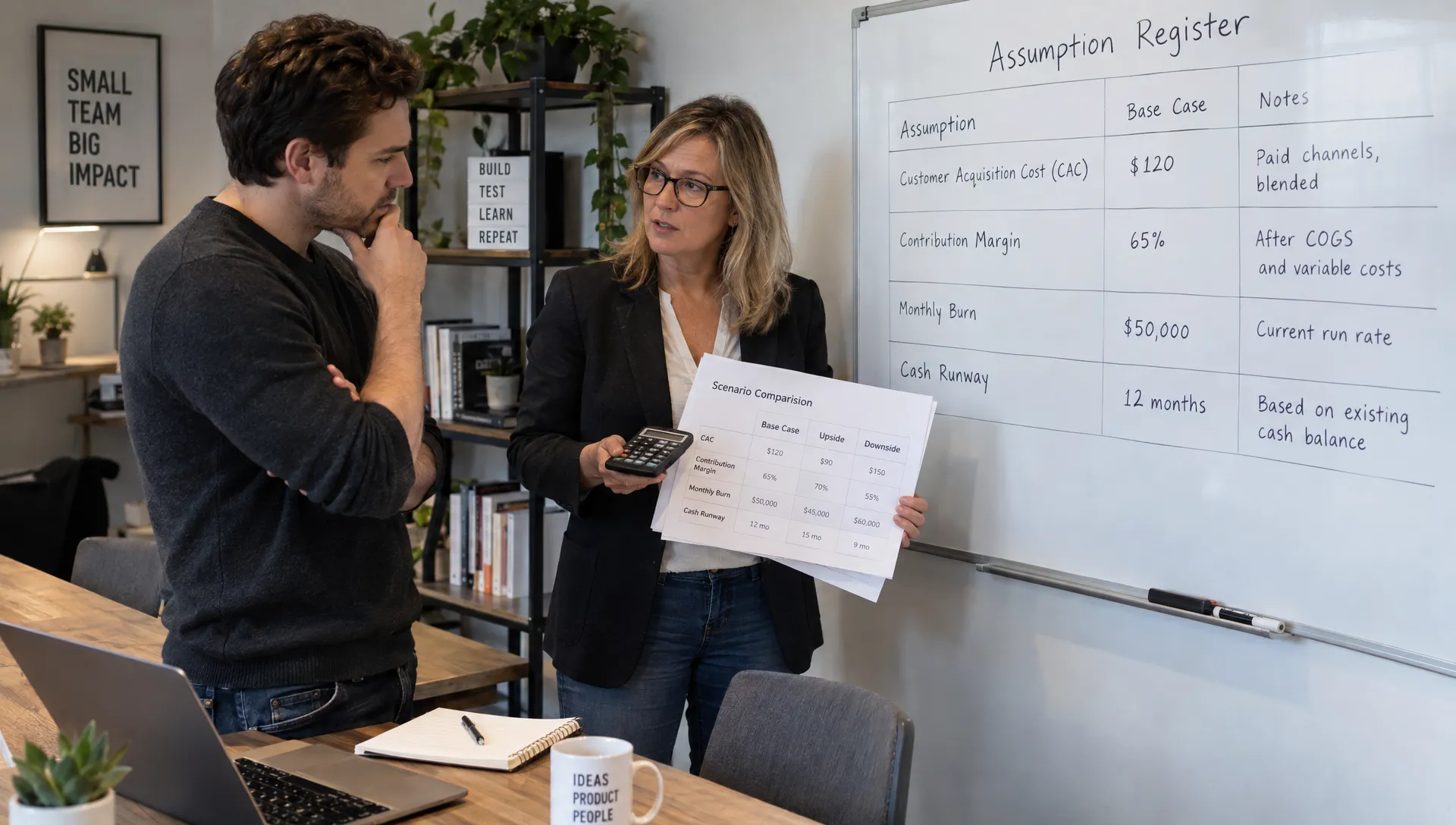
Finish with a revised assumption register. Mark each assumption as unchanged, challenged or requiring external evidence. Avoid calling an assumption “validated” solely because it produced a favorable modeled result.
For instructors, this creates a practical assessment approach: evaluate the clarity of the hypothesis, the suitability of the test and the honesty of the interpretation. A team that identifies why its original plan failed may demonstrate stronger learning than one that wins without understanding why.
Choose software that supports the question
Select the learning environment around the decisions participants need to practice. A marketing-focused simulation may be useful for examining segmentation, positioning and acquisition trade-offs. It may be less suitable for testing operational questions that fall outside its model.
Before selecting an entrepreneur simulation, ask the provider which decisions learners control, which outcomes they can inspect and how market responses are determined. Also check whether teams can access results from earlier rounds and whether instructors can explain the relevant model boundaries.
Replay, scenario controls and detailed cash reporting can help with particular exercises, but availability varies. Do not build a lesson around capabilities that have not been confirmed. A well-designed exercise can still work with limited controls if its conclusions remain appropriately narrow.
For business-school audiences, these considerations complement the broader criteria for selecting MBA business simulations, including learner participation and the connection between decisions and consequences.
Avoid choosing solely on visual realism. The more useful question is whether participants can explain why their decisions produced the reported outcomes and identify what the exercise leaves unresolved.
Move from simulated results to customer evidence
The final output should be an evidence-gathering plan, not just a presentation of financial results. Choose the unresolved assumption that most affects the next funding or launch decision, then identify a real-world test suited to it.
Steve Blank's explanation of the lean startup approach emphasizes testing business-model hypotheses through customer discovery and experimentation. Simulation can prepare teams for that work by clarifying what they need to learn.
For example, concerns about willingness to pay might lead to a carefully designed pricing experiment. Concerns about retention might require a pilot with repeated usage over time. Interviews can reveal customer problems and buying processes, but stated enthusiasm alone does not establish purchasing behavior.
Treat the entrepreneur simulation as preparation for a narrower, more informative external experiment. Record what evidence would change the decision, who will collect it and when the team will review it. Follow applicable privacy requirements and be transparent with participants in customer-facing tests.
Frequently asked questions
Can simulation validate a startup idea? It can test how a business model behaves under specified rules and assumptions. It cannot independently establish real demand, willingness to pay or product-market fit. Those require evidence from the market.
Can I create my own simulation? Yes. A spreadsheet can model relationships among price, volume, variable costs and cash. Document the rules and label assumptions clearly. It can support scenario analysis, although it will not automatically reproduce customer behavior or competitive dynamics.
Is an entrepreneur simulation the same as a business game? The terms can overlap. For assumption testing, the important features are meaningful decisions, understandable consequences and a structured debrief, rather than the label or competitive format.
What should teams do when the results contradict their expectations? Check the inputs, model rules and alternative explanations before changing strategy. Then update the hypothesis and identify the external evidence needed to resolve the uncertainty.
Build the exercise around a decision
Start with one consequential assumption, define a threshold and decide how the result will inform the next step. That gives the exercise a clear purpose beyond achieving a high score.
For academic or corporate learning programs, explore StratX Simulations and discuss which simulation fits the marketing, strategy, sales or innovation decisions your learners need to practice.