Digital marketing is one of the easiest fields to start learning and one of the hardest to master. You can study digital marketing online through courses, certifications, tutorials, webinars, and expert communities. Within weeks, you can understand SEO basics, paid media terminology, customer journeys, email funnels, analytics dashboards, and content strategy.
But understanding the vocabulary is not the same as making good marketing decisions under pressure.
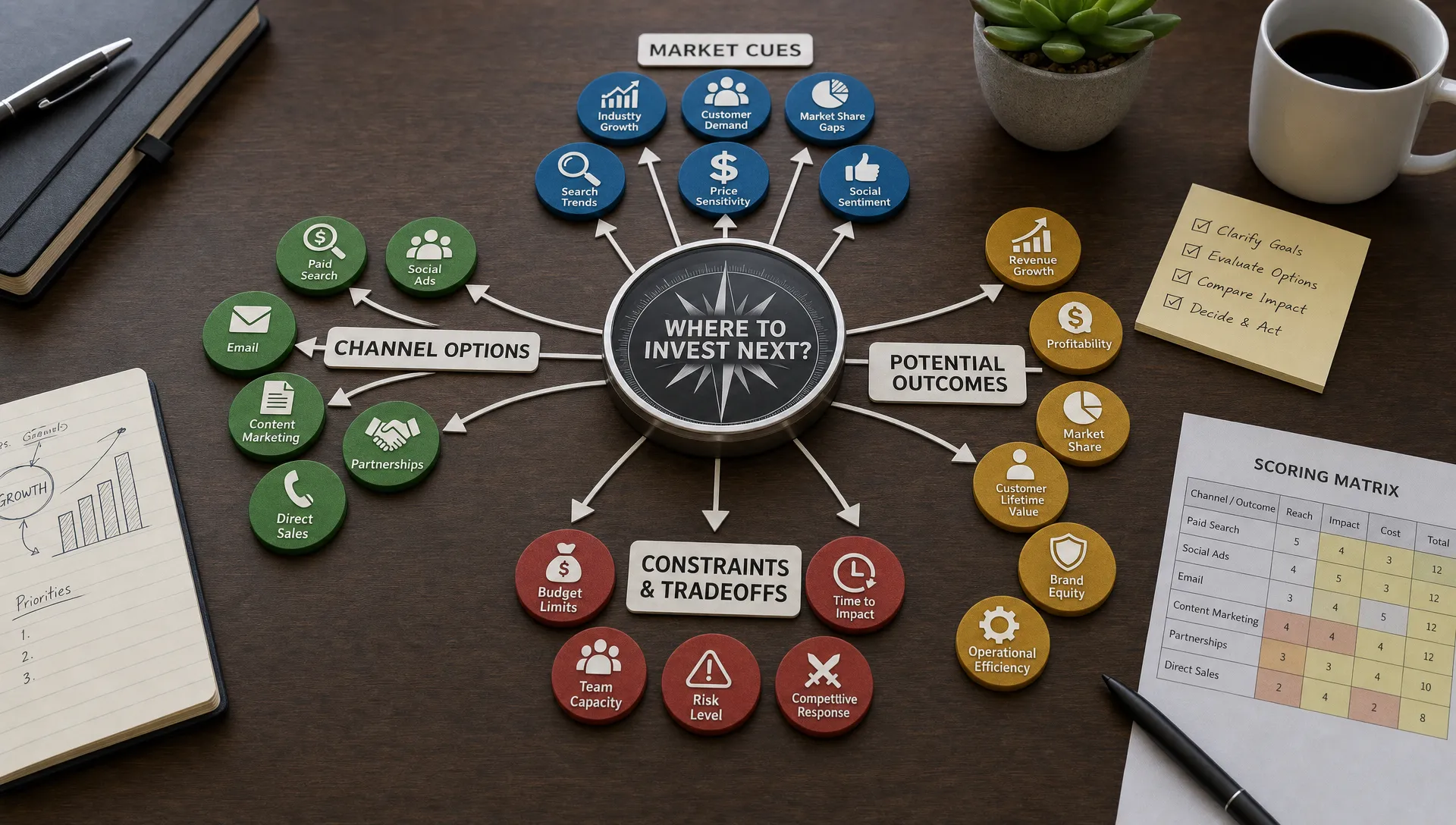
The real question is not whether you should study digital marketing online or learn by doing. The stronger answer is that you need both, but not in equal measure at every stage. Online study builds your foundation. Practice builds your judgment. Simulations, live projects, and structured experiments help close the gap between knowing what a marketer should do and deciding what you would do when budget, competition, timing, and customer behavior collide.
What online study does well
Online learning is excellent for building a base. It gives learners a structured way to understand the language, frameworks, and channels of digital marketing without needing immediate access to a brand, media budget, or analytics stack.
For beginners, this matters. A good online course can explain how search intent works, what makes a paid campaign different from an organic strategy, why customer segmentation matters, and how marketers use data to improve performance over time. It can also help learners compare tools and tactics before they are expected to make decisions.
Online study is especially useful when the goal is to learn concepts that apply across platforms. Google Ads interfaces change. Social media algorithms change. Privacy rules evolve. Yet the core questions remain familiar: Who is the customer? What problem are we solving? What message should we test? Which channel fits the objective? How do we know whether performance is improving?
For instructors and training leaders, online material also makes learning scalable. Students and employees can review lectures, readings, and examples at their own pace, then arrive ready to discuss strategy, test assumptions, and make decisions. StratX has explored this balance before in its guidance on effective ways to teach digital marketing to university students, where digital marketing education becomes more powerful when learners move beyond passive content.
Where online study falls short
The limitation of online study is that it can create fluency without competence. Learners may know what ROAS means, but still struggle to decide whether a campaign should be scaled, paused, repositioned, or reallocated. They may understand segmentation in theory, but fail to choose a target when two segments look attractive and resources are limited.
Digital marketing is full of tradeoffs. A team might have to choose between brand awareness and short-term conversion. A marketer might have to decide whether to invest in a high-intent search audience with higher costs or a broader social audience with weaker purchase signals. A campaign may look successful on one metric and disappointing on another.
Those decisions cannot be mastered by watching tutorials alone. They require repetition, consequences, feedback, and reflection.
This is why learners who only study digital marketing online often hit a plateau. They can explain best practices, but they have not built the mental muscle to apply them in ambiguous situations. Digital marketing performance depends on judgment, not just knowledge.
What learning by doing adds
Learning by doing forces marketers to confront reality. When learners run a campaign, analyze a case, compete in a simulation, or complete a client-style project, they discover that marketing is not a checklist. It is a series of decisions made with incomplete information.
Practice helps develop skills that are difficult to gain from content alone, including prioritization, budget allocation, interpretation of results, experimentation discipline, and cross-functional communication. These are the skills that separate someone who can describe a tactic from someone who can manage a strategy.
The value of practice is not simply activity. It is structured activity with feedback. A learner who posts randomly on social media is doing something, but may not be learning much. A learner who sets an objective, defines an audience, chooses a message, tracks results, compares outcomes, and explains the next decision is developing marketing judgment.
| Learning approach | Best for | Main limitation | How to make it stronger |
|---|---|---|---|
| Online courses | Concepts, vocabulary, frameworks, channel basics | Can remain passive | Add projects, discussion, and application tasks |
| Certifications | Platform knowledge and proof of initiative | May focus on tool mechanics | Pair with strategic decision-making exercises |
| Live projects | Real constraints and portfolio evidence | Results can be messy or hard to compare | Use clear objectives and reflection checkpoints |
| Simulations | Repeatable practice, competition, feedback, decision tradeoffs | Requires facilitation to maximize learning | Debrief decisions and connect outcomes to theory |

The best path is not online versus doing, it is a learning loop
The most effective way to learn digital marketing is to move through a loop: study, decide, act, measure, reflect, and repeat. Online study gives learners the mental model. Doing gives them the experience that tests and reshapes that model.
A beginner might start by learning customer segmentation, channel roles, and funnel metrics online. Then they could complete a campaign planning exercise, audit a brand's digital presence, or participate in a simulation where they must make budget and targeting decisions. After reviewing results, they return to the theory with better questions.
This loop is powerful because mistakes become useful. In a lecture, a student may hear that chasing too many segments can dilute a campaign. In a simulation or project, they feel the cost of spreading budget too thin. That experience makes the concept memorable.
StratX Simulations is built around this kind of experiential learning. For digital marketing education in particular, tools such as Digital Markstrat help learners practice strategic digital marketing decisions in a competitive environment, while instructors can connect decisions back to marketing fundamentals.
What should learners do first?
If you are new to digital marketing, start with online study, but do not stay there too long. Your first goal is to understand the map. Your next goal is to navigate.
A practical beginner path could look like this: learn the core concepts, analyze examples, practice with a simulation or project, document your decisions, and review what changed after each round. This turns learning into evidence.
The evidence matters because digital marketing is also a career field. Employers and clients are less impressed by someone who says they completed a course than by someone who can explain how they approached a marketing problem, what tradeoffs they considered, and what they learned from the outcome. When preparing for applications, tools such as AI-powered resume gap analysis can help learners connect their experience, projects, and skills to the roles they want to pursue.
Good practice activities include:
- Auditing a brand's website, search presence, content, and social channels against a clear customer objective.
- Building a campaign brief with target segments, channel choices, messaging hypotheses, and success metrics.
- Running small, ethical experiments when budgets and permissions allow.
- Using a digital marketing simulation to practice decisions without risking a real brand's budget.
- Reviewing results and writing a short decision memo explaining what you would change next.
The key is to practice decision-making, not just tool usage. A marketer who understands why a decision was made will adapt when platforms change.
What should educators and training leaders prioritize?
For professors, business school faculty, and corporate training teams, the challenge is different. Learners need foundational content, but they also need a safe environment where they can make decisions, experience consequences, and discuss the reasoning behind their choices.
A strong digital marketing learning experience usually includes three layers. The first is conceptual learning, where participants understand customers, objectives, channels, and metrics. The second is applied decision-making, where they choose a strategy and commit resources. The third is reflection, where they interpret outcomes and improve their next decision.
This is where simulations can be especially valuable. They give learners repeated practice in a realistic but controlled environment. Everyone works with comparable information, outcomes can be discussed across teams, and the instructor can focus the debrief on strategic thinking rather than isolated tactics.
For a deeper look at the types of capabilities that emerge through repeated practice, StratX has also covered the digital media marketing skills that grow through practice, from setting objectives to interpreting performance signals.
How to know whether you are really learning
Progress in digital marketing is not just finishing modules or earning certificates. Real progress shows up in the quality of your questions and decisions.
At first, learners often ask tactical questions: Which channel should I use? What is the best ad format? How often should I post? As they mature, their questions become more strategic: Which customer segment is most valuable? What behavior are we trying to change? Which metric best reflects the objective? What would make us stop, scale, or revise this campaign?
That shift is a sign of deeper learning. You are no longer collecting tactics. You are developing judgment.
A useful self-check is to ask whether you can explain your choices before seeing the results. If you can define the objective, state your hypothesis, justify your channel mix, and identify what success would look like, you are practicing like a marketer rather than consuming content like a spectator.
Frequently Asked Questions
Is it enough to study digital marketing online? Online study is enough to build a foundation, but it is usually not enough to develop strong decision-making skills. To become confident, learners need projects, simulations, experiments, or other forms of applied practice.
Should beginners take a course before practicing? Most beginners benefit from a short period of structured online learning first. However, practice should begin early, even if it starts with simple audits, campaign briefs, or simulated decisions.
Are digital marketing certifications valuable? Certifications can show initiative and platform familiarity, but they are strongest when paired with evidence of applied thinking. A project, simulation experience, or decision portfolio often makes the learning more credible.
Why are simulations useful for digital marketing education? Simulations let learners make strategic decisions, compete, receive feedback, and see consequences in a controlled environment. This helps them practice judgment without the risk of spending a real company's budget.
What is the best way to learn digital marketing for a career? Combine online study with repeated practice. Learn the concepts, apply them in realistic scenarios, document your decisions, and reflect on results so you can demonstrate both knowledge and judgment.
Build digital marketing judgment through experience
So, should you study digital marketing online or by doing? Start online if you need the foundation, but prioritize doing if you want the skills to stick.
Digital marketing rewards people who can think strategically, interpret data, adapt to change, and make decisions under uncertainty. Those abilities grow through practice. For educators and training leaders, the opportunity is to design learning experiences where students do more than remember marketing concepts. They apply them, test them, and learn from the consequences.
That is where experiential learning can turn digital marketing from a subject learners understand into a discipline they can actually practice.