
Searches for “gamification marketing” often lead to loyalty programs, customer challenges and promotional rewards. But for marketing instructors and learning leaders, the more consequential question is whether game mechanics can change how people make decisions, not simply how enthusiastically they participate in training.
Gamification can support behavior change, but participation is not proof of learning or workplace transfer. A learner might climb a leaderboard while continuing to choose audiences on instinct, defend weak assumptions or chase clicks instead of profitable growth.
The distinction matters when evaluating a course or simulation. Completion rates tell you who finished. Scores tell you who performed under the scoring rules. Neither automatically shows who will make better marketing decisions afterward. To answer the headline’s question, training needs observable target behaviors, meaningful practice and a way to test what survives once the game ends.
What does “gamification marketing” mean for training?
In a training context, gamification means applying game elements, such as challenges, progression and points, to learning activities. The objective is different from consumer gamification: instead of encouraging another purchase or app visit, the aim is to improve professional judgment and action.
Several related approaches can overlap without being interchangeable:
| Approach | What it involves | What it can demonstrate |
|---|---|---|
| Gamified learning | Game mechanics applied to an existing activity | Participation, persistence and performance on the rewarded task |
| Serious game | A complete game built primarily for learning | Performance within the game's rules and challenges |
| Business simulation | A model in which decisions produce business consequences | How learners interpret information, make trade-offs and adapt |
| Consumer gamification | Game elements used in a customer experience | Customer actions such as participation or repeat visits |
A simulation can include gamification, but it does not need a public leaderboard to provide useful practice. Likewise, adding badges to a marketing quiz does not turn it into a simulation.
The design question is therefore not which approach feels most entertaining. It is whether the activity requires learners to practice the decisions the course is supposed to improve.
What the research supports, and what it does not
Research gives reasons to take gamification seriously without treating it as a guaranteed behavior-change intervention.
Sailer and Homner's meta-analysis of gamification in learning reported positive average effects on cognitive, motivational and behavioral learning outcomes across the included studies. Those findings support its potential, but they do not establish that any particular points system will improve workplace marketing decisions.
Related evidence also requires careful interpretation. Wouters and colleagues' meta-analysis of serious games found advantages for learning and retention compared with conventional instruction, but not a significant overall advantage for motivation. Serious games are not identical to gamification, so their results should not be treated as interchangeable evidence.
For gamification in marketing training, three claims need to remain separate: learners participated more, learners demonstrated better decisions during training and learners changed what they did afterward. Evidence for the first claim does not establish the other two.
A defensible conclusion is that game-based approaches can support learning. Whether they change professional behavior depends on what participants practice, the feedback they receive and the conditions under which they later work.
Define the behavior before choosing the mechanics
“Improve strategic thinking” is too broad to evaluate. A useful target identifies an action someone can observe in a campaign plan, budget discussion or research recommendation.
Start with a small set of behaviors that matter to the intended audience:
| Broad objective | Observable target behavior | Evidence to examine |
|---|---|---|
| Better segmentation | Uses customer evidence to select and reject segments | Segment recommendation with supporting rationale |
| Stronger budget discipline | Compares alternatives before allocating spending | Budget proposal showing assumptions and trade-offs |
| Better experimentation | States a testable hypothesis before launching a test | Experiment brief with a decision rule |
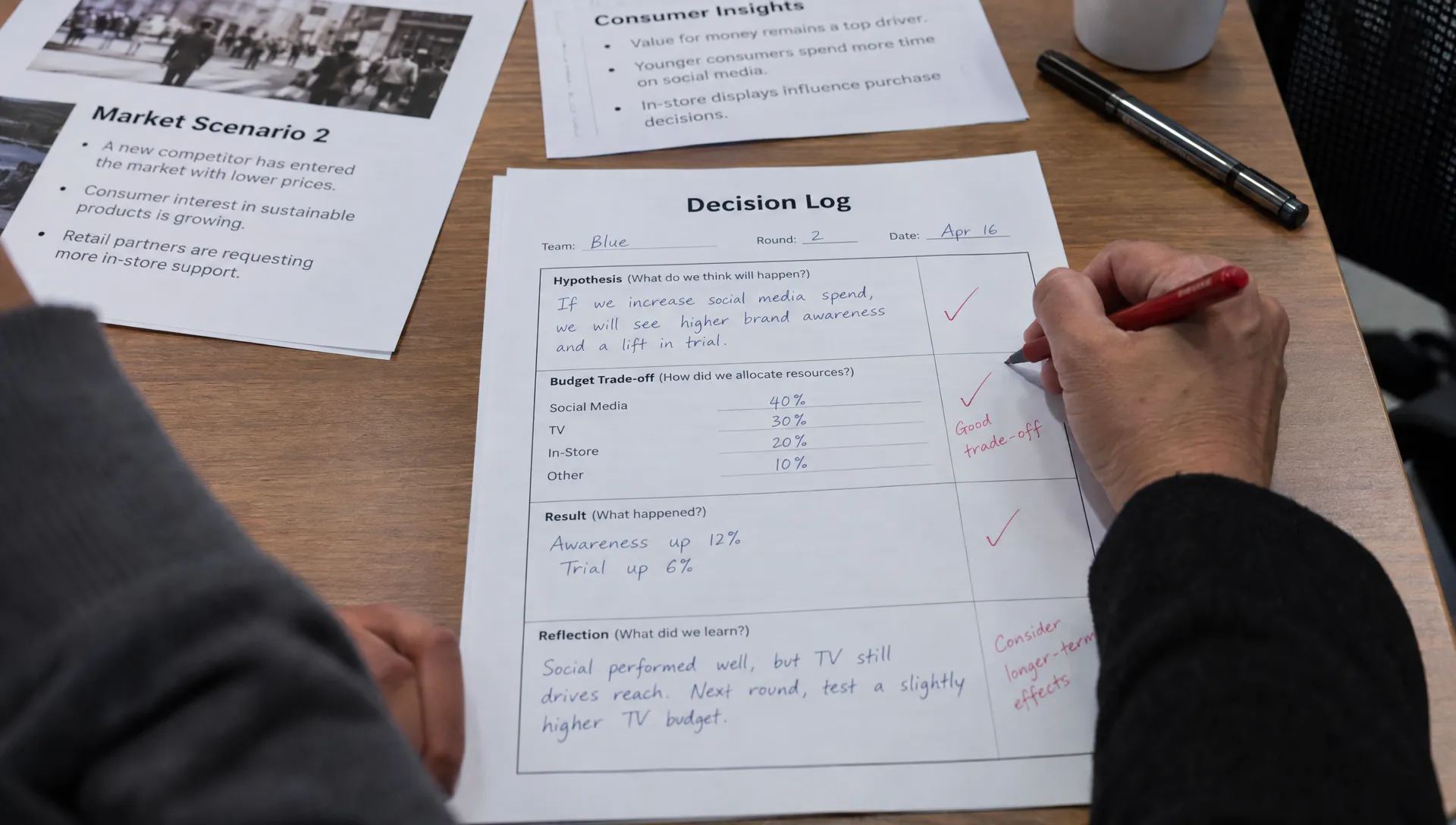
| More adaptive planning | Revises a recommendation when relevant evidence changes | Decision log explaining what changed and why |
For students, these behaviors might appear in a new case assignment. For employees, they might appear in an actual campaign review. The standard should fit the learner's role and opportunity to act.
This is the foundation of corporate learning and development that changes behavior: specify what people should do differently, then collect evidence of that action.
Gamification in marketing training becomes easier to evaluate once these targets are explicit. A challenge or reward either supports the target behavior or distracts from it.
Design decisions and consequences, not just points
Build a scenario with meaningful trade-offs
A useful exercise gives learners competing options, incomplete information and consequences they can interpret. It should require judgment rather than reward whoever clicks fastest or remembers a definition.
Consider a fictional B2B marketing brief using the product categories of workwear supplier Bestex Fabricage as a starting point. Learners could distinguish purchasing managers from garment users, decide which customer needs require research and allocate a limited budget between account development and broader awareness. This would be a hypothetical exercise, not a claim about the supplier's actual strategy or results.
The scenario becomes useful when teams cannot pursue every opportunity. Choosing one segment means explaining why another is less attractive. Increasing reach means accepting less budget for research or sales support.
The same principle applies to academic and corporate settings: make learners expose their assumptions through a decision. A scenario with one obviously correct answer mainly tests recognition, not judgment.
Reward the reasoning you want repeated
Rewards communicate what the course values. If the leaderboard recognizes only simulated revenue, learners may pursue volume at the expense of margin, customer fit or longer-term positioning.
Instead, distinguish business outcomes from decision quality. A team can receive a favorable result through luck, while a well-reasoned decision can produce a disappointing outcome under uncertainty.
For gamification in marketing training, useful recognition might acknowledge a clearly stated hypothesis, a well-supported rejection of an attractive segment or an appropriate revision after new evidence. These are design options, not universal scoring rules.
Publish the criteria before the exercise. Avoid rewarding activity counts that learners can inflate, such as the number of tests proposed or dashboard visits completed. Rewarding more experiments is not the same as rewarding better experiments.
Competition also needs boundaries. Private progress indicators or team challenges may serve the learning objective better than a public ranking that repeatedly exposes the same participants at the bottom.
Make feedback lead to another attempt
Feedback matters most when learners can use it. A final score delivered after the course ends offers less opportunity for practice than feedback followed by another decision round.
After each round, ask participants to explain what they expected, what happened and which assumption they would reconsider. Then give them a related decision in which they can apply that revision.
The facilitator should challenge explanations that rely entirely on hindsight. “We knew that segment was unattractive” is weak evidence if the original decision log says otherwise.
This is where practicing sales and marketing decisions through simulations can provide a useful setting: participants have decisions and consequences to discuss, rather than only abstract principles.
The debrief should finish with a practical bridge: identify the next real decision where the revised approach could be used.

Run a pilot that tests transfer beyond the game
A pilot should test whether the intervention changes the intended behavior, not merely whether participants enjoy it. The following sequence is a proposed evaluation approach, not a validated timetable or a promise of results.
Before training: establish a baseline
Give learners a short, unfamiliar marketing problem before introducing the game mechanics. Ask for a recommendation, supporting evidence and an explanation of the main trade-off.
Use a simple assessment rubric with clearly defined criteria. For example, assess whether the learner identifies a relevant assumption, uses appropriate evidence and explains what would trigger a change of plan. Apply the same criteria later.
Where practical, compare similar groups receiving equivalent content and practice time, with and without the gamified elements. Comparing a rich simulation with a short lecture may reveal differences between the overall learning experiences, but it cannot isolate the contribution of gamification.
For gamification in marketing training, this distinction prevents an overly broad claim: an effective program does not prove that its leaderboard caused the improvement.
During training: record choices, not just scores
Capture a manageable sample of decision rationales alongside performance results. Ask learners to record their reasoning before outcomes are revealed, so they cannot rewrite the explanation afterward.
Keep individual evidence within team activities. A strong team score may reflect one experienced participant directing everyone else, not improvement across the group. Short individual recommendations before team discussion can help reveal that difference.
Also record whether learners understand the rules and can access the activity. Confusion about navigation or scoring should not be mistaken for weak marketing judgment.
An effective pilot does not need to collect every click. It needs enough information to explain whether the target behaviors appeared and how they developed.
After training: use a new problem and a delayed check
First, assess learners on a fresh scenario that uses different surface details but requires comparable reasoning. Repeating the same exercise risks measuring familiarity with the game rather than transferable skill.
Then look for the behavior after learners have had an opportunity to apply it. In a workplace program, this might mean reviewing a later campaign brief or observing a budget discussion. In a course, it might mean an independent assignment several weeks later.
For gamification in marketing training, delayed evidence is especially valuable because it tests whether the behavior persists without immediate points or competitive pressure.
Record opportunity to apply the skill. An employee who has not participated in a campaign decision cannot fairly be classified as failing to transfer it. Likewise, manager feedback is more useful when tied to a specific example than to a general impression.
Separate engagement metrics from behavior metrics
A useful evaluation keeps different kinds of evidence visible rather than blending them into one success score.
Completion, attendance and voluntary participation describe engagement. Performance on a fresh scenario describes demonstrated learning. Changes in actual work describe transfer. Campaign results may provide additional business context, but they also reflect seasonality, budget, competition and other influences.
Suppose participation increases while the quality of decision rationales remains unchanged. That supports a narrow conclusion: the mechanics encouraged participation. It does not support a claim of improved judgment.
If rationales improve during training but not in later work, investigate the transfer conditions. Learners may lack authority, time, relevant data or manager support. The barrier may sit outside the training design.
When evaluating gamification in marketing training, compare patterns across these measures. Where feasible, have reviewers assess work without knowing which training group produced it. Report mixed findings and limitations, especially when the pilot is too small to support confident causal conclusions.
Business outcomes matter, but short-term sales movement alone is a poor verdict on a learning intervention.
Address the risks that can undermine the result
A course can reward the wrong behavior even when its subject matter is sound. Excessive competition may encourage information hoarding, while speed-based scoring may penalize careful analysis. Watch what learners optimize for, not only what the facilitator intended.
Accessibility should be part of the design. Check keyboard navigation, readable instructions and alternatives to color-only signals. Provide an appropriate alternative when a timed task measures processing speed rather than the intended marketing skill.
Privacy also matters. Explain what learner data will be collected, who can see it and how long it will be retained. Use fictional or appropriately de-identified customer information. Do not quietly turn training analytics into employee performance surveillance, and obtain consent where required.
Finally, gamification in marketing training should not undermine sound marketing practice. A game that rewards intrusive data collection or misleading promotion teaches the wrong lesson, even if its engagement metrics look impressive.
Frequently asked questions
Is gamification a teaching strategy? Yes. It uses game elements to structure participation and feedback. Its educational value depends on whether those elements support meaningful practice and the intended learning outcomes.
Are points and leaderboards necessary? No. Challenges, progression, feedback and opportunities to retry can support an activity without public rankings. Choose mechanics that fit the learners and the behavior being taught.
Can a simulation prove that someone will perform better at work? Not by itself. Simulation performance shows what someone did within a particular model. A new assessment and evidence from later work provide a stronger basis for judging transfer.
What is the clearest sign that training changed behavior? A learner repeatedly demonstrates the target action in a new situation without needing the original reward. For example, they document a testable hypothesis before launching a campaign experiment, then use the results to make a decision.
Choose training around the decisions learners need to improve
StratX Simulations provides experiential business simulation software for marketing, strategy, sales and innovation, with academic and corporate formats, instructor support and instant learner feedback.
When exploring business simulations from StratX, begin with one observable behavior and a plan to assess it after training. That gives the learning experience a clear purpose and makes it possible to distinguish an engaging session from a lasting change in practice.