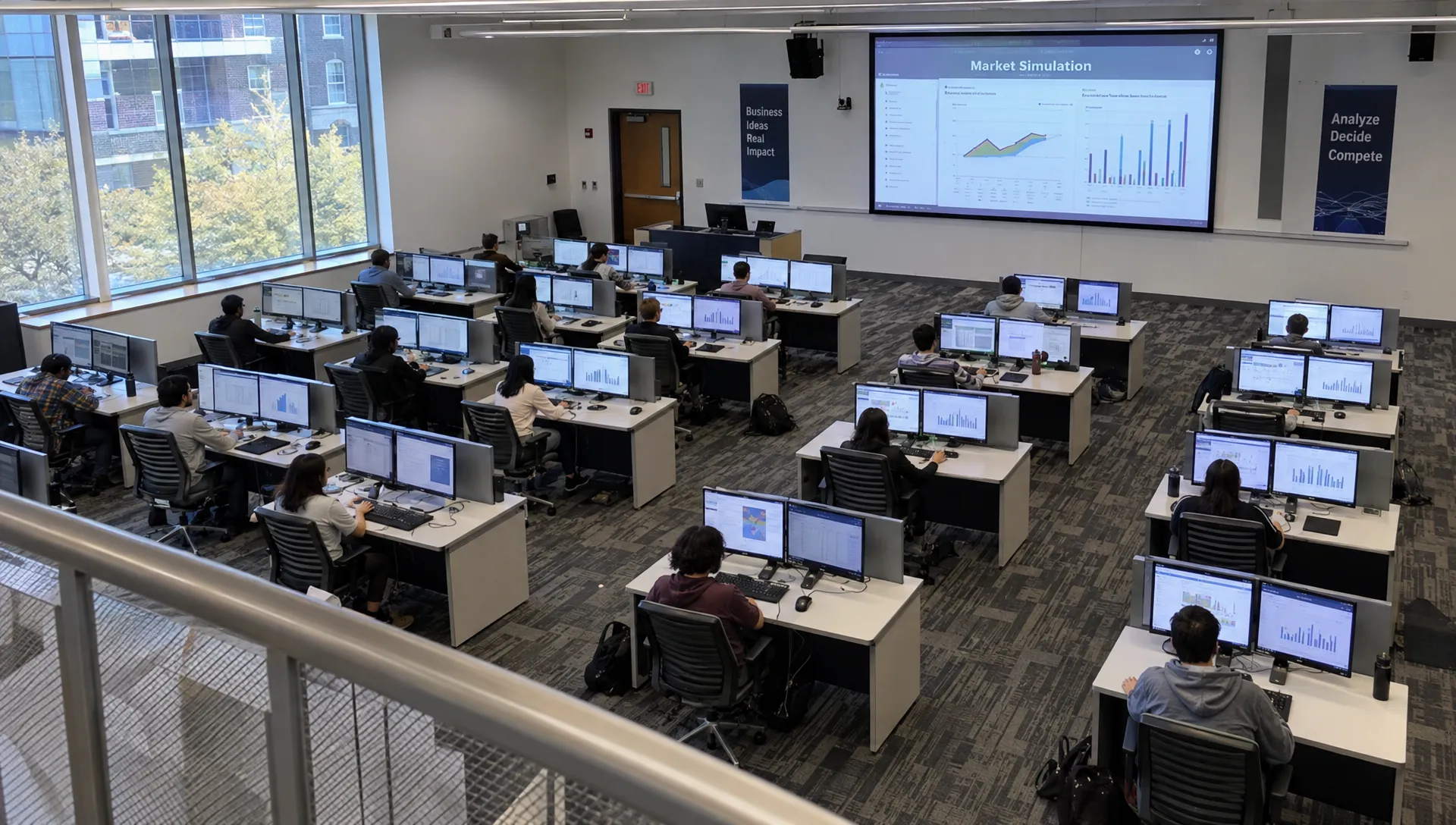
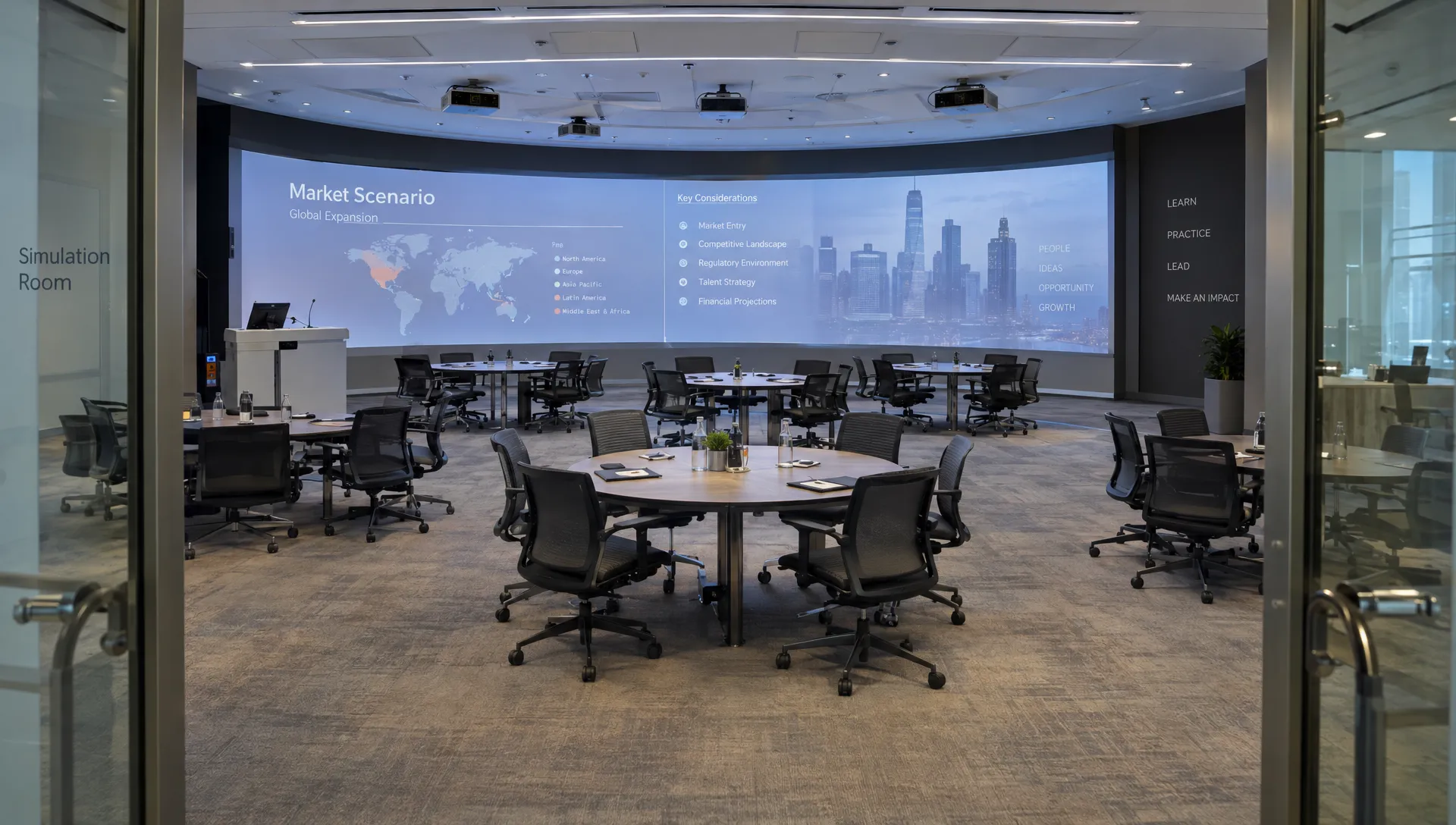
A strong performance record does not automatically show whether someone is ready to lead a larger function or business unit. Business simulations for leadership development give organizations a way to practice that transition before assigning greater responsibility. Participants make connected decisions, experience the consequences and examine how their behavior affects both business results and their colleagues.
For succession planning, the value is not simply identifying who wins a simulation. It is creating useful evidence about development needs, then connecting that evidence to workplace assignments, coaching and broader talent discussions. That requires deliberate scenario design and a clear boundary between learning and assessment.
What is a leadership-focused business simulation?
A business simulation is a structured learning experience in which participants manage a modeled business situation. They might allocate resources, respond to competitors, negotiate priorities or adjust a market strategy as conditions change.
A leadership-focused experience adds explicit attention to how decisions are made. Who invites competing views? Who connects a functional recommendation to enterprise performance? How does the team respond when its original assumptions prove wrong?
Unlike a discussion-only case study, a simulation lets participants act and receive feedback on the consequences. Team decisions also create opportunities to observe collaboration, influence and accountability. Different business simulation formats support different learning objectives, so the format should follow the leadership challenge rather than the other way around.
How do business simulations for leadership development build readiness?
The learning process combines action, feedback, reflection and another opportunity to act. A disappointing result becomes useful when participants can examine its causes and test a different approach in the next round.
Realism matters, but complexity alone does not make an experience effective. The scenario needs credible trade-offs, understandable rules and enough time for participants to discuss their reasoning. Facilitation should keep attention on leadership behavior as well as commercial outcomes.
Start with the demands of the next role
Define the responsibilities participants are preparing to assume. A new manager may need practice delegating and resolving competing priorities. A potential business-unit leader may need to balance growth, profitability and long-term investment across functions.
For example, a team could decide whether to fund an established product or invest in a promising new segment. Marketing favors growth, finance questions the assumptions and sales raises concerns about execution. The leadership challenge is to integrate those perspectives without avoiding a decision.
Well-designed business simulations for leadership development connect such choices to specific behaviors: asking for missing information, making assumptions explicit and explaining why one priority takes precedence over another. Avoid treating every available competency as an objective. A small set of observable behaviors is easier to practice and discuss meaningfully.
Match the delivery format to the learning goal
In-person, virtual and self-paced experiences can all serve a purpose. Their suitability depends on the interaction required, participant schedules and facilitation capacity.
| Format | Useful when | Design consideration |
|---|---|---|
| In-person team simulation | Leaders need intensive negotiation, relationship-building or cross-functional practice | Allow time to observe discussions and debrief decisions |
| Facilitated virtual simulation | Participants work across locations or need to practice remote collaboration | Provide a technology orientation, accessible materials and structured discussion time |
| Self-paced simulation | Participants need flexible practice or foundational business knowledge | Add a separate discussion or team exercise if interpersonal leadership is an objective |
| Blended program | The organization wants preparation, shared practice and workplace follow-through | Make the connection between each stage explicit |
Do not assume that individual completion reveals how someone leads a team. If collaboration matters, the program needs an opportunity to practice and observe collaboration.
Make participation accessible and relevant
Provide a practice round, explain unfamiliar business terminology and share materials early enough for preparation. Check accessibility requirements, scheduling constraints and whether time pressure is essential to the learning objective.
Use scenarios that do not depend unnecessarily on familiarity with one country, industry or corporate function. Rotate responsibilities so that prior experience does not determine who controls the discussion throughout the exercise.
Inclusive business simulations for leadership development distinguish the capability being practiced from avoidable barriers. For instance, rapid spoken responses may reveal language fluency more readily than strategic judgment. Give participants multiple ways to contribute and make the evaluation criteria clear.
Which leadership capabilities can participants practice?
A simulation is most useful when an abstract competency becomes a visible action. “Strategic thinking” is difficult to discuss constructively unless participants and facilitators agree on what it looks like.
| Capability | Practice opportunity | Behavior to discuss afterward |
|---|---|---|
| Business acumen | Balance revenue, costs, investment and customer value | Explains how a functional choice affects the wider business |
| Strategic judgment | Choose among options with incomplete information | Identifies assumptions and revises them when evidence changes |
| Cross-functional influence | Resolve competing team priorities | Seeks input and explains trade-offs without relying on authority |
| Adaptability | Respond to an unexpected market development | Changes the plan without abandoning the underlying objective |
| Accountability | Review an unsuccessful decision | Owns the reasoning and proposes a specific correction |
Decision-making under pressure deserves particular care. A deadline can expose how a team prioritizes, but constant urgency may crowd out reflection. Include enough decision time to observe considered judgment as well as reactions to uncertainty.
The purpose of business simulations for leadership development is to create practice opportunities, not to assume that one exercise proves a durable capability. A participant who changes approach after feedback has demonstrated learning within that experience. Workplace application still needs to be observed.
Use simulation evidence responsibly in succession planning
Succession planning asks who may be ready for a future role, what development they need and which experiences could help close the gap. Simulation observations can inform those questions, but they should not replace evidence from real work.
Turn observations into development hypotheses
Record specific actions rather than broad personality judgments. “Asked the team to test its demand forecast before committing the budget” is more useful than “showed executive presence.” Likewise, “did not request input from two colleagues” is more actionable than “lacks leadership potential.”
For high-potential employees, these observations can help shape stretch assignments. Someone who understands commercial trade-offs but struggles to build agreement might benefit from leading a cross-functional initiative with coaching support.
In succession discussions, business simulations for leadership development should contribute one perspective alongside sustained performance, relevant experience, career aspirations and demonstrated workplace behavior. Compare the evidence with the requirements of a specific future role rather than ranking participants against a vague ideal leader.
A useful output is a development hypothesis: “Needs more practice integrating operational and customer priorities.” The next step is an assignment that allows the employee and manager to test that hypothesis.
Separate development from high-stakes assessment
Tell participants in advance whether observations will be used only for learning or will inform talent decisions. Explain who can access the information and how it will be retained under organizational policy. Do not quietly turn a development workshop into a promotion test.
If an exercise will influence selection or promotion, involve qualified assessment specialists. The process needs job-relevant criteria, trained assessors, consistent administration, appropriate accommodations and evidence supporting its intended use.
The U.S. Office of Personnel Management’s guidance on assessment centers describes an approach that uses multiple assessment methods to evaluate job-related competencies. Adding a scorecard to a training simulation does not make it an equivalent assessment process.
Business results also need context. A strong team score may reflect prior knowledge, another participant’s contribution or a fortunate decision. Assess reasoning and observed behavior separately from the final leaderboard.
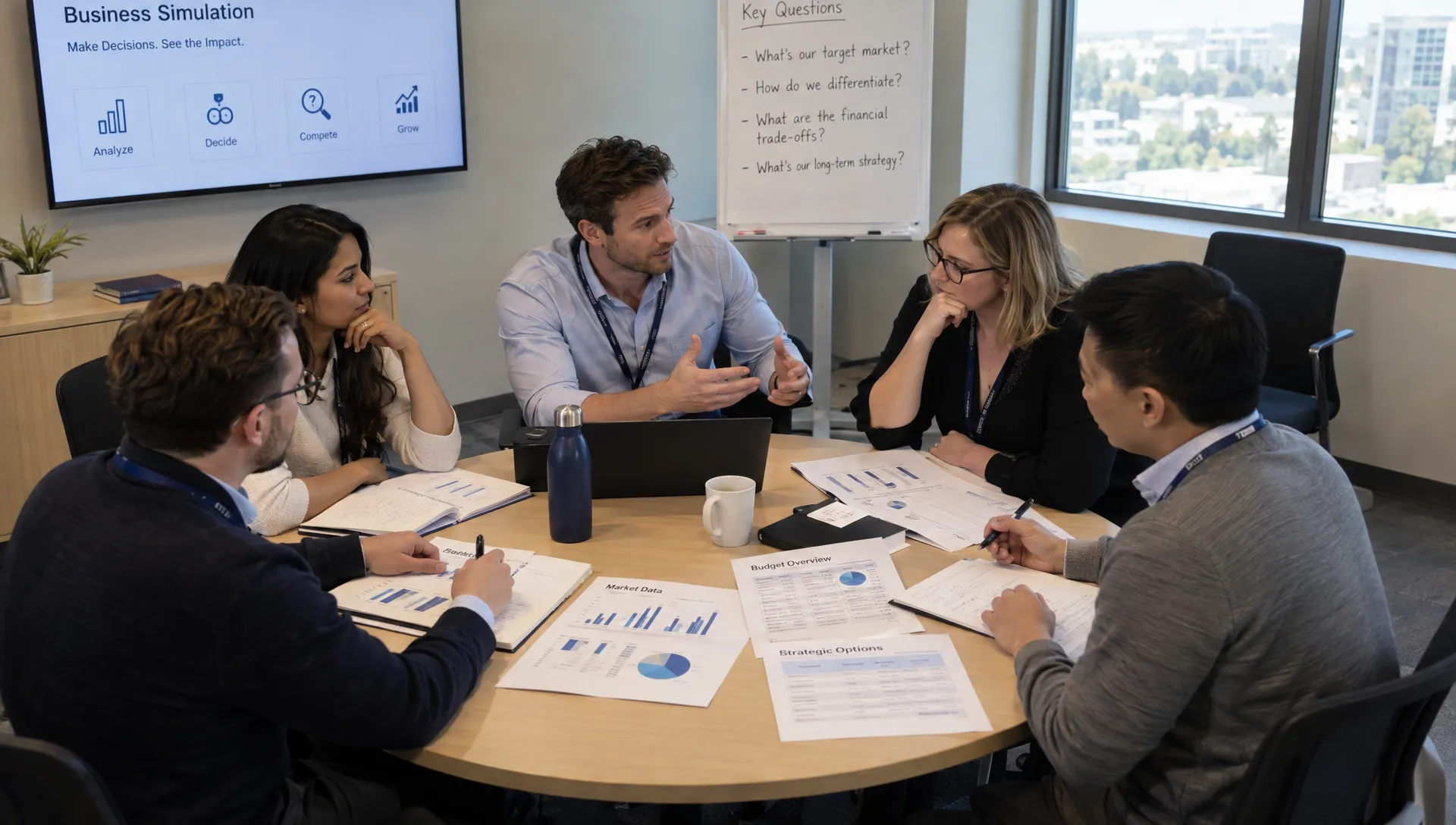
Connect the experience to workplace behavior
A simulation can make a development need visible. Turning that insight into a new habit requires opportunities, feedback and manager involvement after the program ends.
Debrief the decisions, not just the results
Begin with what participants intended to achieve, then compare that intention with their decisions and outcomes. Examine what information they used, which assumptions went unchallenged and how the team handled disagreement.
Ask participants to distinguish a weak decision process from an unfavorable result. A defensible decision can still produce a poor outcome under uncertainty. Conversely, a weak process can occasionally deliver a good result.
Effective business simulations for leadership development make this distinction explicit, so participants learn more than how to optimize a particular game. Facilitators should connect each insight to a recognizable workplace situation. This relationship between practice, feedback and reflection is central to simulation-based learning for better decision-making.
End the debrief with one or two behavioral commitments per participant. “Become more strategic” is too broad. “Present two alternatives and their enterprise-level trade-offs before requesting an investment decision” is observable.
Build a practical follow-through plan
Before the program, ask each participant and manager to identify a relevant work challenge. Afterward, agree on where the participant will apply the chosen behavior, what support is needed and what evidence will indicate progress.
The following is an example review cadence, not a universal timetable:
| Checkpoint | Participant action | Evidence to review |
|---|---|---|
| Before the program | Identify a development goal and a suitable work assignment | Existing feedback and a specific behavioral baseline |
| Within 30 days | Apply one agreed behavior in a real decision | Decision notes, a project review or direct observation |
| Around 60 days | Seek feedback and adjust the approach | Specific examples from the manager and relevant colleagues |
| Around 90 days | Review consistency and remaining gaps | Repeated workplace examples and an updated development plan |
The schedule should match the opportunities available. A leader cannot demonstrate a new investment-review approach if no relevant decision occurs during the follow-up period.
The value of business simulations for leadership development becomes clearer when organizations track application, not just attendance, satisfaction or simulation scores.
Review readiness without overstating the evidence
For succession reviews, distinguish among three findings: the participant understood a concept, demonstrated it during the simulation or applied it consistently at work. These are related but different levels of evidence.
Use follow-up conversations to identify what helped or blocked transfer. A participant may need another practice opportunity, clearer authority or support from a manager. Lack of visible change should prompt investigation rather than an automatic judgment about potential.
At program level, review whether participants received relevant assignments and whether managers observed the targeted behaviors. Business outcomes can provide context, but attributing a revenue or retention change solely to training requires a stronger evaluation design.
This approach gives talent teams a more useful succession conversation: what has changed, what remains uncertain and which experience should come next.
Frequently asked questions
Can simulations identify high-potential employees? They can reveal useful examples of judgment, collaboration and learning within a defined situation. They should not be the sole basis for identifying potential. Combine observations with workplace evidence, career interests and the requirements of future roles.
How are business simulations for leadership development different from leadership role-play? Business simulations model connected decisions and consequences, such as how investment affects market performance. Role-play typically emphasizes an interpersonal situation. A program can use both when it needs commercial decision-making and focused conversation practice.
Can virtual simulations support leadership development? Yes, when the design includes meaningful interaction, accessible participation and facilitated reflection. Virtual delivery can also provide practice in remote collaboration. Self-paced work alone offers less evidence of how someone influences or supports colleagues.
Should simulation scores influence promotion decisions? Not on their own. If results will inform a high-stakes employment decision, the assessment process needs appropriate professional design and evidence for that use. Participants should know the purpose in advance, and decision-makers should consider multiple sources of job-relevant evidence.
Choose a simulation around the leadership transition
Start with the decisions future leaders must make, the behaviors they need to practice and the workplace opportunities available afterward. Then evaluate whether the simulation and facilitation approach support those objectives.
StratX Simulations provides experiential business simulation software for corporate and academic learning across marketing, strategy, sales and innovation, with instructor training and support. Explore how these learning experiences could fit your leadership curriculum, while keeping succession decisions grounded in transparent criteria and broader workplace evidence.