Choosing a serious game development partner is a learning investment, not just a software purchase. A compelling demo can show that a game is engaging, but it cannot establish whether learners will practice the right decisions, whether instructors can run it effectively or whether your organization can maintain it after launch.
For corporate learning teams and academic program leaders, the strongest selection process starts with evidence. Define what learners must do differently, compare partners against the same requirements and test the proposed experience before making a large commitment. This guide focuses on those purchasing decisions, including when custom development may not be necessary.
Decide whether you need custom development at all
Before requesting proposals, distinguish between an established simulation, a configurable solution and a fully custom game. These options involve different levels of responsibility for design, validation and maintenance.
| Approach | Best fit | Main question to resolve |
|---|---|---|
| Established simulation | Common business capabilities such as marketing strategy or commercial decision-making | Does the existing experience match your learning objectives? |
| Configurable solution | Familiar learning goals with organization-specific context | What can change without altering the underlying model? |
| Custom development | Distinctive workflows, decisions or constraints that existing products cannot represent | Does the added relevance justify development and maintenance costs? |
A serious game development proposal should explain why its recommended approach is necessary. Custom branding alone rarely justifies building a new decision engine, while a genuinely distinctive operating environment may require more than cosmetic changes.
Prepare a short brief covering the audience, target behaviors, delivery format, expected cohort size and constraints. Describe decisions learners should practice rather than requesting features such as badges or leaderboards. For example, “evaluate customer segments and defend a resource allocation” is more useful than “make strategy training interactive.”
If you need help translating business goals into a brief, the principles behind designing a corporate training simulation provide a useful starting point.
Evaluate a serious game development partner on evidence
Look for learning expertise and a credible business model
Ask who will lead instructional design, who will validate the subject matter and who owns the technical implementation. A studio with strong visual design may still need an experienced learning specialist. A training consultancy may need a delivery partner for the software.
The people responsible for serious game development should be able to trace a learning objective through a learner decision, its consequences and the subsequent reflection. Request a worked example of that chain, not simply a list of educational principles.
For a business simulation, also examine the underlying model. Ask which assumptions determine outcomes, how trade-offs are represented and how unrealistic strategies are identified. Simplification is necessary, but it should preserve the relationships learners need to understand.
If your project involves AI adoption, ground scenarios in actual workplace tasks. Offerings such as role-specific enterprise AI training illustrate how instruction can be organized around team use cases and documents. Ask the prospective partner to distinguish prerequisite tool skills from the business judgment your game will assess.
Finally, request references from comparable settings. A successful school project does not automatically establish suitability for executive education or a confidential corporate program. Ask references about delivery reliability, instructor workload and what changed after launch.
Check facilitation and assessment, not just gameplay
Ask to see the facilitator guide alongside the learner experience. It should explain setup, decision rounds, feedback interpretation and debriefing. Clarify what instructors must understand before running a session and what support is available when learners get stuck.
A leaderboard can encourage participation, but a game score is not automatically evidence of learning. Teams may win through prior knowledge, experimentation or one dominant participant. Ask how the experience reveals individual reasoning and whether learners can explain their choices afterward.
For academic programs, clarify grading options and how participation can be distinguished from mastery. For corporate learning, identify a realistic follow-up task that demonstrates application at work.
A serious game development partner should explain both what its assessment can establish and what it cannot. Avoid proposals that promise business impact without describing how that impact would be measured. Reviewing common simulation hurdles learners encounter can also help you test whether the proposed instructor support addresses practical problems.
Give every shortlisted partner the same evaluation task
Sales presentations are difficult to compare when each vendor chooses its own example. Instead, give shortlisted partners the same learning brief and ask each to demonstrate one representative decision cycle.
The demonstration should reveal what information learners receive, what choices they make, how consequences appear and how the facilitator turns those consequences into a discussion. Request supporting artifacts: a sample guide, assessment approach, delivery plan and maintenance proposal.
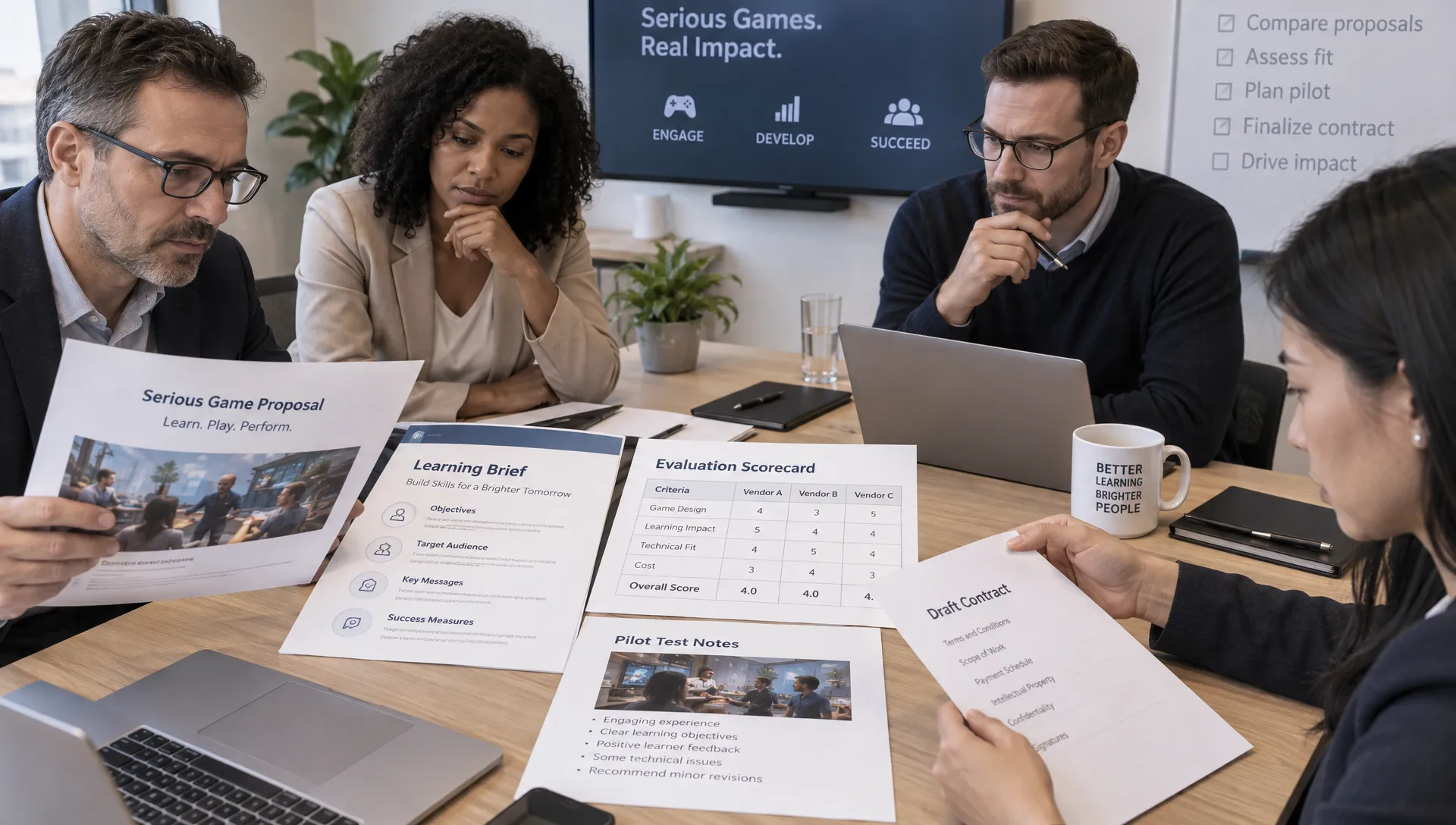
Use a weighted scorecard to make trade-offs visible. The following weights are illustrative, not an industry benchmark:
| Criterion | Example weight | Evidence to request |
|---|---|---|
| Learning design | 25% | Objective-to-decision mapping and assessment plan |
| Domain credibility | 20% | Model assumptions and subject-matter review process |
| Facilitation and usability | 15% | Instructor guide and representative learner test |
| Technical suitability | 15% | Accessibility, security and deployment documentation |
| Delivery capability | 10% | Named team, milestones and comparable references |
| Commercial terms | 15% | Full cost breakdown, rights and support obligations |
Score each category consistently, such as from zero to five, and record the evidence behind the rating. Define non-negotiable requirements separately so a strong overall score cannot conceal an unacceptable security or accessibility gap.
This process makes serious game development proposals easier to compare without allowing presentation quality to outweigh learning fit.
Use a pilot to test the proposal before scaling
A pilot should answer unresolved purchasing questions, not simply produce enthusiastic feedback. For an established simulation, test the real product with representative learners. For a custom project, consider a paid discovery phase or limited prototype before authorizing full production.
Include participants with different levels of subject knowledge and technical confidence. Have the people expected to facilitate the program run the session wherever possible. Vendor-led delivery alone may conceal the preparation your team will need.
Agree on success criteria before the pilot. Useful measures include whether learners can complete onboarding, understand the consequences of decisions and explain a trade-off in a new scenario. Also record facilitator preparation time, technical issues and support requests.
Keep satisfaction separate from capability. A participant can enjoy a session without improving, or find a demanding session uncomfortable while learning something valuable. A short pre-session task and a comparable post-session task can provide useful evidence, although a small pilot does not prove long-term business impact.
Use the findings to evaluate the serious game development partner’s response to problems as well as the product itself. Ask which issues require changes to the interface, model or facilitation guidance, then document the fixes and retesting required before rollout.
Resolve technical and operational risks early
Confirm access, security and accessibility
Bring IT, procurement and accessibility stakeholders into the evaluation before commercial terms are finalized. Clarify browser and device requirements, authentication, hosting arrangements, data retention and any necessary integration with your learning environment.
Request the documentation your organization requires for security review. If learners will enter confidential information, determine exactly what is collected, who can access it and how deletion works. For AI-enabled functionality, ask whether inputs reach third-party services and whether they can be retained or used for model training.
Accessibility should be demonstrated rather than reduced to a broad claim. For web-based interfaces, WCAG 2.2 provides a recognized framework for discussing requirements such as keyboard access and readable content. Specify the conformance level your organization requires and test the actual learner workflows.
Your serious game development agreement should identify which technical requirements are acceptance conditions, not optional improvements to address later.
Verify session-day support and continuity
Ask what happens if connectivity fails during a session, an instructor cannot access the platform or a participant needs an accommodation. Clarify support hours, escalation routes and which problems your facilitators are expected to resolve themselves.
For custom software, identify who maintains browser compatibility and updates dependencies after launch. Also ask what happens if the original development team becomes unavailable. These operational details matter more than an impressive feature list when a course is already underway.
Compare total cost, not just the initial quote
Separate one-time expenses from recurring charges. A custom proposal may include discovery, instructional design, model development, interface production, testing and deployment. An established simulation may instead involve licensing, instructor preparation and delivery support. Request the actual breakdown rather than assuming what either offer includes.
Ask how fees change with learner numbers, repeat cohorts, additional languages and new delivery locations. Clarify whether reporting, integrations, accessibility remediation and content updates are included or separately priced.
Internal effort belongs in the comparison too. Your team may need to supply subject-matter experts, review scenarios, coordinate IT approval and train facilitators. A lower vendor quote can still require substantially more work from your organization.
When comparing serious game development costs, use the same planning horizon and participation assumptions for every proposal. Request a cost schedule for launch and subsequent use, then test how it changes if adoption is lower or higher than expected.
You do not need an elaborate return-on-investment forecast to make a disciplined decision. You do need visibility into the commitments you are accepting and the costs of changing direction later.
Put scope, ownership and acceptance into the contract
Convert important promises into written deliverables. “An engaging game” is not an acceptance criterion. A defined scenario, functioning decision cycle, documented scoring logic and approved facilitator guide are easier to evaluate.
For custom work, distinguish ownership of your content and data from rights to the partner’s platform, reusable components and third-party assets. Do not assume that paying for development gives you unrestricted access to source code or the right to transfer maintenance elsewhere.
Resolve these items before signing:
- Deliverables and exclusions: Identify what will be produced, reviewed and handed over, including instructor materials.
- Approval responsibilities: Name who approves learning content, model assumptions, technical implementation and final release.
- Acceptance testing: Define test conditions, defect severity, remediation responsibilities and sign-off criteria.
- Change control: Explain how additional requests affect price, scope and delivery dates.
- Ongoing rights and support: Specify licensing, maintenance, data export, termination arrangements and any handover obligations.
Ask an appropriate legal or procurement reviewer to examine the terms. The goal is not to insist on owning every component; it is to understand which rights your organization needs.
A serious game development contract should also distinguish maintenance from enhancement. Fixing a defect and creating a new scenario are different obligations, and an unclear boundary can cause disputes after launch.
Recognize warning signs before committing
Be cautious when a partner emphasizes visuals but cannot explain the learning mechanism. Similar concerns arise when demonstrations require constant guidance that the proposed instructor materials do not provide.
Unexplained model assumptions, inaccessible learner workflows and vague support commitments deserve investigation. So do references that cannot speak to projects with comparable audiences or delivery constraints.
Another warning sign is reluctance to define acceptance criteria or expose recurring costs. A credible partner does not have to offer every capability internally, but it should be clear about subcontractors, responsibilities and limitations. Specific answers are more useful than assurances that everything can be customized later.
Frequently asked questions
Should we choose a specialist studio or an established simulation provider? Choose according to the decisions learners need to practice. Serious game development from scratch makes sense when those decisions cannot be represented adequately by an existing solution. Otherwise, an established simulation may reduce the amount of design, validation and maintenance your organization must commission.
How long does a custom project take? There is no reliable universal timeline. Scope, model complexity, integrations, review cycles and testing all affect delivery. Request a milestone plan that includes your organization’s approval time rather than relying on an estimated launch date alone.
What should we ask during a reference call? Ask whether the project met its learning brief, how much internal effort it required, what went wrong and how the partner responded. Also ask whether costs and support needs changed after launch.
Can we assess learning through game results alone? Not reliably. Combine game performance with evidence of reasoning, reflection or application to a new task. For team-based play, clarify how individual learning will be assessed.
Start with the learning need, then choose the partner
The right partner can explain its model, demonstrate its learning design and commit to clear delivery terms. Use a common brief, an evidence-based comparison and a representative pilot to test those claims before scaling.
If your goals center on marketing, strategy, sales or innovation, explore StratX Simulations as part of that evaluation. StratX provides experiential business simulation software for academic and corporate learning, with instructor training and support. Compare the available experiences against your learning objectives before deciding whether custom development is necessary.